Transformation Roadmap Business Data Strategy for CEOs
- Jun 29, 2026
- Isha Taneja
Build a transformation roadmap business data strategy that delivers real outcomes. Five steps every CEO must follow to align data and transformation for growth.

Build a transformation roadmap business data strategy that delivers real outcomes. Five steps every CEO must follow to align data and transformation for growth.

Three years ago a large insurance company completed one of the most ambitious digital transformation programmes in its sector. New customer portal. New CRM system. AI driven claims processing. The board declared success.
Eighteen months later customer satisfaction scores were unchanged. Revenue growth was flat. And a consultancy brought in to diagnose the problem delivered a finding nobody wanted to hear.
The technology had been transformed. The data strategy had not. Without a transformation roadmap business data strategy connecting every technology investment to a measurable data outcome the new systems were delivering processes that were faster but not smarter.
In 2026 this is the defining failure mode of digital transformation. Not the technology. The absence of a data strategy aligned to it from the first day of the programme.
Most digital transformation programmes treat data as a sub-workstream. A parallel track managed by the data team while the main programme focuses on new platforms, new processes, and new capabilities. This approach consistently produces the same result. Organisations that move faster through their inefficiencies rather than replacing them.
The transformation roadmap business data strategy that works treats data not as a supporting track but as the primary evidence layer that tells every other workstream whether it is working. Every transformation initiative produces data. The organisations that capture it, interpret it, and act on it in real time are the ones that correct course before failure becomes irreversible.
Tips to address and resolve: In your next transformation programme steering meeting ask one question. What data will tell us whether this initiative is working six weeks after go live? If nobody can answer specifically the programme does not have a data strategy. It has a technology strategy. Building the answer to that question into every workstream from day one is how a transformation roadmap business data strategy actually begins.
The second most common transformation failure is sequencing. Organisations deploy new technology into environments where the data is not ready to support it. New AI driven recommendation engines fed by inconsistent customer data. New analytics dashboards built on ungoverned product hierarchies. New personalisation capabilities pointed at duplicate contact records.
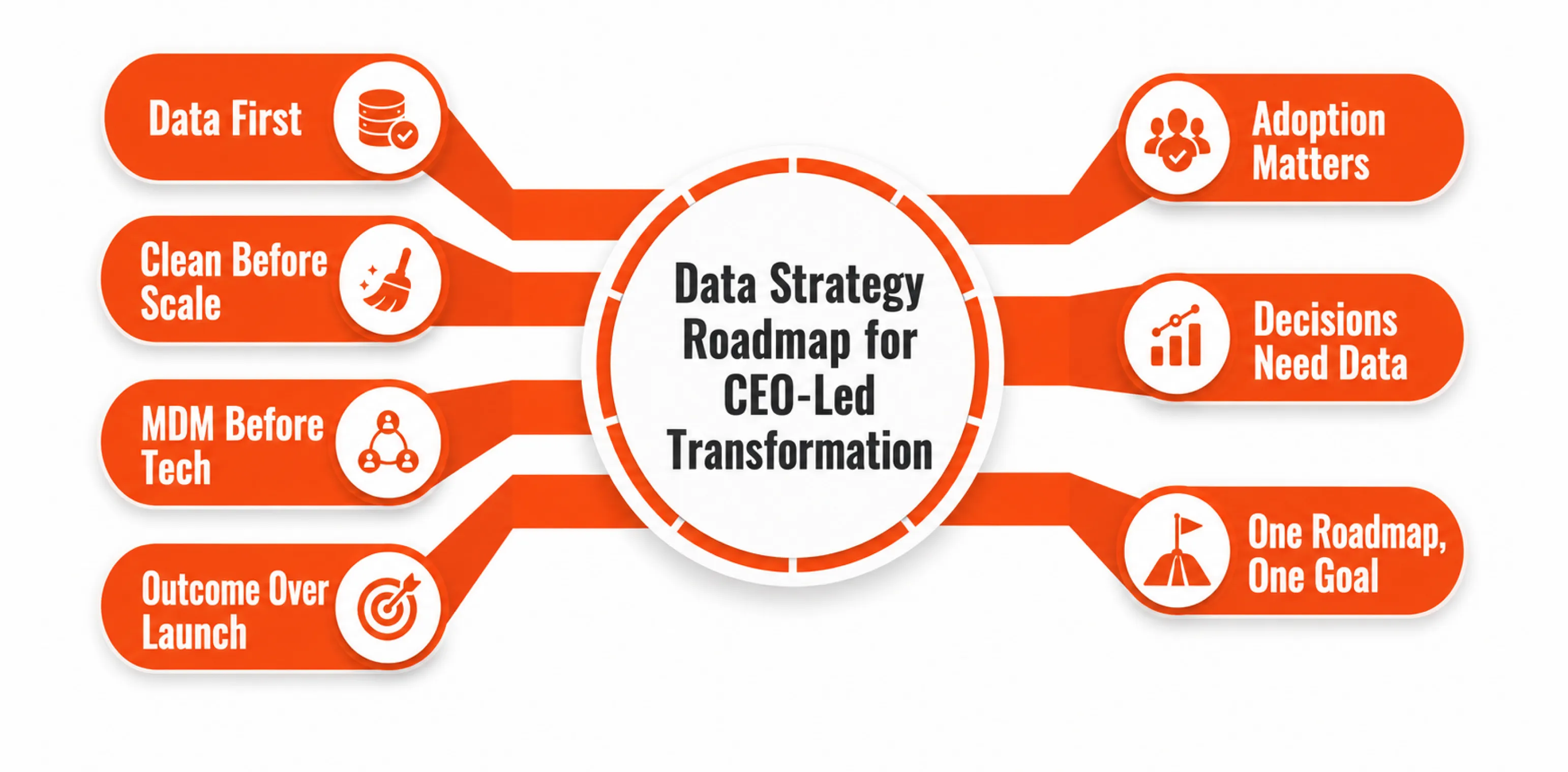
A master data management strategy roadmap is not a separate programme running alongside your transformation. It is a prerequisite gate that every transformation workstream must clear before the technology investment above it is approved. The organisations that understand this do not run MDM and transformation in parallel. They run MDM first for the entities each transformation workstream depends on.
Tips to address and resolve: Map every transformation initiative to the data entities it requires. For each entity ask whether your master data management strategy roadmap has governed that entity to a production-ready standard. If the answer is no the transformation workstream that depends on it should not launch until it is. Sequencing discipline is the single most important skill in a transformation roadmap business data strategy.
The third reason transformation roadmaps fail to deliver business outcomes is that they are built around technology projects rather than data capabilities. The milestone is go live. The success metric is deployment. And the business outcome which depends entirely on the organisation's ability to use the new data the technology produces is assumed to follow automatically.
It does not. A data analytics strategy roadmap aligned to transformation programmes specifies the data capability the organisation needs to develop alongside every technology deployment. Not just the ability to collect the data. The ability to interpret it, act on it, and improve the next decision because of it.
Tips to address and resolve: Rewrite every major transformation milestone as a data capability statement rather than a technology deployment statement. New CRM goes live becomes teams can identify at-risk customers within forty-eight hours of a behaviour change. New analytics platform deployed becomes finance closes the period in two days instead of eight. Data strategy roadmap examples that consistently deliver transformation outcomes all use capability statements not deployment milestones.
The most powerful shift any CEO can make in their transformation governance is changing what they ask for at milestone reviews. Most transformation updates report on whether the technology is on schedule and on budget. Neither question tells a CEO whether the transformation is creating the business value it was approved to deliver.
A transformation roadmap business data strategy changes the milestone conversation entirely. Every review asks three questions. What data do we now have that we did not have before? What decision are we making better because of it? And what business outcome has changed as a result? These three questions connect the data strategy roadmap to the transformation investment in language every board member understands.
Tips to address and resolve: Redesign your transformation steering pack to include one data outcome slide per workstream at every review. Each slide answers the three milestone questions above. If a workstream cannot answer all three it should be treated as at risk regardless of whether the technology is on schedule. How to develop a data strategy that stays connected to transformation value is answered entirely by this one discipline.
The final and most overlooked element of a transformation roadmap business data strategy is using data to measure the transformation programme itself not just the business outcomes it is designed to deliver.
Transformation programmes that fail rarely fail suddenly. They accumulate quiet signals over months. Adoption rates that are lower than projected. Processes that revert to old behaviours within weeks of go live. Training completion rates that suggest capability gaps nobody is naming. A data strategy roadmap built into the transformation governance structure surfaces these signals in time to act on them rather than after they have compounded into a programme review.
Tips to address and resolve: Build a transformation health dashboard from month one. Include adoption metrics, behaviour change indicators, data quality scores for the entities each workstream depends on, and decision speed measurements for the outcomes the programme is designed to improve. Data strategy roadmap examples from the most successful transformation programmes treat the programme itself as a data product with its own quality standards and its own owners.
A transformation roadmap business data strategy that sequences correctly, governs master data before deploying technology, builds around data capabilities, measures in business outcomes, and monitors the programme itself does something most transformation programmes never achieve.
It creates an organisation that gets better at transformation with each programme it runs. The data capabilities built in one programme become the foundation for the next. The governance discipline established for one entity extends naturally to the next. And the CEO who owns the data strategy as a transformation asset rather than a technical programme builds an organisation that compounds transformation returns over years not quarters.
The insurance company's transformation was not a failure of technology. It was a failure of integration. The technology roadmap and the data strategy roadmap were built by different teams, governed in different meetings, and measured by different standards.
A transformation roadmap business data strategy is not two roadmaps running in parallel. It is one roadmap that treats data as the evidence layer for every transformation decision. How to develop a data strategy that survives contact with a transformation programme requires one fundamental commitment from the CEO. Data outcomes and business outcomes are the same thing. They will be governed together from the first day or the transformation will deliver technology without value.
Data strategy roadmap examples from the organisations that have made this work all begin with that commitment.
Partner with Complere Infosystem and let our data engineering and transformation specialists design the integrated roadmap your organisation needs.

Listen in for business strategies and interviews with business experts to help you build a business and a life that you love.
About Us