A manufacturing company spent $4.2M on data infrastructure last year. New data warehouse. Modern BI tools. Cloud migration completed. Twelve months later, executives still make decisions based on spreadsheets emailed between departments.
What went wrong? They invested in technology without a data strategy roadmap. Tools existed. Direction didn't. This pattern repeats across industries. Organizations buy capabilities but never define how those capabilities connect to business outcomes.
In 2026, the gap between data leaders and data laggards isn't about technology budgets. It's about strategic clarity. Here's how to build a data strategy roadmap that actually delivers results.
Why Most Data Initiatives Fail Without a Roadmap
Data projects fail at alarming rates. Research shows 73% of enterprise data initiatives never reach production. The cause isn't technical complexity. It's strategic ambiguity.
Without a clear data strategy roadmap, teams pursue conflicting priorities. Marketing wants customer analytics. Finance wants reporting automation. Operations wants predictive maintenance. Each department builds isolated solutions. Data silos multiply. Integration becomes impossible.
A proper data strategy framework prevents this chaos. It aligns investments with business outcomes, sequences initiatives logically, and creates accountability across departments.
Phase 1: Assess Your Current Data Reality
Before building forward, understand where you stand. Most organizations overestimate their data maturity. They assume data exists, is accurate, and is accessible. Reality often disappoints.
Conduct an honest assessment covering data quality across critical business systems, current governance structures and ownership clarity, existing technology capabilities and limitations, and team skills and capacity gaps.
A healthcare company discovered their "comprehensive" patient data was only 62% complete. Their big data strategy roadmap had to address this foundation before any advanced analytics could begin.
Document findings without politics. Executives need truth, not comfort. This assessment shapes everything that follows.
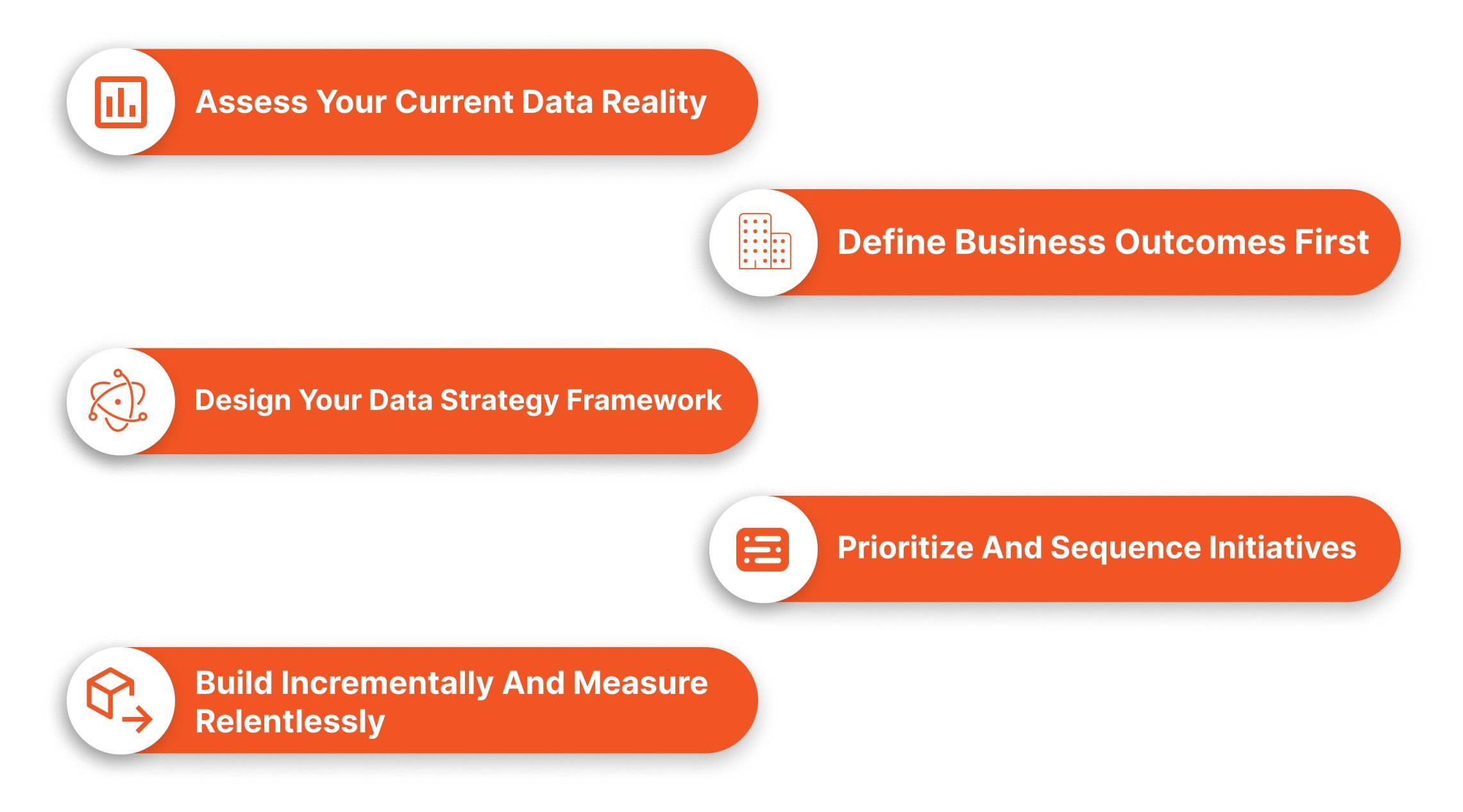
Phase 2: Define Business Outcomes First
The most common roadmap mistake is starting with technology. "We need a data lake" isn't a strategy. "We need to reduce customer churn by 15%" is a strategy.
Effective data management strategy connects every initiative to measurable business outcomes. Revenue growth. Cost reduction. Risk mitigation. Customer satisfaction. Operational efficiency.
Work backwards from outcomes. If the goal is reducing churn, what data enables prediction? What systems contain that data? What quality issues exist? What capabilities must be built?
This outcome focus transforms vague data ambitions into funded, accountable projects.
Phase 3: Design Your Data Strategy Framework
With current state assessed and outcomes defined, design the framework connecting them. This framework covers four essential elements:
Governance structure. Who owns data domains? Who resolves quality disputes? Who approves access requests? Without clear governance, data management strategy collapses into confusion.
Architecture principles. Will you centralize in a warehouse or distribute through mesh? Cloud native or hybrid? Real time or batch? These decisions shape years of investments.
Operating model. Centralized data team or embedded analysts? Shared services or federated ownership? The right model depends on organizational culture and maturity.
Success metrics. How will you measure progress? Data quality scores, adoption rates, time to insight, and business outcome improvements all matter.
Phase 4: Prioritize and Sequence Initiatives
Every organization has more data ambitions than capacity. Prioritization separates successful roadmaps from wish lists.
Evaluate initiatives on two dimensions: business impact and implementation feasibility. High impact, high feasibility projects go first. They build momentum and prove value quickly.
A financial services firm identified 34 potential data projects. Their data strategy roadmap sequenced only eight for year one. Each built capabilities the next required. By year end, they delivered $18M in measurable value.
Resist pressure to do everything simultaneously. Parallel initiatives compete for resources, attention, and talent. Sequential focus delivers faster results.
Phase 5: Build Incrementally and Measure Relentlessly
The best data strategy roadmap is a living document. It evolves based on results, not just schedules.
Implement in 90 day cycles. Each cycle delivers measurable capability. Each cycle informs the next. This approach reduces risk and accelerates learning.
Measure what matters. Not just project milestones but business outcomes. Is decision quality improving? Are costs reducing? Is revenue growing? If metrics don't move, strategy needs adjustment.
Organizations that treat roadmaps as fixed plans fail. Those that treat them as learning frameworks succeed.
Practical Tips for Roadmap Success
Beyond phases, certain practices dramatically improve outcomes.
Secure executive sponsorship early. Data strategy roadmap success requires cross functional cooperation. Only executive authority breaks departmental barriers.
Invest in quick wins first. Visible early success builds organizational confidence. Skeptics become supporters when they see results.
Don't underestimate change management. Technology is 30% of the challenge. Getting people to actually use data differently is 70%.
Consider external perspective. Data strategy consulting brings experience from dozens of implementations. Patterns that take years to learn internally come ready made from specialists who've seen what works.
The Bottom Line
Building a data strategy roadmap isn't optional for organizations serious about data value. It's the difference between coordinated progress and expensive chaos.
Start with honest assessment. Define outcomes before technology. Design governance, architecture, and operating models deliberately. Prioritize ruthlessly. Build incrementally. Measure relentlessly.
The organizations winning with data in 2026 aren't those with biggest budgets. They're those with clearest roadmaps. Strategic clarity beats tactical spending every time.
Build your data strategy roadmap with expert guidance. Schedule a free consultation call with Complere Infosystem.