A regional bank's CFO approved a $2.1M enterprise business intelligence implementation. Eighteen months later, the dashboards were live, the reports were running, and executives were still making decisions from manually updated spreadsheets. The platform worked. The transformation didn't.
This is the gap that defines most BI conversations in 2026. Organizations invest in intelligence infrastructure and receive reporting infrastructure instead. Understanding that distinction starts at the top.
What Enterprise Business Intelligence Actually Means in 2026
Enterprise business intelligence is not a software category. It is the organizational capability to convert data from across the enterprise into decisions that move business outcomes.
That definition shifts accountability. BI is not an IT delivery. It is a business capability that requires executive ownership, governed data foundations, and a culture where decisions are made on evidence rather than instinct. In 2026, organizations leading on enterprise data analytics share one common trait: their leadership treats BI as a strategic asset, not a reporting function.
Why This Is Now a CEO and CTO Priority
The volume and velocity of enterprise data has outpaced human capacity to interpret it manually. AI-assisted analytics, real-time operational data, and cross-functional reporting demands have fundamentally changed what enterprise business intelligence must deliver.
CEOs need BI that connects operational reality to strategic decisions, not lagging reports describing last quarter. CTOs need BI architecture that is scalable, governed, and actually adopted by the business teams it serves. When these two perspectives are not aligned, organizations end up with sophisticated enterprise business intelligence tools that generate reports nobody uses to make decisions that matter.
The Four Pillars Every Enterprise BI Strategy Needs
1. Governed Data Foundations
Enterprise data analytics is only as reliable as the data beneath it. Organizations that skip data governance before launching BI programs discover their dashboards faster and their trust in those dashboards collapses within months.
Governed foundations mean defined data ownership, clear lineage from source to report, and quality standards enforced before data reaches any analytics layer. Without this, BI produces confident wrong answers at scale.
What leaders must do: Assign business data owners, not IT owners, to every critical data domain before any BI tool goes live.
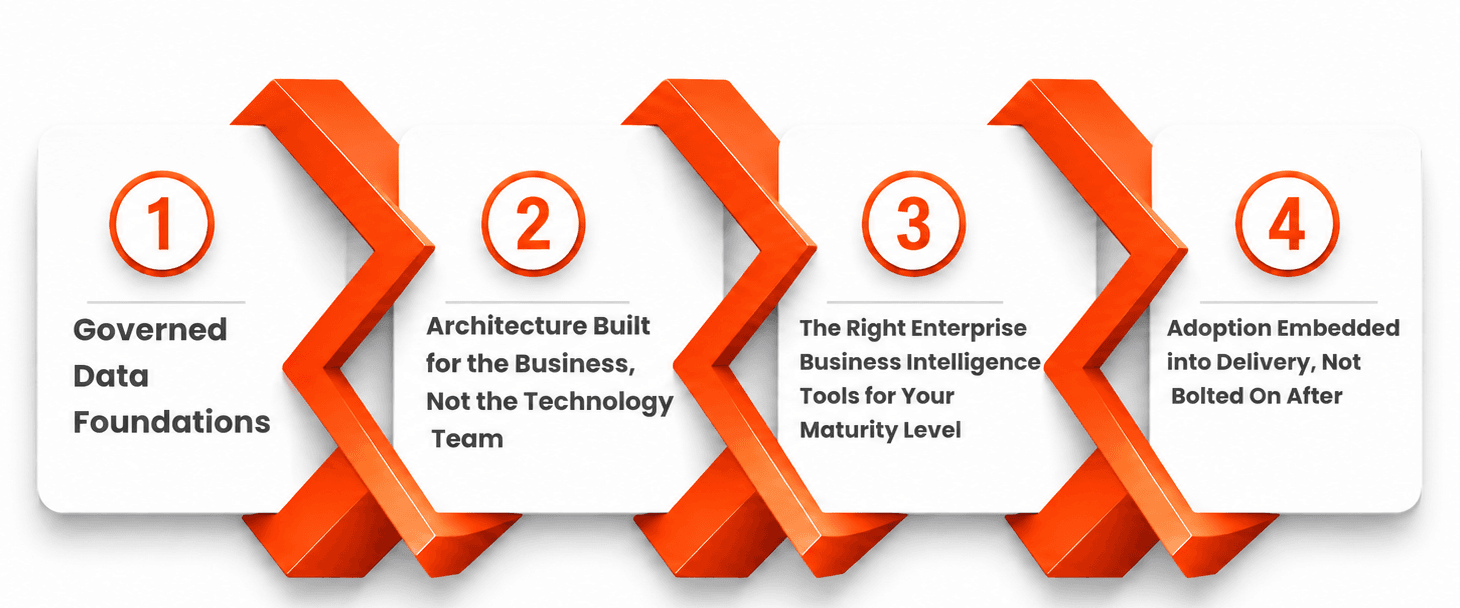
2. Architecture Built for the Business, Not the Technology Team
The most common BI architecture failure is building for sophistication rather than usability. A manufacturing company rebuilt their enterprise business intelligence architecture twice before realizing the problem was not the platform. It was that data engineers were designing for data engineers. The third architecture was co-designed with operations and commercial teams. Adoption tripled within one quarter.
What leaders must do: Require BI architecture decisions to include business stakeholder sign-off, not just technical approval.
3. The Right Enterprise Business Intelligence Tools for Your Maturity Level
Enterprise business intelligence tools range from self-service visualization platforms to AI-powered predictive analytics suites. The mistake most organizations make is selecting tools based on peer benchmarking rather than internal readiness.
A tool that works at a data-mature organization will create chaos at one still establishing basic reporting standards. Readiness determines fit, not brand recognition, analyst rankings, or what competitors are implementing.
What leaders must do: Evaluate enterprise business intelligence tools against three criteria: alignment to defined business use cases, compatibility with existing data infrastructure, and realistic internal capability to operate and scale them.
4. Adoption Embedded into Delivery, Not Bolted On After
Deployment is not adopted. The most sophisticated enterprise data analytics platform delivers zero value if business teams revert to spreadsheets because the tool feels foreign, or the training was insufficient.
Adoption planning must begin at the architecture stage. Which users need what views, what decisions will BI support, and how will usage be measured and reinforced over time.
What leaders must do: Define adoption of metrics before go-live. Platform usage rates, decision velocity, and self-service query volume are adoption indicators. Report availability is not.
What Separates BI That Delivers from BI That Disappoints
Organizations winning with enterprise business intelligence in 2026 share a clear pattern. They start with specific business questions, not technology selections. They fix data quality before building dashboards. They measure business outcomes, not report counts.
Those writing post-mortems did the reverse. They selected tools first, assumed data was ready, and measured project completion instead of business impact.
The Leadership Imperative
For CEOs: Enterprise business intelligence becomes a competitive advantage only when it informs decisions that matter at the top. If your leadership team is not using BI to make strategic calls, the investment is functioning as expensive reporting infrastructure.
For CTOs: The architecture you build must serve the business user, not the data team. Scalability means nothing if adoption is low. Govern first, scale second.
Enterprise business intelligence in 2026 is a leadership discipline before it is a technology one. The organizations that understand this are building a genuine analytical edge, not just buying another platform.
Ready to build enterprise BI that actually drives decisions? Schedule a call with Complere Infosystem.