A financial services company deployed ChatGPT Enterprise across 3,000 employees last year. Adoption soared initially. Six months later, usage dropped 67%. Employees returned to old workflows. The $1.2M investment delivered no measurable business impact.
What went wrong? They deployed technology without an LLM strategy for enterprises. Tools existed. Direction didn't. Use cases weren't defined. Governance wasn't established. Training was minimal. The result was expensive experimentation with no sustainable value.
In 2026, large language models represent the most significant technology shift since cloud computing. Organizations that deploy strategically will transform. Those that deploy randomly will waste millions. This guide helps business leaders build LLM strategies that actually deliver results.
Why LLM Strategy for Enterprises Is Required
LLMs aren't typical software deployments. They're capability platforms that can transform how organizations operate, compete, and serve customers. Without strategy, this potential becomes chaos.
Consider what happens without direction. Marketing uses one LLM for content. Customer service uses another for responses. Legal uses a third for contract review. Each deployment creates different security risks, governance gaps, and vendor dependencies. Integration becomes impossible. Costs multiply unnecessarily.
An LLM strategy for enterprises prevents this fragmentation. It aligns AI investments with business priorities. It establishes governance before problems arise. It sequences adoption for maximum impact with minimum risk.
The digital transformation challenges organizations faced with cloud and mobile repeat with LLMs. Those who learned from previous technology transitions will navigate this one faster. 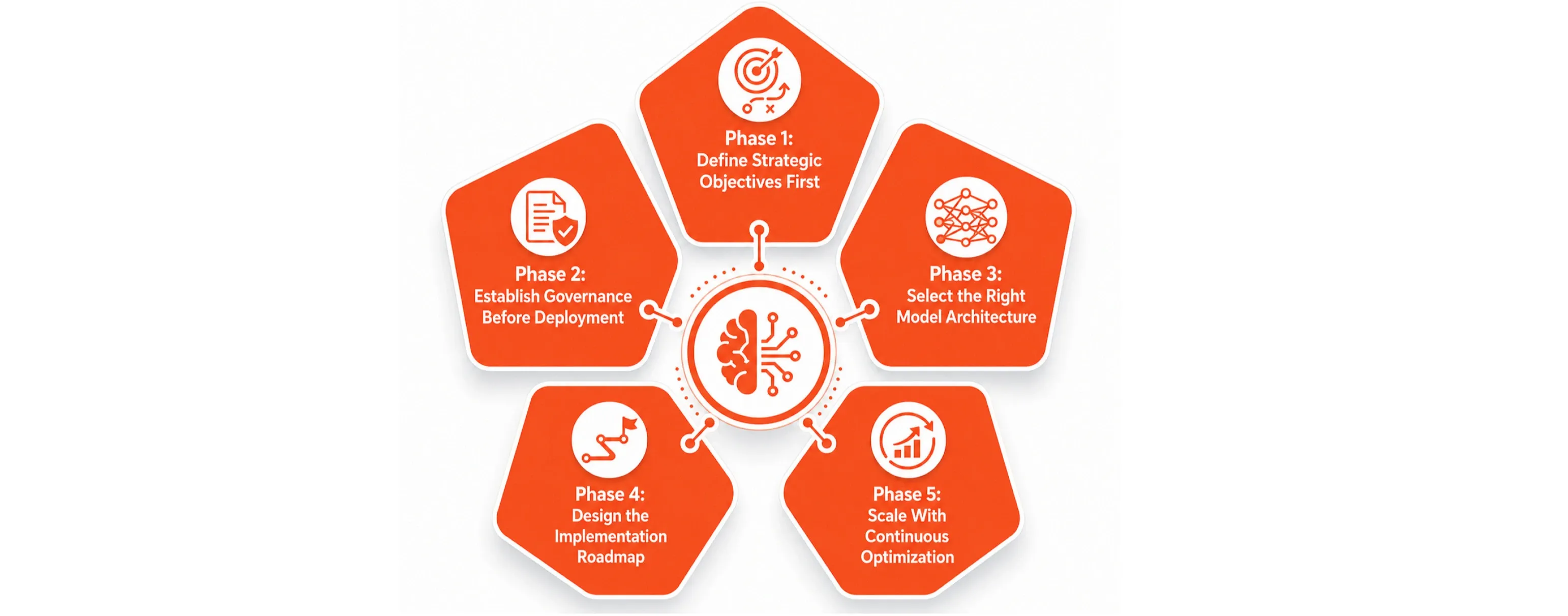
Phase 1: Define Strategic Objectives First
Every failed LLM deployment shares one characteristic. Technology came before purpose. "We need AI" isn't strategy. "We need to reduce customer response time by 40%" is strategy.
Start with business outcomes. Where does your organization need improvement? Cost reduction. Revenue growth. Operational efficiency. Customer satisfaction. Employee productivity. Competitive differentiation.
Map LLM capabilities to these outcomes. Content generation accelerates marketing. Summarization improves knowledge work. Code assistance boosts developer productivity. Conversational AI transforms customer service.
Prioritize use cases by impact and feasibility. High impact, achievable use cases execute first. They prove value quickly and build organizational confidence for larger initiatives.
Phase 2: Establish Governance Before Deployment
Governance isn't optional with LLMs. The risks are too significant. Data privacy. Intellectual property. Accuracy. Bias. Regulatory compliance. Security. Each demands proactive controls.
Effective LLM governance addresses four critical areas:
Data policies. What data can employees input into LLMs? Customer information? Financial data? Strategic plans? Clear boundaries prevent costly mistakes.
Output validation. LLMs hallucinate. They generate confident nonsense. Which use cases require human verification? What accuracy standards must outputs meet?
Vendor assessment. Where does your data go? How is it stored? Who can access it? Enterprise agreements differ dramatically from consumer terms.
Compliance alignment. Regulated industries face additional requirements. Healthcare has HIPAA. Finance has SOX. Legal has privilege concerns. Governance must address industry specifics.
Organizations that skip governance face the same digital transformation challenges that plagued earlier technology adoptions. Problems compound faster than solutions.
Phase 3: Select the Right Model Architecture
The LLM landscape offers multiple approaches. Each carries different tradeoffs for enterprises.
Public APIs like OpenAI and Anthropic offer fastest deployment but raise data privacy questions. Private cloud deployments address privacy but increase cost and complexity. On premise models maximize control but demand significant infrastructure investment. Fine tuned models deliver domain expertise but require specialized skills.
Most enterprises blend approaches. Public APIs handle low risk, high volume use cases. Private deployments address sensitive applications. The LLM strategy for enterprises must define which approach applies where.
Consider total cost carefully. API pricing seems cheap until usage scales. A customer service chatbot processing 100,000 conversations monthly costs differently than internal document summarization used occasionally.
Phase 4: Design the Implementation Roadmap
Strategic deployment sequences initiatives for maximum learning with minimum risk. Rushing creates expensive failures. Excessive caution surrenders competitive advantage.
Start with contained pilots. Select two or three use cases with clear success metrics. Deploy to limited user groups. Measure rigorously. Learn quickly. Expand based on results.
Build internal capabilities progressively. Early projects might rely on external expertise. Over time, internal teams must own LLM operations. Plan this transition deliberately.
The digital transformation journey with LLMs resembles earlier technology shifts. Organizations that piloted cloud workloads before enterprise migration succeeded more often. The same pattern applies here.
Phase 5: Scale With Continuous Optimization
Successful pilots create pressure to scale rapidly. Resist the urge to deploy everywhere simultaneously.
Expand methodically. Add use cases that build on proven patterns. Extend to user groups prepared for adoption. Increase complexity only after simpler applications succeed.
Measure relentlessly. Track adoption rates. Monitor output quality. Calculate ROI by use case. Kill initiatives that don't deliver value regardless of executive enthusiasm.
Optimize continuously. LLM capabilities evolve monthly. Costs decrease. New models emerge. Your LLM strategy for enterprises must adapt to this rapidly changing landscape.
Common Implementation Mistakes
Experience reveals patterns that predict LLM failure. Avoid these traps.
Deploying without use case clarity wastes licenses on tools nobody uses productively. Skipping governance creates security incidents that damage trust and invite regulation. Underestimating change management leaves powerful capabilities abandoned for familiar workflows. Expecting immediate transformation ignores the learning curve every technology requires.
The digital transformation challenges of the past decade taught hard lessons. Organizations that apply those lessons to LLM adoption will succeed faster than those repeating old mistakes.
The Bottom Line
Building an LLM strategy for enterprises isn't optional in 2026. It's the difference between transformation and expensive distraction.
Start with business outcomes, not technology enthusiasm. Establish governance before deployment, not after incidents. Select model architectures that match use case requirements. Implement through sequenced pilots that prove value before scaling. Optimize continuously as capabilities evolve.
The digital transformation journey with LLMs will separate market leaders from followers. Organizations with clear strategies will capture value. Those without will fund experiments that deliver nothing.
The choice is strategic clarity or expensive chaos. Choose wisely.
Build your enterprise LLM strategy with expert guidance. Book a free session with Complere Infosystem.