CIOs in 2026: From Data Chaos to Decision Intelligence
- Jan 15, 2026
- Isha Taneja
CIOs in 2026 must own the data value chain, align strategy, platforms, and governance, and deliver decision intelligence leaders can trust.

CIOs in 2026 must own the data value chain, align strategy, platforms, and governance, and deliver decision intelligence leaders can trust.

For years, CIOs were judged by how many dashboards they rolled out or how quickly they could “move to the cloud.” In 2026, that bar is outdated. Boards now expect CIOs to own something deeper and messier: the entire data value chain—from how data is captured in business applications to how it turns into front-line decisions.
The core job of CIOs in 2026 is no longer “keep systems running” or “ship features fast.” It is to make sure every critical decision in the business is supported by data that is trusted, explainable, and repeatable. That means understanding where data is born (ERP, CRM, E-com, support tools), how it is transformed, who owns its quality, and how it lands in KPIs, AI models, and frontline workflows.
Why this matters: most organizations don’t fail because they lack data. They fail because:
The result is decision fatigue and political debates instead of clarity. CIOs in 2026 are measured not just by uptime, but by how often leaders can take a decision without spending half the meeting arguing about the metric.
The winning CIO mindset is simple:
“If the data behind a decision isn’t trusted, the decision doesn’t scale.”
In the early analytics era, success was defined by how many dashboards you could stand up. Today, leaders don’t need more charts—they need decision intelligence:
CIOs in 2026 act less like “reporting owners” and more like decision architects. They design:
Instead of celebrating “We launched a new dashboard,” they ask, “Which decision got faster, cheaper, or more accurate because of it?”
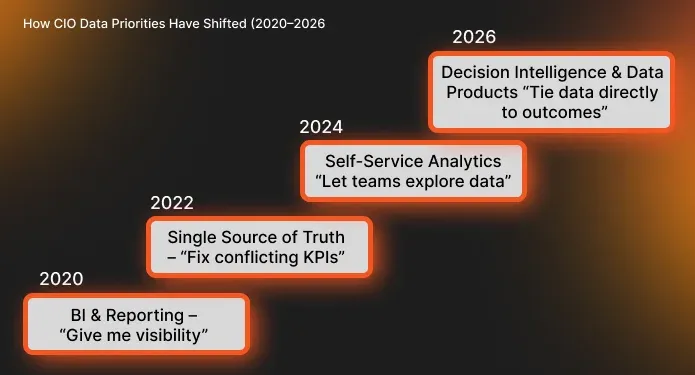
A simple view of how the data agenda evolved for CIOs:
| Year | Primary CIO Data Priority |
|---|---|
| 2020 | BI & Reporting – “Give me visibility” |
| 2022 | Single Source of Truth – “Fix conflicting KPIs” |
| 2024 | Self-Service Analytics – “Let teams explore data” |
| 2026 | Decision Intelligence & Data Products – “Tie data directly to outcomes” |
By 2026, CIOs in 2026 are not satisfied with “everyone has access.” They push for:
Every boardroom wants “AI use cases.” But without solid data foundations, AI becomes expensive theatre—great demos, weak outcomes. That’s why CIOs in 2026 treat data strategy as the precondition for AI strategy, not a separate track. They focus on:
In practice, it looks like this:
Instead of pouring everything into “more tools,” leading CIOs rebalance investments across the data lifecycle:
| Data Function | Approx. Allocation | What It Covers |
|---|---|---|
| Data Platform & Engineering | 30% | Lakehouse/warehouse, pipelines, CDC, performance, scalability |
| Data Governance & Data Quality | 25% | Catalogs, lineage, rules, policies, DQ monitoring, data contracts |
| Analytics & Decision Intelligence | 20% | Metric layers, BI, decision workflows, experimentation frameworks |
| AI / ML Initiatives | 15% | Models, MLOps, scenario simulation, personalization, risk models |
| Literacy, Change & Enablement | 10% | Training, playbooks, office hours, data communities, change management |
The big shift: CIOs in 2026 deliberately protect budget for governance, literacy, and quality—because they know these are the multipliers of every technical dollar spent on analytics and AI.
You can’t build a data-driven company with a data-illiterate leadership team. CIOs in 2026 know this. They don’t just roll out tools; they raise the floor of data fluency across the organization. Common moves from leading CIOs:
The goal is not to turn everyone into a data engineer. The goal is to make sure no important decision is made blind, and no important metric is accepted without being understood.
At Complere Infosystem, the CIO and data leaders start with a simple principle for clients:
“If your business leaders don’t trust the data, no AI initiative will survive its second steering committee.”
In practice, this means co-building:
Instead of selling “yet another platform,” they focus on durability: making sure every dashboard and AI model sits on top of well-governed, transparent, and testable data foundations.
As regulations tighten, customers demand transparency, and competition accelerates, CIOs in 2026 become Chief Data Orchestrators:
The strategic question is shifting from:
“Do we have enough data?” to: “Can we reliably turn our data into decisions we’re proud to defend?”
Organizations that answer “yes” consistently will enjoy compound advantages—faster decision cycles, fewer disputes, clearer accountability, and higher trust from customers, partners, and regulators.
If you want your CEO outlook to be more than a slide deck—and turn into daily habits your teams actually follow—The Executive Outlook and Complere Infosystem can help. Together, we help you define the culture you want, the metrics that prove it, and the data foundations that make it real.
Still debating whose numbers are “right”? Fix your data with Complere Infosystem.

Listen in for business strategies and interviews with business experts to help you build a business and a life that you love.
About Us