
What Is Enterprise Data Analytics? 5 Reasons Businesses Use It
- May 5, 2026
- Isha Taneja
Discover what enterprise data analytics is and 5 reasons businesses use it in 2026. Learn how organizations turn massive data into competitive advantage.

Discover what enterprise data analytics is and 5 reasons businesses use it in 2026. Learn how organizations turn massive data into competitive advantage.
A logistics company tracked 2.3 million shipments monthly across 47 countries. Data existed everywhere. Warehouse systems. Transportation logs. Customer portals. Finance spreadsheets. Yet when the CEO asked why delivery times increased last quarter, nobody could answer confidently.
Six months after implementing enterprise data analytics, that same CEO receives automated insights every Monday morning. Delivery bottlenecks surface before they impact customers. Cost anomalies trigger immediate investigation. Decisions that took weeks now take hours.
This transformation isn't magic. It's what happens when organizations stop drowning in data and start extracting value from it systematically.
Enterprise data analytics is the practice of collecting, processing, and analyzing data across an entire organization to drive business decisions. Unlike departmental analytics that examine isolated functions, enterprise analytics connects data from every business unit into unified insights.
Think of it this way. Marketing has customer data. Sales has pipeline data. Finance has revenue data. Operations has efficiency data. Individually, each tells a partial story. Enterprise data analytics combines them into complete narratives that reveal what's actually happening and why.
The scope matters. Big data analytics processes massive volumes that traditional tools cannot handle. Enterprise analytics applies this capability across organizational boundaries to answer questions no single department could address alone.
Modern platforms like Redshift Azure data analytics solutions enable this scale. They process petabytes of data from hundreds of sources, delivering insights that were impossible just five years ago.
Organizations invest in enterprise data analytics for tangible business outcomes. Here are five reasons driving adoption in 2026.
Siloed data creates siloed decisions. Marketing optimizes campaigns without understanding inventory constraints. Sales pursues deals finance cannot support. Operations improves efficiency that impacts customer experience negatively.
Enterprise data analytics breaks these barriers. It creates single sources of truth that every department trusts. When everyone sees the same numbers, alignment happens naturally.
A retail company discovered their "best" customers were actually unprofitable after enterprise analytics connected sales data with returns, support costs, and shipping expenses. That insight reshaped their entire customer strategy.
Speed matters in competitive markets. Organizations waiting weeks for reports lose to those deciding in hours.
Enterprise data analytics delivers real time visibility. Dashboards update continuously. Anomalies trigger immediate alerts. Leaders access insights on demand rather than waiting for scheduled reports.
The confidence element matters equally. When data is integrated, validated, and governed properly, executives trust the numbers. Decisions move faster because debates about data accuracy disappear.
Historical reporting tells you what happened. Enterprise data analytics tells you what will happen next.
Predictive models identify customers likely to churn before they leave. Demand forecasting optimizes inventory before stockouts occur. Equipment sensors predict failures before machines break. Fraud detection flags suspicious transactions before losses mount.
Consider data analytics examples from healthcare. Hospitals using enterprise analytics predict patient readmissions with 84% accuracy. Interventions happen proactively. Outcomes improve. Costs reduce.
Big data analytics reveals inefficiencies invisible to human observation. Patterns emerge from millions of transactions that no manual analysis could detect.
A manufacturing firm analyzed production data across 12 facilities using enterprise data analytics. They discovered that ambient temperature variations caused 23% of quality defects. Simple HVAC adjustments saved $4.7M annually.
These insights compound. Small efficiency gains across thousands of processes create massive competitive advantages over time.
In 2026, data capability separates market leaders from followers. Organizations with mature enterprise data analytics outperform peers on every metric that matters.
They personalize customer experiences based on complete behavioral understanding. They price dynamically based on real time market signals. They innovate faster because they understand what customers actually want.
Companies without these capabilities compete on intuition against rivals armed with insights. The outcome is predictable.
Achieving these benefits requires more than purchasing software. Four foundational elements determine success:
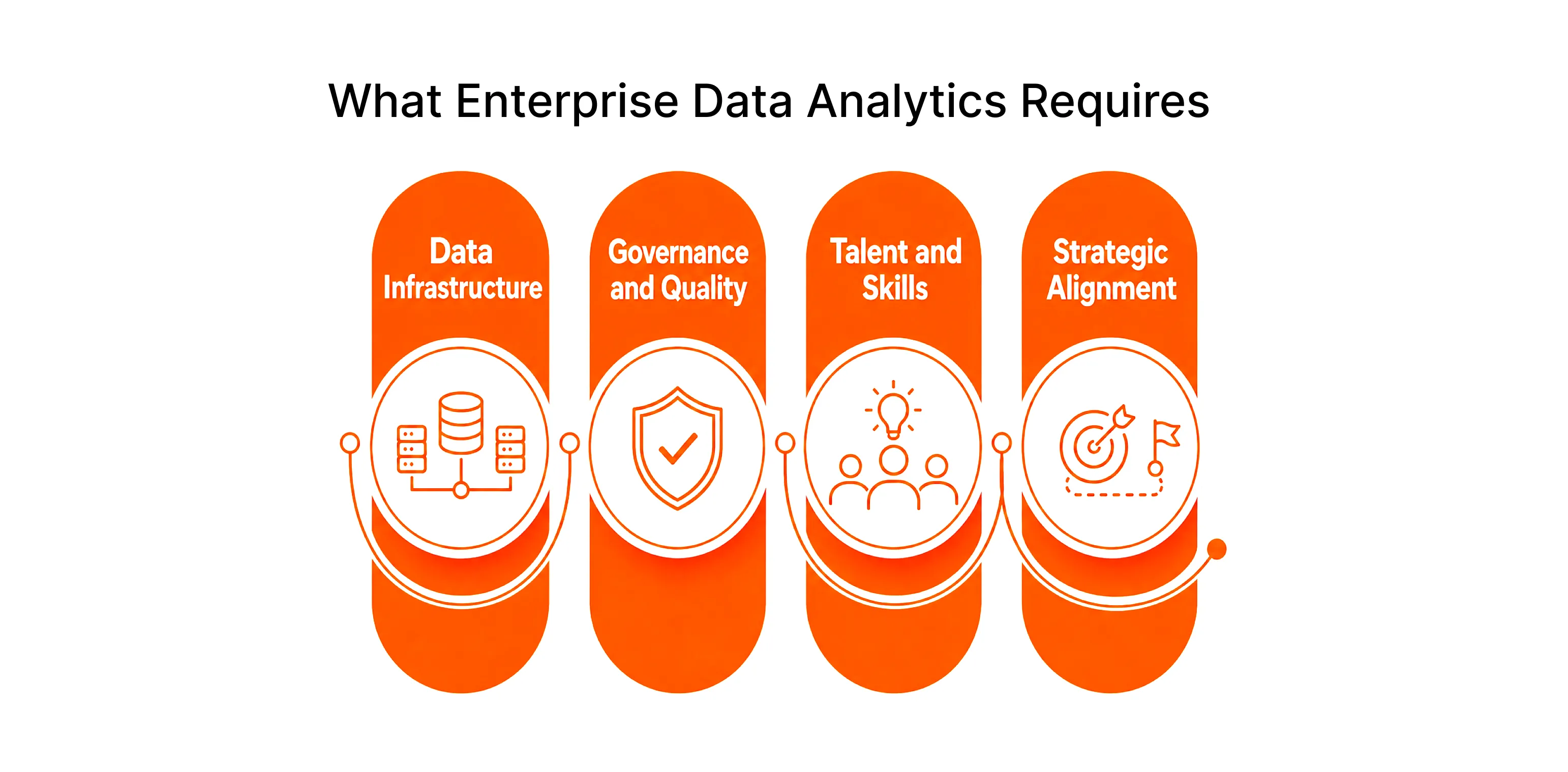
Data infrastructure. Modern cloud platforms like Redshift Azure data analytics provide scalable processing. But infrastructure must connect all data sources reliably and securely.
Governance and quality. Analytics built on bad data produce bad insights. Data quality, ownership, and standards must be established before advanced analytics can deliver value.
Talent and skills. Tools don't interpret themselves. Analysts, engineers, and data literate business users must work together effectively.
Strategic alignment. Enterprise data analytics must connect to business priorities. Technology without direction wastes investment.
Organizations lacking internal expertise often accelerate through data analytics consulting partnerships. External specialists bring proven frameworks, avoid common pitfalls, and transfer knowledge to internal teams.
Enterprise data analytics transforms how organizations operate, compete, and win. It unifies scattered data into actionable insights. It accelerates decisions with confidence. It predicts problems before they occur. It reveals efficiencies at scale. It creates competitive advantages rivals cannot easily replicate.
The question for business leaders isn't whether to invest in enterprise data analytics. It's how quickly they can build capabilities before competitors pull ahead.
Data analytics examples from every industry prove the same pattern. Organizations that master enterprise analytics outperform those that don't. The gap widens every year.
In 2026, data is not just an asset. It's the asset. Enterprise data analytics is how organizations unlock its value.
Turn your enterprise data into a competitive advantage. Schedule a free consultation call with Complere Infosystem.


Listen in for business strategies and interviews with business experts to help you build a business and a life that you love.
About Us