Last year a logistics company launched a large-scale transformation initiative with full executive sponsorship, a solid technology stack, and a detailed roadmap. Eighteen months later adoption was negligible, the original problem remained unsolved, and leadership was pointing fingers in every direction.
Sound familiar? It should. This story repeats across industries every single year. Not because leaders lack vision. But because the most damaging digital transformation challenges are rarely the ones that appear in the project plan.
In 2026 the organisations winning at transformation are not those with the biggest budgets. They are those who understand what actually drives failure and address it before the damage compounds.
Lesson 1: Timing Is the Most Honest Answer Nobody Gives
Most post-mortems on failed digital transformation projects point to technology selection or change resistance. Very few point to the most honest answer. Timing.
A great idea pitched at the wrong moment fails regardless of execution quality. Consider the US frac sand industry. A unit train model had been pitched before the shale boom with zero interest. Then the shale boom created urgent demand and the same idea became the solution the entire industry needed overnight. The company that timed it correctly went from 30% to 70% market share in two years. Every competitor followed.
The transformation did not change. The timing did.
Tips to address and resolve: Before approving any transformation budget require leadership to articulate why now is the right moment. Build a timing checkpoint into your digital transformation strategy. If timing is wrong shelf the initiative with defined market signals that will tell you when the moment has arrived.
Lesson 2: Listening Is a Strategy, Not a Soft Skill
The second most consistent driver of failed digital transformation projects is the absence of genuine listening at leadership level. Not listening as a courtesy. Listening as a discipline that connects market signals into a trend story guiding every major decision.
Without the trend story leaders cannot recognise when conditions have shifted, when an initiative has drifted, or when customer needs have quietly changed beneath them.
Tips to address and resolve: Apply the trend story test before every major decision. Ask your leadership team to articulate the three to five connected observations that led to the conclusion. If they cannot the decision is premature. Build formal listening mechanisms into your digital transformation framework so front-line intelligence reaches decision-making tables before budgets are committed.
Lesson 3: Resistance Hides Behind Legitimate Objections
Change resistance rarely announces itself. It hides behind compliance concerns and integration complexity that sound entirely reasonable but stretch far beyond what the actual work requires.
The most consistent pattern in failed digital transformation strategy is the procurement team raising objection after objection to an idea the sales team would have embraced immediately. Getting the right people in the room at the right moment is not a communication tactic. It is a transformation strategy.
Tips to address and resolve: Map your stakeholders before you pitch. Identify who measures the idea against cost and who measures it against competitive advantage. Find your first adopter and invest disproportionate energy in their visible success. One organisation winning publicly brings every holdout along faster than any top-down mandate.
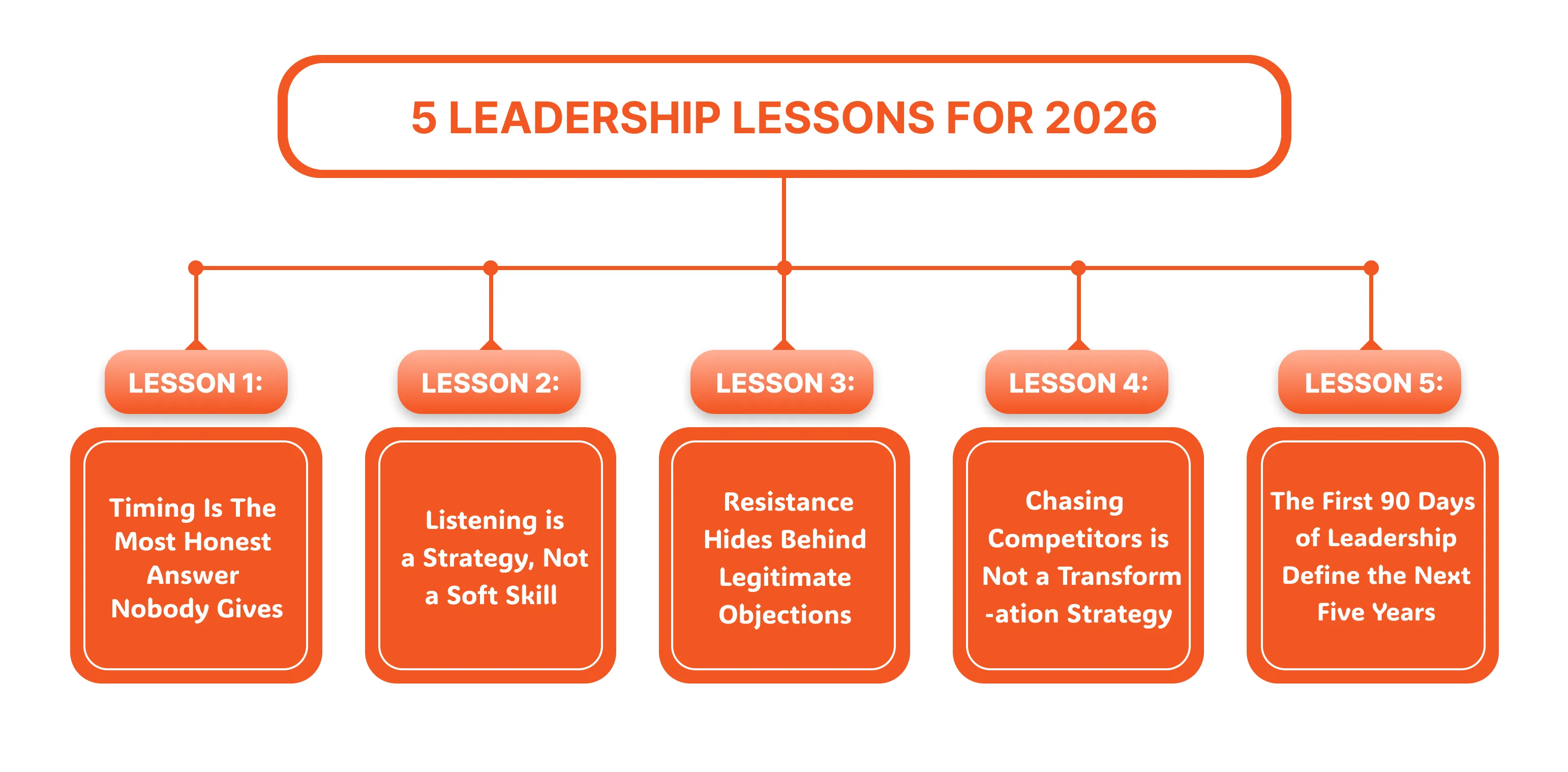
Lesson 4: Chasing Competitors Is Not a Transformation Strategy
The entrepreneurial temptation is one of the most dangerous digital transformation challenges facing leadership teams today. A competitor launches something new. A board member asks why you are not doing the same. And suddenly an initiative is born that has nothing to do with what your organisation is genuinely good at.
Organisations pursuing capabilities outside their core carry disproportionate implementation risk in markets they do not understand with talent they do not yet have.
Tips to address and resolve: Define your core before your transformation roadmap. Use a simple impact versus implementation difficulty matrix and prioritise high revenue impact with lower implementation complexity. Be disciplined about saying no to initiatives outside your core even when a competitor appears to be winning with them.
Lesson 5: The First 90 Days of Leadership Define the Next Five Years
The most overlooked digital transformation challenge is personal. The decisions a leader makes in their first 90 days establish the cultural patterns that determine how every subsequent initiative is received and whether the organisation has the psychological safety to tell the truth before failures become expensive.
"I earned trust through the competence of bringing people around me who knew more than I did and listening to them," says Ben Banks, President and CEO of BNSF Logistics, who led veteran railroaders as a first-time supervisor before leading the transformation that changed an entire industry.
Tips to address and resolve: Make your first 90 days a listening tour. Ask your team what is working, what is not, and what they would change. Implement their best ideas visibly. Build the roundtable mentality from day one where no major decision is made by one person in isolation.
Why These Challenges Compound When Ignored
These five digital transformation challenges do not exist in isolation. Leaders who miss the timing signal are usually the same leaders not listening closely enough. Organisations chasing competitors beyond their core face resistance that feels insurmountable. First 90 days failures create cultures where every subsequent initiative is received with scepticism before it begins.
The organisations executing digital transformation strategy most effectively in 2026 listen before they build, define the core before the roadmap, find the first adopter before moving the whole organisation, and earn trust before casting vision.
The Bottom Line
Digital transformation failures are not primarily technology failures. They are leadership failures. Failures of timing, listening, stakeholder alignment, core discipline, and the personal leadership patterns established before a single initiative launches.
Before your next transformation investment ask five questions. Is the timing genuinely right? Are we listening to the trend story? Have we found our first adopter? Does this fit our core? And are our leaders earning trust or assuming it?
If any answer is unclear address that first. The transformation built on the right foundation at the right moment with the right people will always deliver more than anything launched prematurely on the wrong one.
Ready to build a digital transformation strategy that actually delivers? Partner with Complere Infosystem and work with experts who understand what transformation really requires.