A global manufacturing company had forty seven live dashboards across their BI platform. Every department had reporting. Every function had visibility. And when the board asked three basic questions about which product lines were actually profitable after logistics costs nobody could answer within the week.
Not because the data did not exist. Because the data analytics strategy roadmap had never been built. They had built reports. They had not built analytics. The difference between those two things is where most organisations quietly lose the business value their data investments were supposed to create.
In 2026 a data analytics strategy roadmap that connects data to decisions is not optional for any CEO serious about competitive growth. It is the single clearest differentiator between organisations that use data to compete and organisations that use data to report.
Stop Measuring Everything and Start Measuring What Matters
The first reason most data analytics strategy roadmaps fail is scope. Organisations try to build analytics across every business function simultaneously. The result is a platform that measures everything and informs nothing because no single metric is clear enough to drive a decision.
The strongest data analytics strategy roadmap begins with a ruthless prioritisation exercise. Which five business decisions — if made better and faster — would have the highest impact on revenue, cost, or customer outcomes? Every analytics investment in the first twelve months should serve those five decisions exclusively.
Tips to address and resolve: Run a prioritisation workshop with your senior leadership team before defining your analytics scope. Ask one question per business function. If you could make one decision better with data what would it be? The answers define your analytics strategy. The data strategy roadmap builds backwards from those decisions not forwards from the available data.
Analytics Without Governance Produces Noise Not Insight
The second failure mode of a data analytics strategy is building the analytics layer before the governance layer. Reports that contradict each other. KPIs that mean different things to different teams. Revenue figures that differ between the CFO and the sales director. These are not data quality problems. They are governance problems.
A master data management strategy roadmap sits underneath every successful analytics programme. Before any dashboard is built the organisation needs to agree on the definition of every critical metric. What counts as a customer. When a transaction is recognised. How churn is calculated. Without these agreements analytics produces arguments not insights.
Tips to address and resolve: Before building a single dashboard define your metric dictionary. Document the agreed definition of your ten most important business metrics. Include the data source, the calculation method, and the business owner for each one. This one document will prevent more analytics failures than any technology investment your organisation could make.
Build Your Data Strategy Framework Around Decisions
The third reason data analytics strategies fail is that the data strategy framework is built around the data rather than around the decisions the business needs to make. Data teams build what they can build rather than what the business needs to act on.
A transformation roadmap business data strategy that works connects every analytics deliverable to a specific decision owner. Not a department. A named person responsible for a specific business outcome who will use the analytics to make better decisions faster. When that connection exists analytics gets used. When it does not analytics gets ignored.
Tips to address and resolve: For every analytics deliverable in your roadmap name the decision owner before building begins. Write a one sentence decision statement. This analytics will help the role decide the specific decision by showing the specific insight. Data strategy roadmap examples from the highest performing analytics programmes all share this decision ownership structure as their foundation.
Plan the Analytics Maturity Curve From Day One
Most data analytics strategy roadmaps fail because they try to deliver predictive analytics before descriptive analytics is working reliably. The maturity curve exists for a reason. Organisations that skip stages pay twice — once to build what they skipped and once to fix what they built on top of it.
The four stages of analytics maturity move in sequence. Descriptive analytics answers what happened. Diagnostic analytics answers why it happened. Predictive analytics answers what will happen. Prescriptive analytics answers what should we do. The data strategy framework that delivers sustainable value plans all four stages explicitly and builds each one on the foundation of the previous.
Tips to address and resolve: Assess your current analytics maturity honestly before defining your roadmap timeline. If your descriptive analytics is unreliable do not begin predictive analytics regardless of the business pressure to move faster. Data strategy roadmap examples from organisations that have successfully navigated the full maturity curve consistently show that the investment in reliable descriptive analytics paid back faster than any subsequent stage.
Democratise Analytics Without Losing Control
The fifth and most common late-stage failure of a data analytics strategy roadmap is what happens when analytics succeeds. Teams want their own data access. Business users build their own reports. The data strategy framework that worked for fifty users breaks down when five hundred people are creating their own versions of the same metrics.
A transformation roadmap business data strategy built for scale includes a self service analytics layer with clear guardrails from the beginning. Certified datasets that every user can access. A metric library that prevents parallel definitions from proliferating. And a clear escalation path for when users need data that does not yet exist in the certified layer.
Tips to address and resolve: Build your certified data layer and your self service layer as two distinct components of your master data management strategy roadmap from day one. Define clearly which datasets are certified for business decision making and which are available for exploration only. The distinction protects governance while enabling the organisation wide data literacy that makes analytics investments compound over time.
Why Getting This Right Compounds Over Time
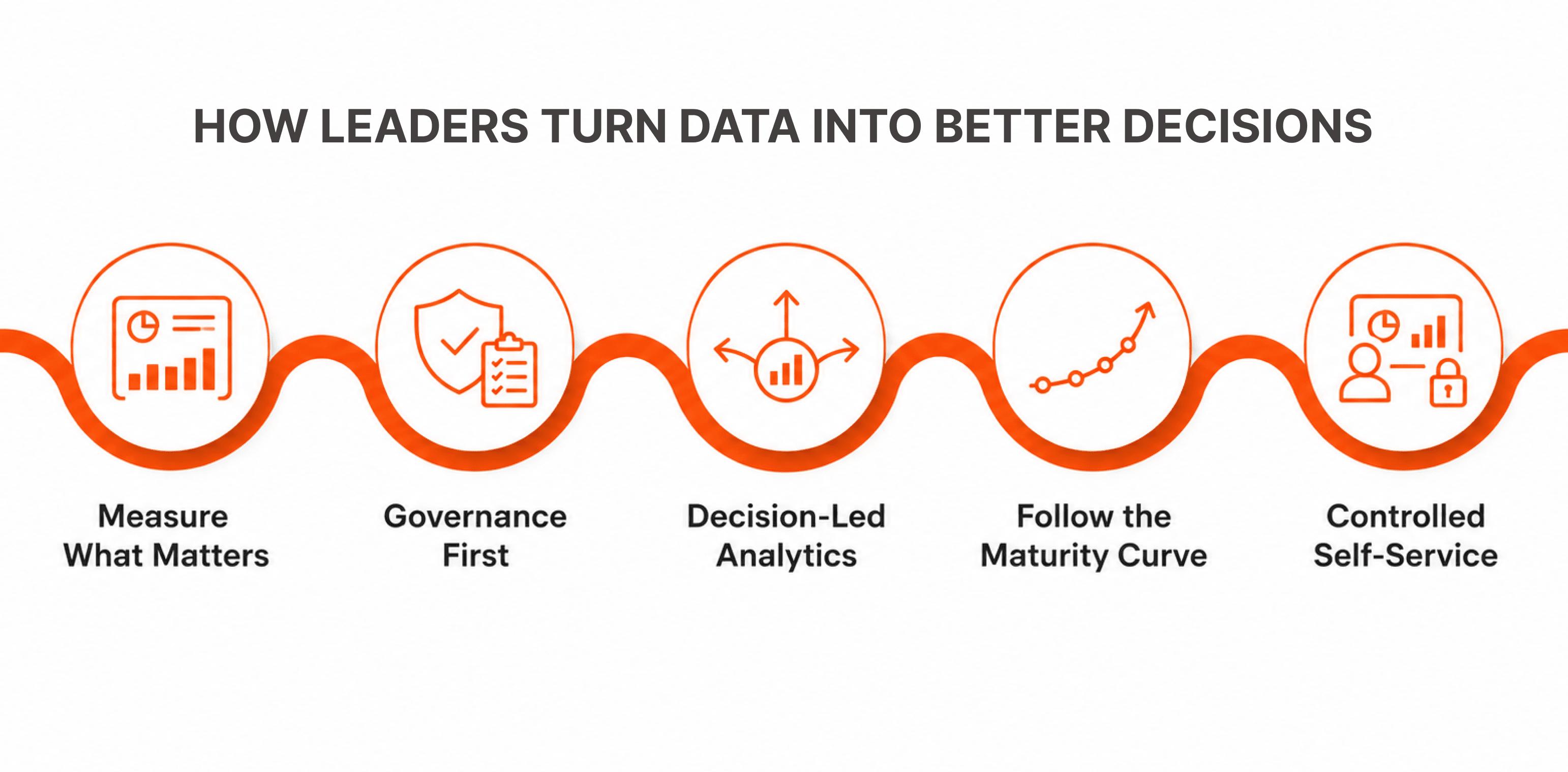
A data analytics strategy roadmap that starts with the right decisions, builds governance before analytics, connects every deliverable to a decision owner, respects the maturity curve, and scales through controlled self service creates a compounding advantage.
Each quarter more decisions are made faster and more accurately. Each year the analytics foundation deepens. Each AI initiative builds on analytics that already works. The organisations that built this right two years ago are not just ahead today. They are increasingly difficult to close the gap on.
 The Bottom Line
Every CEO who has approved a data investment and seen it underdeliver has experienced the same gap. The technology worked. The strategy that connected it to the business did not exist.
A data analytics strategy roadmap built around business decisions, governed from the start, connected to named decision owners, built through the maturity curve, and designed to scale is not a data team deliverable. It is a CEO priority.
The organisations pulling ahead in 2026 are not the ones with the most data. They are the ones whose CEOs decided to own the data strategy roadmap rather than delegate it.
Ready to build the data analytics strategy roadmap your business needs? Partner with Complere Infosystem and let our data engineering and analytics specialists design the roadmap that connects your data directly to business outcomes.