A few quarters ago a global financial services firm presented a strategic plan to its board built on twelve months of analytical work. The numbers were clean, the visuals were sharp, and the recommendations were specific. Two weeks later the CFO discovered that one of the underlying datasets had been silently double counting a major revenue stream for the past eighteen months. The recommendations had to be withdrawn. The board lost trust in the analytics function. The cost of that single data quality failure exceeded the entire annual analytics budget.
Sound familiar? It should. Research from Gartner has consistently estimated that poor data quality costs organisations millions of dollars annually in lost productivity, flawed decisions, and missed opportunities. Most leadership teams underestimate the cost because the failures are invisible until they are catastrophic.
In 2026 the organisations making reliable decisions are not those with the largest data estates. They are those who treat data quality as an executive discipline rather than a technical afterthought.
Practice 1: Define What Quality Actually Means for Each Data Domain
The first practice that separates reliable decisions from unreliable ones is defining what data quality actually means in context. Quality is not a universal standard. The accuracy threshold acceptable for marketing analytics is unacceptable for financial reporting. The completeness expectation for product data is different from the completeness expectation for regulatory data.
Organizations that apply uniform quality standards across all data domains either overinvest in domains that do not need that level of rigour or underinvest in domains where the cost of error is severe.
Tips to address and resolve: Map your critical data domains and define the data quality dimensions that matter most for each. Accuracy, completeness, consistency, timeliness, validity, and uniqueness. Set explicit thresholds per domain rather than across the enterprise. Tailored definitions create tailored discipline.
Practice 2: Treat Data Quality as a Permanent Function, Not a Project
The second practice is structural. Most organisations launch data quality initiatives as projects with start dates, milestones, and end dates. Data quality does not work that way. Source systems change. Business processes evolve. Integration points multiply. What was clean last quarter quietly drifts this quarter unless someone is permanently responsible for keeping it clean.
This is one of the most overlooked decisions in data quality solutions design. The technology can be excellent. Without permanent ownership the technology degrades into shelfware within eighteen months.
Tips to address and resolve: Assign permanent owners for each critical data domain with clear accountability for the quality dimensions that matter most. Build data quality reviews into standing operating cadences alongside performance reviews. A practical data quality framework treats quality as an operating discipline embedded into permanent roles, not a transformation programme with an end date.
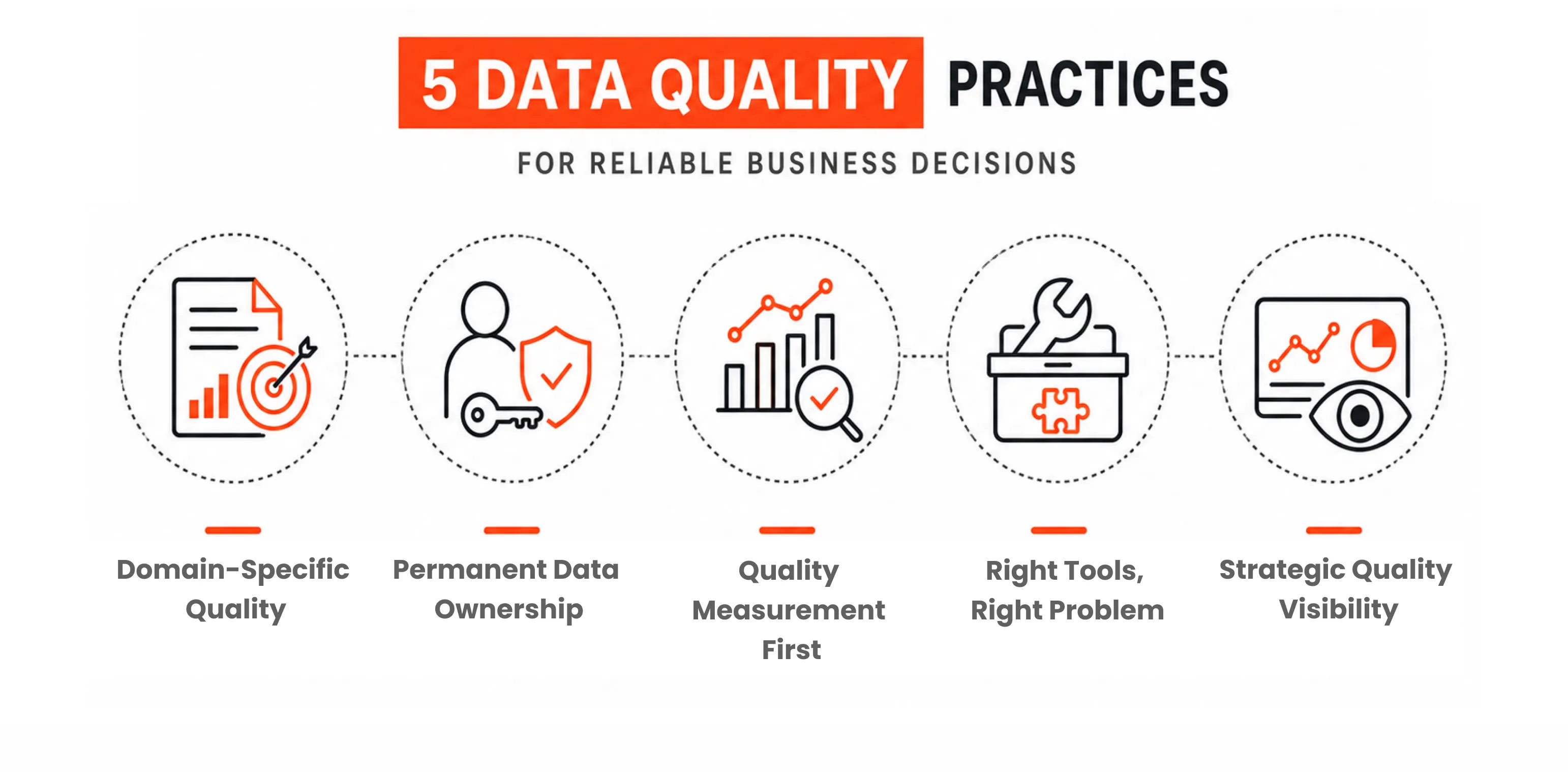
Practice 3: Measurement Must Come Before Improvement
The third practice is measurement discipline. Organisations that try to improve data quality without first measuring it consistently discover that they cannot tell whether their interventions are working. The improvements feel real. The metrics tell a different story. Without baseline measurement and ongoing monitoring the work becomes anecdotal.
This is particularly important for CIOs and CTOs reporting data quality progress to executive teams. Without measured baselines and consistent metrics the conversation drifts into opinion rather than evidence.
Tips to address and resolve: Before launching any data quality intervention define how to measure data quality for each domain. Establish baselines. Track trends. Report metrics on a regular cadence to the executive team. Use a small number of meaningful indicators rather than a large dashboard of metrics nobody reads. Measurement creates accountability. Accountability creates improvement.
Practice 4: Match Data Quality Management Tools to the Actual Problem
The entrepreneurial temptation in data quality work is to invest in sophisticated data quality management tools before understanding the actual problem. Profiling engines, master data platforms, observability layers, and rule based validation systems are all genuinely valuable. None of them solve a problem they were not selected to address.
Organisations that purchase tools before defining the specific quality issues those tools must solve consistently discover that the tools sit underutilised while the original quality problems persist.
Tips to address and resolve: Before evaluating any data quality tools document the three to five highest cost quality issues currently affecting business decisions. Evaluate shortlisted platforms against those specific issues. The right tool for the actual problem creates measurable improvement. The wrong tool, however sophisticated, creates ongoing licence cost without proportional return.
Practice 5: Leadership Must Treat Quality Failures as Strategic Events
The most overlooked practice in data quality is cultural. Most organisations treat individual data quality failures as technical incidents to be fixed quietly by the data team. The pattern repeats because the executive team never sees the cumulative cost. Reliable decisions require leadership to treat significant data quality failures as strategic events worthy of the same attention as financial misstatements or operational failures.
When data quality failures get strategic visibility, organisational behaviour changes. Source systems get prioritised for investment. Integration points get governance. Ownership becomes visible. Without that visibility the failures continue silently until the next catastrophic event.
Tips to address and resolve: Establish a clear escalation path for material data quality failures to the executive team. Treat repeated failures in the same data domain as a strategic risk requiring leadership intervention. Looking at real data quality examples across industries shows the same pattern. Organisations that escalate quality failures improve faster than those that contain them quietly.
Why These Practices Compound
These five data quality practices do not work in isolation. Domains without defined quality standards cannot be measured meaningfully. Quality work treated as a project rarely justifies the right tool investment. Tools purchased without measurement create unmeasured outcomes. And quality failures contained quietly never trigger the leadership attention that drives systemic improvement.
The organisations making reliable decisions in 2026 define quality per domain, treat the work as permanent, measure rigorously, match tools to actual problems, and elevate significant failures to strategic visibility.
The Bottom Line
Reliable business decisions are not the product of more data. They are the product of trustworthy data. Domain specific quality definitions. Permanent ownership of critical data assets. Measurement before improvement. Tools matched to actual problems. And leadership attention proportionate to the strategic cost of failure.
Before your next strategic decision built on analytics ask five questions. Have we defined what quality means for this specific data domain. Is there permanent ownership for this data asset. Have we measured the baseline quality and the current state. Are our tools solving the actual quality problems we have. And does leadership see and respond to material quality failures.
If any answer is unclear address that first. The organisation that builds data quality as an executive discipline will always outperform one that treats it as a back office function.
Ready to build the data quality discipline behind reliable business decisions? Partner with Complere Infosystem today.