A few months ago a global insurance group launched a new claims strategy informed by months of analytical work. The dashboards were detailed. The models were sophisticated. The board approved the strategy with confidence. Six weeks after rollout the operational results contradicted nearly every assumption the analytics had supported. The investigation revealed something uncomfortable. The executives had consumed the outputs without understanding the assumptions underneath them.
Sound familiar? It should. Research from MIT Sloan Management Review has found that organisations using analytics intensively in decision making are significantly more likely to outperform their peers financially, yet most leadership teams still struggle to translate analytical output into reliable decisions.
In 2026 the executives benefiting most from big data analytics are not those with the most advanced platforms. They are those who understand how analytics actually improves decisions and where it quietly misleads when used poorly.
Shift 1: Better Decisions Start With Better Questions
The first shift big data analytics drives in executive decision making is upstream of the analysis itself. Strong decisions begin with sharp questions. When executives ask precise questions, analytics teams deliver focused answers. When questions arrive vague, the analytics produce broad dashboards that look comprehensive and inform nothing.
A consumer goods executive asking "how is our category performing" receives a different quality of answer than the same executive asking "which three SKUs are quietly losing margin in our top five markets and why." The data infrastructure does not change. The question quality does.
Tips to address and resolve: Before requesting any analytical output force yourself to write the decision the analysis is meant to inform. If the decision is not specific the analysis cannot be useful. Treat question quality as an executive discipline, not an analytics team responsibility.
Shift 2: Knowing the Difference Between Big Data and Regular Analytics Matters
The second shift comes from understanding what big data analytics actually offers. The big data analytics vs data analytics distinction matters because they answer different kinds of questions. Traditional analytics explains what happened and why. Big data analytics enables decisions at scale, in near real time, across patterns no human can manually identify.
Executives who treat the two as interchangeable either overspend on big data infrastructure for simple problems or underestimate what genuine big data capability can unlock for the right problems.
Tips to address and resolve: For each major decision area ask whether the question is genuinely about scale, velocity, or pattern complexity. If yes, big data analytics is the right tool. If not, traditional analytics will deliver the answer faster and cheaper. Right tool for the right problem is the most underrated executive discipline in analytics.
Shift 3: Big Data Analytics Tools Are Only as Useful as the Decisions They Support
The third shift is selection discipline. Big data analytics tools have become genuinely powerful. Real time pipelines, machine learning workbenches, and visualisation layers that surface insights in seconds. None of this matters if the tools are evaluated against generic capability rather than the specific decisions executives need to make.
This is particularly important for CIOs and CTOs evaluating analytics platforms under board pressure. The temptation is to standardise on enterprise grade tools first and identify use cases later. The result is impressive infrastructure that struggles to justify its cost.
Tips to address and resolve: Define the five most important recurring executive decisions in your business. Evaluate big data analytics tools against those specific decisions rather than against feature checklists. The platform that improves five real decisions outperforms the platform that supports fifty theoretical ones.
Shift 4: Real Examples Reveal Where Analytics Actually Changes Decisions
The entrepreneurial temptation in analytics is to focus on what is possible rather than what is being decided differently. Looking at what is big data analytics with example based outcomes reveals where executive decision making actually changes. Dynamic pricing decisions that adjust thousands of times daily across product portfolios. Fraud detection decisions made in milliseconds across millions of transactions. Predictive maintenance decisions made before equipment failure rather than after.
In each example the analytics did not just inform the decision. It changed the speed, scale, and accuracy of the decision in ways traditional approaches could not match.
Tips to address and resolve: For your top three strategic priorities identify a real world example where big data analytics has measurably changed how a peer organisation makes that type of decision. If no equivalent example exists the technology may not yet be the right answer. Examples ground executive expectations in what analytics actually delivers.
Shift 5: Executives Must Engage With Assumptions, Not Just Outputs
The most demanding shift big data analytics requires of executives is also the most overlooked. Every analytical output rests on assumptions about data quality, model design, and business context. Executives who consume only the headline numbers make decisions on assumptions they have never examined. Executives who engage with the underlying assumptions make stronger decisions even when the analytics is imperfect.
The insurance example at the start of this article failed not because the analytics was wrong. It failed because the executives accepted the outputs without testing the assumptions.
Tips to address and resolve: Before any major decision based on analytics ask three questions. What data is this built on and how recent is it. What assumptions does the model make about behaviour or conditions. And what would have to be true for this conclusion to be wrong. These three questions separate executives who use analytics well from those who are used by it.
Why These Shifts Compound
These five shifts in how big data analytics improves executive decision making do not work in isolation. Better questions produce sharper analytics. Right tool selection unlocks the value of better questions. Real world examples calibrate expectations. And assumption testing prevents the false confidence that often follows sophisticated analytical output.
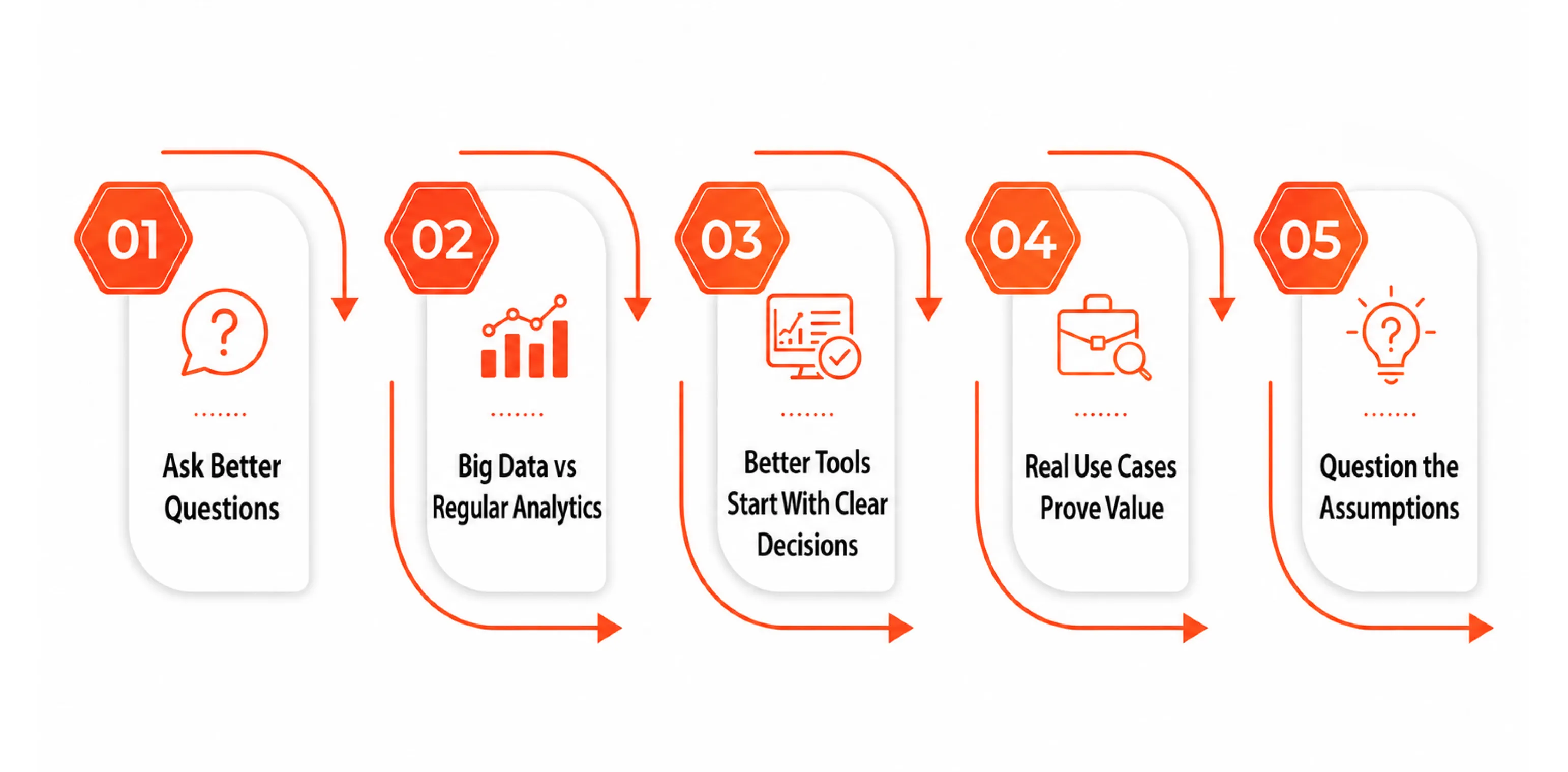
The organisations getting analytics right in 2026 train executives to ask better questions, distinguish big data scale from regular analytics, evaluate tools against real decisions, ground expectations in proven examples, and engage with assumptions rather than just outputs.
The Bottom Line
Big data analytics improves executive decision making only when executives engage with it as a discipline rather than a deliverable. The improvement does not come from the platform. It comes from the questions executives ask, the tools they choose, the examples they study, and the assumptions they test.
Before your next major analytics informed decision ask five questions. Have we defined the actual decision precisely. Is this genuinely a big data problem or a regular analytics problem. Were our tools chosen against this kind of decision. Do we have a real world example of analytics changing this decision elsewhere. And have we examined the assumptions underneath the output.
If any answer is unclear address that first. The executive who treats analytics as a thinking discipline will always outperform the executive who treats it as a delivery channel.
Ready to turn big data analytics into measurably better executive decisions? Partner with Complere Infosystem Today.