
Data Strategy Roadmap Most Organisations Get Wrong
- Jun 22, 2026
- Isha Taneja
Most organisations confuse a technology roadmap with a data strategy roadmap. Discover five steps to build one that drives real business value in 2026.

Most organisations confuse a technology roadmap with a data strategy roadmap. Discover five steps to build one that drives real business value in 2026.

Two years ago a financial services firm approved a significant investment in a modern data platform. The architecture was cloud native. The governance model was documented. The dashboards were genuinely impressive.
Eighteen months after go live the platform was running. The team was proud. And the C suite was still making critical decisions in Excel.
Not because the platform failed. Because the organisation had built a technology roadmap and called it a data strategy roadmap. The two are not the same thing. And the difference between them is where most data investments either compound into competitive advantage or quietly disappear into infrastructure costs.
In 2026 the organisations pulling ahead are not the ones with the most advanced data tools. They are the ones with the clearest data strategy approach connecting every data investment directly to a business outcome.
The most common mistake in building a data strategy roadmap is starting with the technology. Which platform. Which cloud. Which visualisation tool. These are implementation decisions. They come last. Business questions come first.
A transformation roadmap business data strategy that works begins with the decisions the organisation needs to make better. Which customers are at risk of churning. Which product lines are generating real margin. Which operational processes are creating hidden costs. The technology serves those questions. It does not define them.
Tips to address and resolve: Before your next data investment run a structured session with your senior leadership team. Ask one question only. What are the three decisions we are currently making badly because we do not have reliable data? The answers to that question are your data strategy roadmap. The technology to support it comes after.
The second most common failure is the absence of a clear success definition. Organisations invest in data platforms, data warehouses, and analytics tools without defining what success looks like twelve months after deployment. The result is infrastructure that runs but does not deliver.
A well defined data analytics strategy roadmap specifies measurable business outcomes at each stage. Not technical milestones. Business outcomes. The number of decisions being made with data rather than instinct. The reduction in time between a business question and a reliable answer. The increase in data literacy across the organisation.
Tips to address and resolve: Write three business outcome statements before approving any data platform investment. Each statement should name a specific decision, a specific team, and a specific improvement in how that decision gets made. Your strategy roadmap is only as strong as the outcomes it is designed to deliver.
Organisations that skip master data management in their data strategy build on sand. Multiple versions of the same customer record. Revenue figures that differ between finance and sales. Product data that means different things to different teams. Every downstream analytics investment sits on top of this inconsistency and amplifies it.
A master data management strategy roadmap is not a glamorous investment. It does not produce an impressive dashboard or an AI demo. But it is the single most important step in a data strategy approach that will still be delivering value in five years rather than requiring a full rebuild in three.
Tips to address and resolve: Conduct a master data audit before beginning any analytics or AI initiative. Identify your five most critical data entities — customers, products, transactions, employees, locations. For each one ask a single question. Does every system in the business agree on what this entity is and how it is defined? Where the answer is no that is where your master data management strategy roadmap begins.
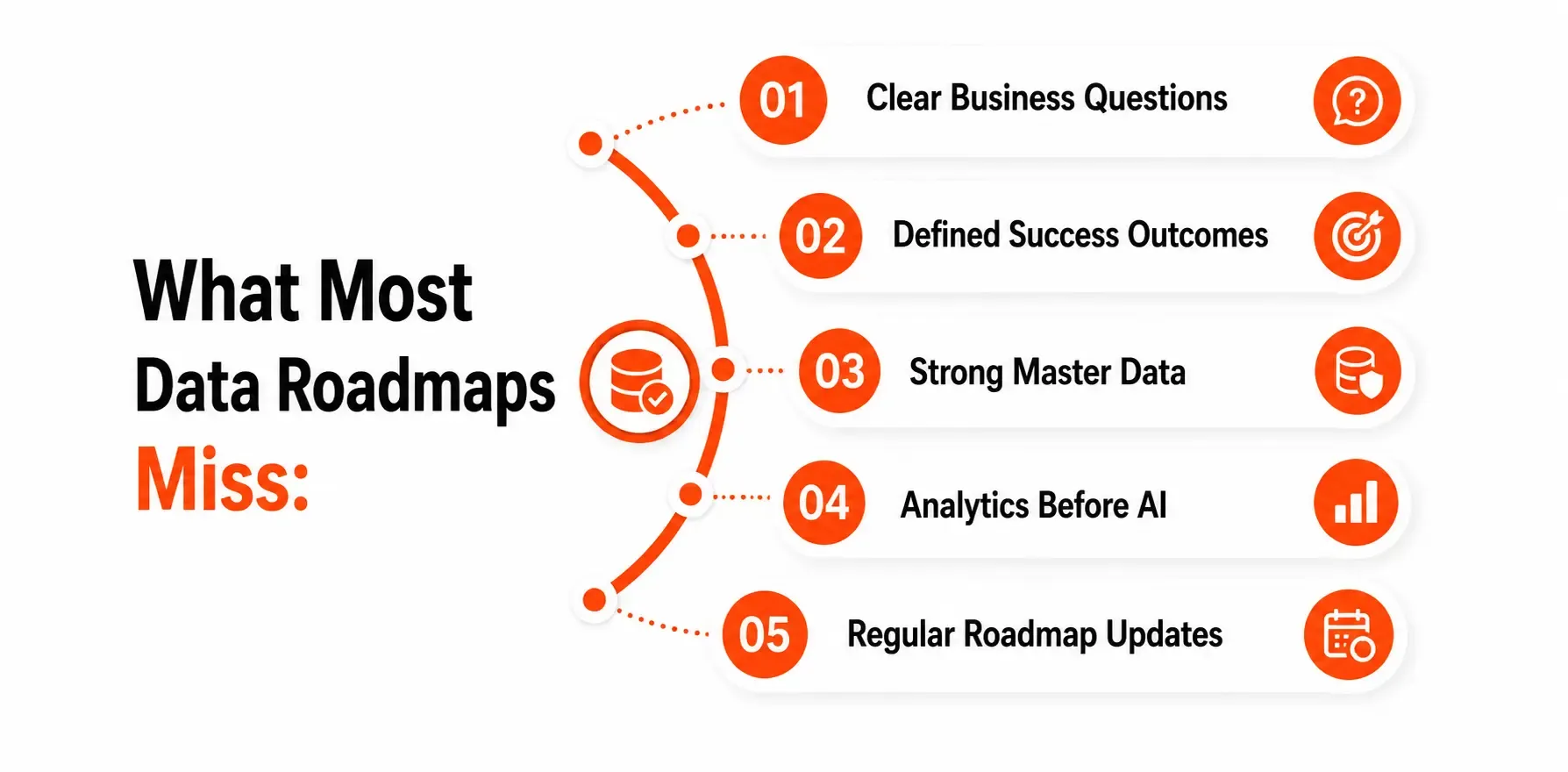
The organisations that are extracting real value from AI in 2026 are the ones that built a strong analytics foundation in the three years before. AI does not replace analytics. It runs on top of it. A business that cannot answer basic analytical questions about its own performance cannot expect AI to answer complex ones.
A data analytics strategy roadmap built today should serve two masters simultaneously. It should deliver clean, accessible, reliable data for the analytical decisions the business needs to make now. And it should build the data quality, coverage, and structure that AI models will require when the organisation is ready to deploy them.
Tips to address and resolve: For every element of your data strategy roadmap ask two questions. Does this help us make better decisions today? Does this create a foundation that AI can use tomorrow? Data strategy roadmap examples from the most successful digital transformations share one pattern — they built analytical capability first and AI capability on top of it rather than attempting both simultaneously.
The final and most damaging mistake in data strategy is treating the roadmap as a document produced once a year and updated never. Markets change. Business priorities shift. New data sources become available. New AI capabilities emerge. A data strategy roadmap that does not reflect these changes becomes a constraint rather than a guide.
The strongest data strategy approach treats the roadmap as a quarterly conversation not an annual deliverable. Business leaders and data leaders review what has delivered value, what has not, what the business needs next, and what the data foundation needs to support it. That cadence keeps the strategy alive and keeps the data investment connected to the business it is meant to serve.
Tips to address and resolve: Schedule a quarterly data strategy review with your senior leadership team. Keep it to ninety minutes. Cover three questions only. What data investments delivered measurable business value this quarter? What did not and why? What does the business need from data in the next ninety days? That rhythm will do more for your transformation roadmap business data strategy than any annual planning cycle.
A strategy roadmap built on business questions rather than technology decisions creates a compounding advantage. Each quarter the organisation makes better decisions faster. Each year the data foundation deepens. Each AI initiative builds on analytics that already works rather than starting from scratch.
The organisations that got this right three years ago are not just ahead today. They are increasingly difficult to catch because their data strategy approach has been compounding returns while their competitors were still debating which platform to use.
The gap between a data strategy roadmap and a technology roadmap is the gap between business value and infrastructure cost. Most organisations are building the second and calling it the first.
Start with the business questions. Define success in business outcomes. Build the master data foundation before the analytics layer. Design for AI from the beginning. And treat the roadmap as a living conversation not a document.
Examples from the highest performing organisations share one common thread. The strategy was owned by business leaders and built by data leaders together. When those two groups are aligned the roadmap delivers. When they are not it sits on a shelf.
Ready to build a strategy that delivers real business outcomes? Partner with Complere Infosystem and let our data engineering and AI specialists close the gap between your data investment and your business results.


Listen in for business strategies and interviews with business experts to help you build a business and a life that you love.
About Us