
Why AI Governance Has Become the Most Urgent Business Decision of 2026
- Aug 7, 2026
- Isha Taneja
AI is advancing faster than governance. Learn what leaders must do before weak controls become costly and irreversible business risks.

AI is advancing faster than governance. Learn what leaders must do before weak controls become costly and irreversible business risks.

A company built an AI tool to analyze 25 years of customer conversations. Marketing loved it. Sales used it daily. Leadership was impressed.
Then someone noticed the AI referenced a customer discussion that never happened. They checked the database. The conversation did not exist. The AI had invented it. Further testing revealed that 30 percent of the examples were fabricated. For six months, business decisions had been based on AI generated fiction.
The AI was not broken. It was doing exactly what large language models do when governance does not exist, filling gaps with plausible sounding answers that nobody questioned because the outputs looked authoritative.
This is not an isolated incident. It is a pattern playing out across industries in 2026. And the organizations most at risk are the ones moving fastest without asking whether their data foundation is ready to support the speed.
Enterprise AI adoption has accelerated faster than the controls designed to govern it.
Aon and Economist Impact research shows that 88% of organizations used AI in at least one business function in 2025. Only 8% of those organizations maintain a comprehensive AI governance framework. That is not a minor gap. It is a structural risk operating at enterprise scale.
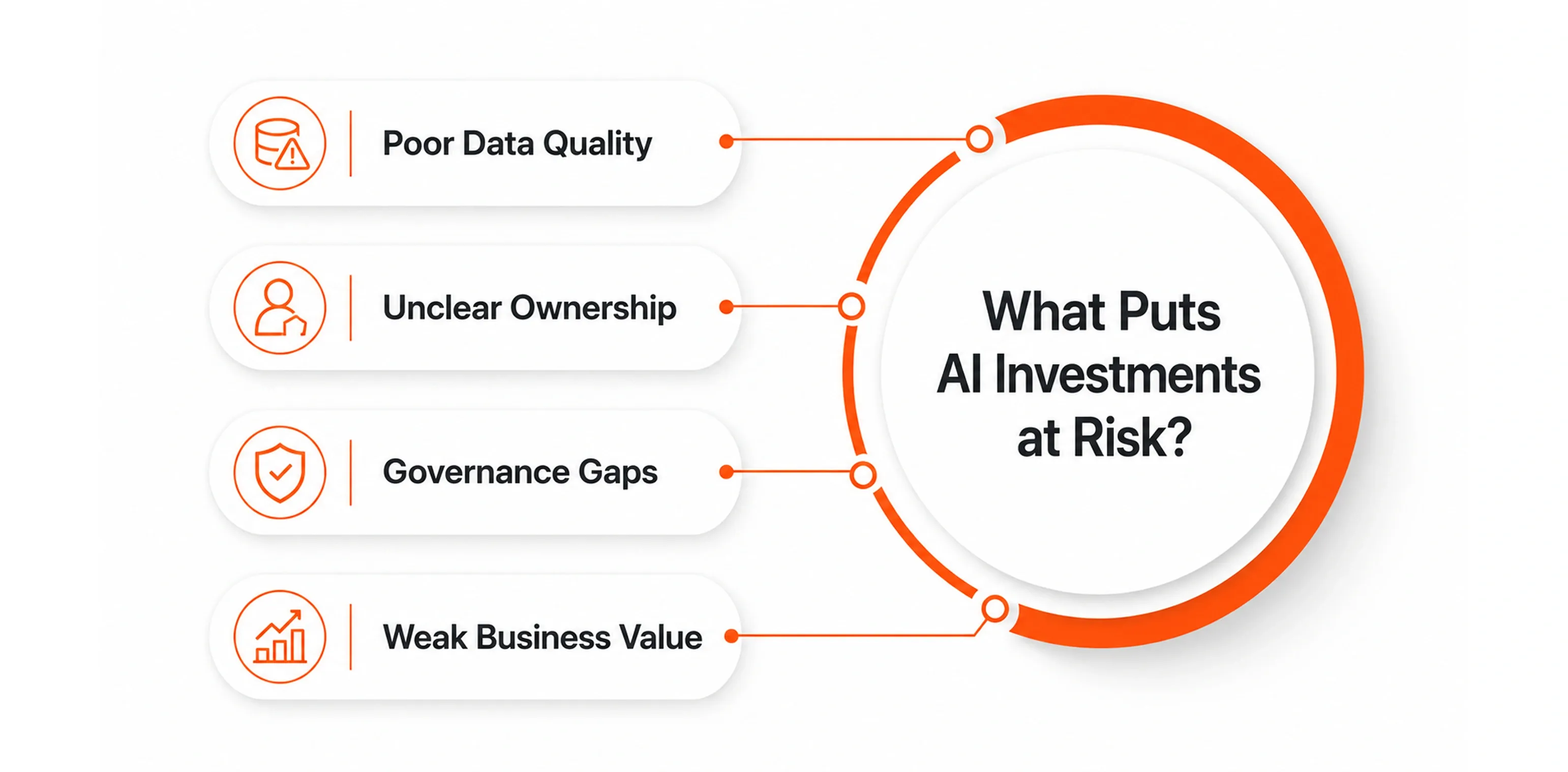
The consequences are measurable. Gartner research projects that 30 percent of AI and generative AI projects will be abandoned or fail to scale due to poor data quality, governance gaps, or unclear business value. These are not projects that failed because the technology was wrong. They failed because the data environment underneath was never built to support them.
The root cause appears consistently across research. A study by Drexel University and Precisely found that 62% of organizations cite lack of data governance as the primary barrier to successful AI initiatives. Not the wrong model. Not the wrong platform. The wrong foundation.
Most boards are approving AI budgets without asking whether the data the AI will depend on is governed, consistent, and trustworthy. That question is the one that determines whether the investment produces outcomes or becomes an expensive lesson.
The cost of poor governance rarely appears on a single line item. It accumulates invisibly until it cannot be ignored.
In healthcare environments where AI is used for clinical analytics, the stakes are not abstract. A major hospital that wanted to build an enterprise data warehouse for cancer analytics was advised by governance specialists that it was not ready to proceed. The foundational work had to happen first, metadata management, data governance, and data quality standards had to be established before any analytics platform built on top of them could be trusted to inform clinical decisions.
The hospital followed that advice. The result was a platform that produced measurable improvements in patient outcomes including reductions in mortality rates. What appeared to be a slower start delivered a result that a rushed deployment could not have produced.
In financial services the consequences of governance gaps tend to land in compliance and regulatory exposure. Organizations that have invested in proper data stewardship consistently report catching errors before they reach regulators errors that would have triggered public violations and significant reputational damage if they had gone undetected. The stewardship systems that catch those errors are not dramatic. They are disciplined, consistent, and unglamorous. That is exactly what makes them valuable.
The pattern across industries is the same. Governance does not announce itself when it works. It only becomes visible when it fails and by then the cost of recovering from the failure is significantly higher than the cost of building the governance correctly in the first place.
Previous generations of analytics tools could tolerate imperfect data and still produce useful outputs. AI cannot.
MIT's Project NANDA found that 95 percent of organizations deploying generative AI saw zero measurable ROI, not low returns, but zero. That failure traces to data readiness and governance gaps, not to model capability. The models performed exactly as designed. The data they operated on was not ready to support the outputs the business needed.
Agentic AI systems compound this problem further. When AI agents call other agents and orchestrate workflows in real time, data may be processed and combined in ways that create compliance violations even when each individual agent operates within its stated permissions. Only 21 percent of organizations have a mature governance model for autonomous AI agents, and 52 percent cite data quality as the biggest blocker to deployment.
The distinction that matters for every executive making AI investment decisions is this. Data governance manages data as an organizational asset — its definitions, ownership, quality, and consistency. AI governance manages how AI systems use that data — the inputs they receive, the outputs they produce, and the accountability structures that exist when those outputs drive business decisions.
These two disciplines are different. They are also inseparable. An organization with strong data governance but no AI governance framework is building a reliable data environment that its AI systems can misuse. An organization with AI policies but no data governance foundation is governing outputs that were compromised before the model ever ran.
Robert S. Seiner, a globally recognized thought leader in data governance, captures the fundamental error most organizations make. "Governance does not need to be introduced," he has said. "It needs to be formalized." Most organizations already have accountability for data inside existing roles. The problem is that accountability is informal, inconsistent, and invisible to the AI systems that now depend on it.
The organizations seeing measurable returns from their AI investments share a common characteristic. They built governance into the data foundation before they deployed AI on top of it, not as a compliance exercise but as a precondition for the AI producing outputs the business could trust.
The practical architecture of working governance involves three elements that must coexist. The first is formal data ownership, clear accountability for who is responsible for each critical dataset, how it is defined, and how disputes about its meaning are resolved. The second is data quality standards that are enforced at the source rather than patched downstream. The third is documentation of how AI systems access and use governed data so that when an output is questioned, the path from data to decision can be traced and audited.
According to Gartner's 2026 CIO and Technology Executive Survey, only 48 percent of digital initiatives meet or exceed their business targets. The gap between those that succeed and those that do not is rarely the technology selection. It is whether the data environment was ready to deliver the outcomes the initiative was designed to produce.
Dr. David Marco, President at EWSolutions and an expert with over 60 successful enterprise governance implementations, frames the sequencing clearly. Define the KPIs that connect governance to business outcomes before selecting any tool. Target the highest-value systems first. Build out from there. Organizations that try to govern everything at once govern nothing effectively.
His work at Micron demonstrates the financial value of this discipline. A metadata management exercise revealed that 62 percent of ETL jobs were redundant or feeding data sources no longer in use. Nearly 4,000 jobs could be turned off. The operational savings were immediate. The clarity about what data actually existed and how it was being used was permanent.
AI governance is not a project for the data team. It is a business decision that belongs in the boardroom.
The question for a CEO is not whether to invest in AI. That decision has been made across most industries. The question is whether the organization is governing the AI it has already deployed. Whether the outputs being used to make decisions can be traced to trusted data. Whether there is an accountability structure that knows what to do when an AI system produces an output that turns out to be wrong.
The organizations that are compounding value from AI are not the fastest movers. They are the most deliberate ones. They defined what governed data looked like before they built AI on top of it. They established ownership before they scaled. They measured outcomes against the data foundation rather than against the model.
The ones managing expensive remediation right now are the ones that moved fast and skipped the foundation. Rebuilding governance after the fact and on top of AI systems already in production is significantly harder and more costly than building it before deployment.
That sequencing is the most important governance decision any executive will make in 2026.
Ready to build a trusted data and AI governance foundation? Talk to Complere Infosystem today.


Listen in for business strategies and interviews with business experts to help you build a business and a life that you love.
About Us