AI Accuracy Starts with Data Not with the Model
- Aug 13, 2026
- Isha Taneja
AI accuracy failures are costing enterprises billions in 2026. Learn why better models are not enough and what leaders must build instead.

AI accuracy failures are costing enterprises billions in 2026. Learn why better models are not enough and what leaders must build instead.

A lawyer submitted a court filing that referenced case law generated by an AI tool. The cases did not exist. The AI had invented them with complete confidence and convincing detail. The result was a sanction. Then another. Then another.
By Q1 2026, AI fabricated legal citations had produced $145,000 in court-imposed financial sanctions in the United States alone. These were not rogue actors experimenting with unproven tools. They were practicing lawyers at established firms using AI systems that appeared authoritative, produced fluent outputs, and were wrong in ways that nobody caught until the damage was done.
Legal is one industry. The same pattern is repeating in finance, healthcare, operations, and strategy functions across every sector where AI is now embedded in decision workflows. The AI accuracy problem is not a future risk. It is a present cost. And the fix is not a better model. It is a better foundation.
The fundamental challenge with AI accuracy is that wrong outputs do not look wrong. They look authoritative. They are formatted correctly, written fluently, and delivered with the same confidence as accurate outputs. This is what makes the problem particularly dangerous for executive decision making.
The Stanford HAI 2026 AI Index Report tested hallucination rates across 26 leading AI models and found rates ranging from 22 percent to 94 percent. Even the best performing model in the benchmark produces inaccurate outputs roughly one in five times. For an enterprise running AI in a production workflow — processing insurance claims, generating financial analysis, making operational recommendations — a 22 percent error rate is not a minor technical imperfection. It is a structural risk operating at the speed and scale of automated systems.
The business community is responding to this reality. McKinsey's annual AI survey found that 74 percent of respondents now cite inaccuracy as their top AI risk — up 14 percentage points in a single year, placing it ahead of cybersecurity, regulatory compliance, and privacy as the primary concern organizations have about AI they have already deployed.
The financial consequences of that risk are measurable. AllAboutAI's analysis estimated that AI hallucinations cost businesses $67.4 billion globally in 2024 — broken down as approximately $18.2 billion in direct losses, $21.5 billion in operational cleanup costs, and $27.7 billion in reputational damage. That figure is growing as adoption accelerates.
AI inaccuracy does not affect all use cases equally. Understanding where it fails most severely is critical for any executive making deployment decisions.
In legal research, Stanford RegLab found that large language models hallucinate between 69 percent and 88 percent of the time on specific legal queries. Purpose built legal AI tools are not immune — independent testing found established legal AI platforms producing incorrect information at rates exceeding 17 percent and 34 percent respectively.
In financial services, hallucinations in analysis tools have produced incorrect pricing data and misinterpretation of financial regulations. A Deloitte survey found that 38 percent of business executives reported making incorrect decisions based on hallucinated AI outputs. These were not junior analysts running experiments. They were senior decision makers acting on AI generated analysis they had no systematic way to verify.
In retail and ecommerce, a 2026 report documented how hallucinated product specifications caused a 25 percent spike in product returns for an electronics company — a direct financial loss compounded by operational costs and reputational damage from customers whose purchases did not match what the AI had described.
In software development, the trust problem is visible even among the people building with AI every day. 84 percent of software developers use or plan to use AI coding tools, but 46 percent actively distrust the accuracy of the output — a number that has grown as developers encounter AI generated code that appears correct but contains errors that only surface in production.
The instinctive response from most organizations facing AI accuracy problems is to look for a better model. This is the wrong diagnosis and the most expensive one.
A healthcare organization's AI diagnostic model was producing outputs the clinical team could not confidently rely on. Model accuracy was measured at 62 percent. Rather than replacing the model, the organization focused on the data feeding it — improving data quality, standardizing inputs, and addressing inconsistencies at the source. Within ten weeks, model accuracy jumped from 62 percent to 84 percent. The model had not changed. The data had.
This is the finding that appears consistently across industries and research organizations. The AI accuracy problem is almost always a data problem. The model performs exactly as designed on the data it receives. When that data is inconsistent, incomplete, or ungoverned, the model produces inaccurate outputs with complete confidence — because it has no way to know the foundation it is operating on is unreliable.
Dr. David Marco, President at EWSolutions and a practitioner with over 60 enterprise data implementations, states the principle directly: AI cannot scale responsibly without trustworthy data foundations. The organizations that treat data quality as a precondition for AI deployment consistently outperform those that treat it as a problem to address after the AI is already running.
Gartner expects 60 percent of AI projects unsupported by AI ready data to be abandoned through 2026. Not because the models failed. Because the data environment was never ready to support the accuracy the business needed from the outputs.
The organizations demonstrating measurable improvement in AI accuracy are not doing it by chasing newer models. They are building it through three disciplines that work together.
Data quality at the source
Accuracy cannot be patched downstream. If the data entering the AI system is inconsistent, duplicated, or ungoverned, every output inherits those problems at scale. The organizations solving this invest in data standards, ownership structures, and quality validation before data reaches the model — not after the model produces a wrong output that someone catches manually.
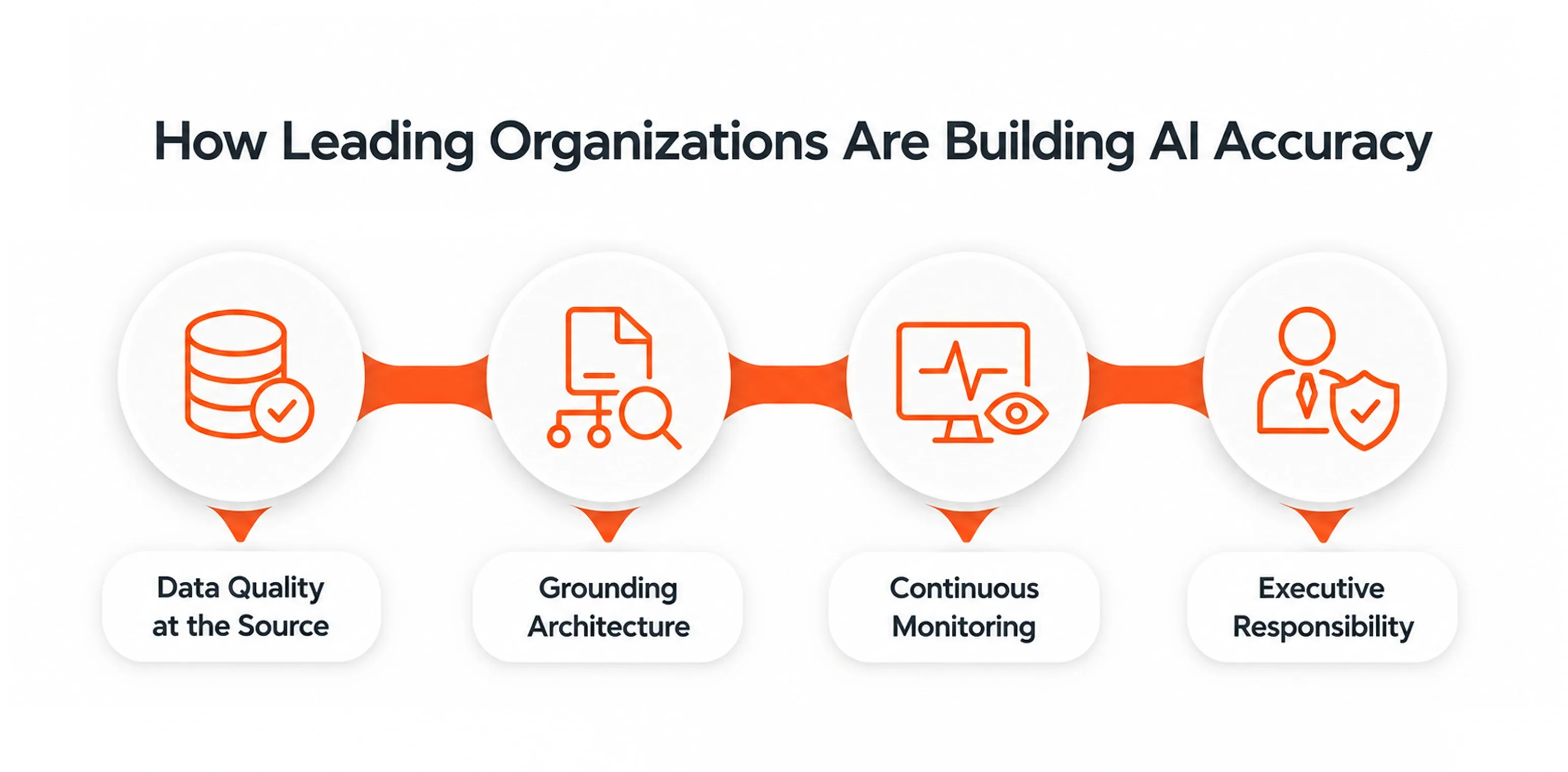
Grounding architecture
Retrieval-Augmented Generation — known as RAG — is emerging as the standard architecture for enterprise AI in 2026 because it addresses the accuracy problem at the design level. Instead of generating answers from what the model memorized during training, a RAG system retrieves verified and current information from the organization's own data before generating a response. Retrieval quality alone accounts for approximately 70 percent of final answer quality in RAG systems. Improving what the model retrieves produces more accurate outputs than improving the model itself.
RAG now powers an estimated 60 percent of production AI applications in enterprise environments — from customer support to internal knowledge bases — because it makes accuracy a design property rather than a hope. When an output is wrong, the organization can trace it back to the retrieved source and correct the problem at the root.
Continuous monitoring
AI-specific governance roles grew 17 percent in 2025 as organizations recognized that accuracy requires ongoing measurement rather than one-time validation at deployment. Models drift. Data changes. The accuracy that existed at go live degrades silently without monitoring systems designed to detect it before the degradation affects business decisions.
AI accuracy is a board level concern because the decisions being made on the basis of AI outputs are board level decisions.
When AI generated financial analysis influences an acquisition, when AI summarized regulatory guidance shapes a compliance strategy, when AI produced market intelligence informs a product roadmap — the accuracy of those outputs is not a technology question. It is a business risk question that belongs in the same conversation as financial controls, legal exposure, and reputational risk.
The average employee using AI tools spends approximately 4.3 hours per week verifying AI generated outputs. At enterprise scale, that verification burden represents a significant ongoing operational cost — one that shrinks dramatically when accuracy is built into the system architecture rather than outsourced to the people reading the outputs.
The organizations getting ahead of this problem are asking different questions before they deploy. Not just what this model can do — but what happens when it is wrong. Not just how fast they can deploy — but whether the data quality and grounding architecture they have can support the accuracy the use case actually requires.
Those questions change the deployment decision entirely. And the organizations asking them are building AI systems that produce outputs the business can rely on rather than outputs that require constant human verification to catch the errors that should not have been produced in the first place.
Build AI systems with accuracy, grounding, and data quality built in from the start. Free consultation with our experts to build AI agents. Talk to Complere Infosystem today.


Listen in for business strategies and interviews with business experts to help you build a business and a life that you love.
About Us