Data leadership in 2026 demands more than technical expertise. Discover actionable tips for CDOs and data executives to lead with clarity, build trust, and drive measurable impact.
A CDO at a mid-sized insurance company spent two years building one of the most sophisticated data platforms her industry had seen. Clean architecture. Governed pipelines. Real-time dashboards. When the CEO restructured the leadership team, her role was eliminated. The reason? The board didn't understand what her function had delivered for the business.
The platform was exceptional. The data leadership was invisible.
In 2026, this is the defining risk for data leaders. Technical credibility is no longer sufficient. The executives driving real impact are those who lead the business through data, not just lead the data function.
Anchor Every Data Initiative to a Business Decision
The most damaging habit in data leadership is building capability in search of a use case. Data lakes, governance frameworks, and machine learning models that exist because they are best practice rather than because they serve a specific business decision are expensive infrastructure with uncertain return.
Effective data leadership begins by identifying which decisions the organization makes poorly, slowly, or inconsistently and targeting those first. That framing changes everything. It shifts data from a cost center narrative to a decision acceleration narrative, which is a language every CEO and CFO immediately understands.
What leaders must do: For every active data initiative, identify the specific business decision it is designed to improve. If no decision can be named, the initiative needs reframing before it needs more resources.
Translate Data Fluency Into Business Language
The gap between technical leadership and adaptive leadership is most visible in how data leaders communicate. Technical leadership relies on precision - model performance, pipeline latency, schema design. Adaptive leadership reads the room and translates that precision into terms the audience can act on.
A VP of Data presenting churn model accuracy at 89% to a commercial leadership team is providing information. A data leader presenting that the same model identified 340 at-risk accounts worth $4.2M in annual revenue, and here is the recommended intervention, is driving action.
The difference is not the data. It is the framing. In 2026, data leaders who cannot make this translation consistently will find their function respected but never truly influential.
What leaders must do: Before every executive or cross-functional presentation, rewrite your key findings in terms of revenue, cost, risk, or time. Remove all technical qualifiers that do not change the business conclusion.
Build Trust Before Building Capability
One of the most overlooked tensions in technical leadership vs adaptive leadership is the sequencing of trust and capability. Many data leaders invest heavily in building platforms before building organizational confidence in the data those platforms produce.
When business leaders do not trust the numbers, they do not use the platform regardless of how well it is built. A healthcare organization deployed a $1.8M analytics environment and saw clinical leadership continue pulling data manually from source systems. The reason was a single high-profile incident six months earlier where the dashboard showed incorrect patient volumes. The platform was fixed within days. The trust took eighteen months to rebuild.
What leaders must do: Identify the three reports or metrics your most skeptical business stakeholders rely on most. Make those the highest priority for data quality, consistency, and explainability. Win trust where it matters most before expanding scope.
Develop Data Literacy Across the Organization
Effective data leadership does not end at the boundary of the data function. The impact ceiling of any data program is determined by the analytical capability of the business leaders consuming its output. A sophisticated analytics capability serving a leadership team with low data literacy produces underutilized insight and frustrated data teams.
The most impactful data leaders in 2026 treat organizational data literacy as part of their mandate. Not training programs for the sake of training but targeted capability building that helps specific business leaders make specific decisions better.
What leaders must do: Identify two or three business functions where improved data literacy would have the most immediate commercial impact. Design focused, outcome-oriented capability building for those functions first.
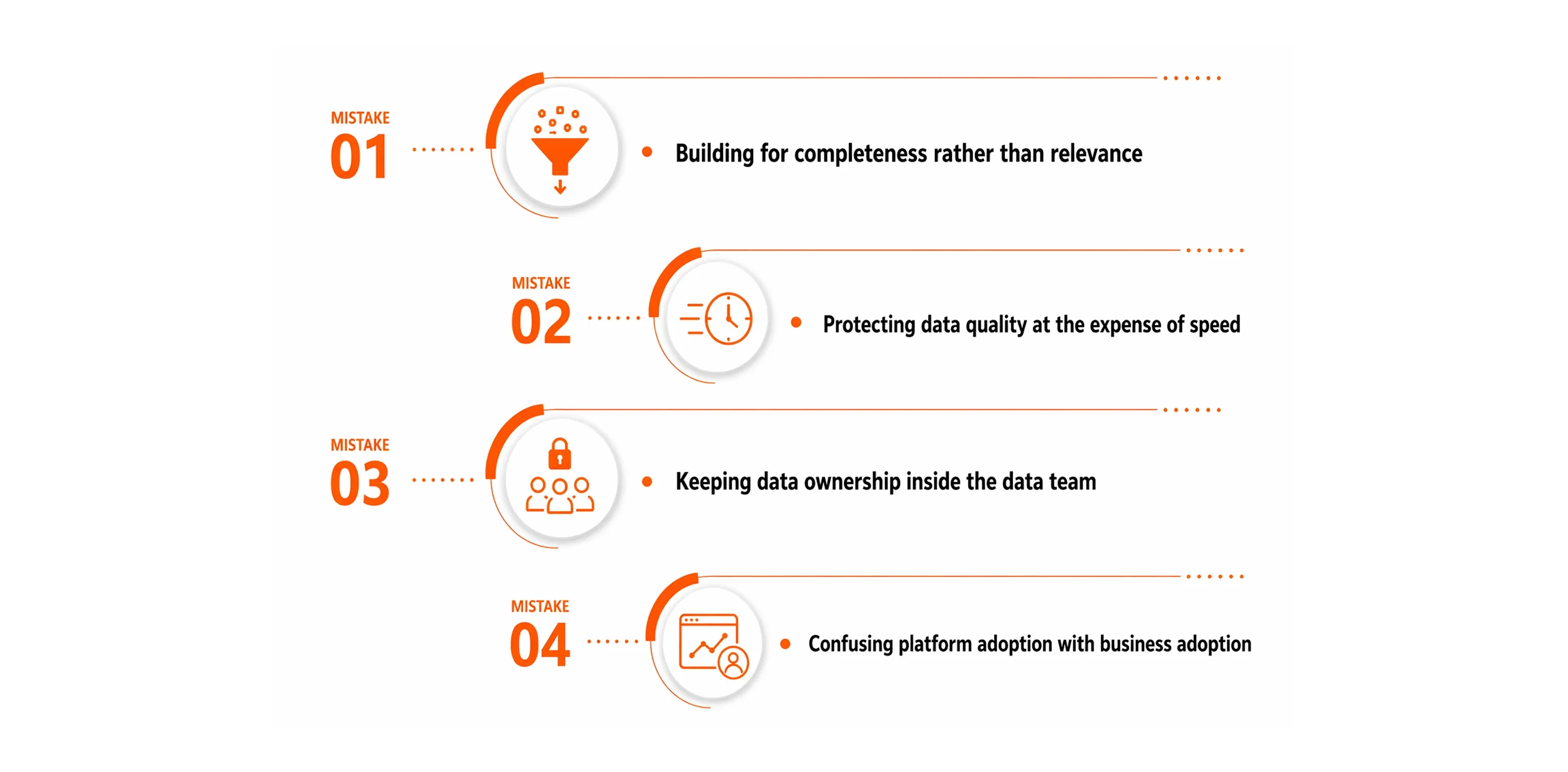
The Mistakes That Quietly Limit Data Leadership Impact
Even strong data leaders hit ceilings they do not recognize until damage is done.
Building for completeness rather than relevance — Comprehensive data coverage that answers every possible question often answers none of the urgent ones well.
Protecting data quality at the expense of speed — Perfect data delivered too late to influence a decision is functionally useless. Leaders must balance both.
Keeping data ownership inside the data team — When business units do not own their data domains, they do not trust or champion the outputs.
Confusing platform adoption with business adoption — Login metrics measure curiosity. Decision change measures impact.
Conclusion
For CDOs and data executives: data leadership in 2026 is measured by one thing. Whether the organization makes better decisions because of what your function builds and enables. Not the sophistication of the architecture. Not the breadth of the data catalog. The quality and speed of decisions made by the people your function serves.
The shift from technical leadership to adaptive leadership is not a softening of rigor. It is an expansion of accountability. Own the business outcome, not just the data outcome. That is where lasting impact is built.
The Executive Outlook is brought to you by Complere — a data engineering & AI consulting firm helping enterprises turn data into decisions. Want to reach data and analytics leaders? Partner with us.