CIO and CTO Digital Transformation Culture Gap
- Jun 22, 2026
- Isha Taneja
The biggest CIO and CTO digital transformation failure is never the technology. Discover five ways both roles must lead the human side of transformation in 2026.

The biggest CIO and CTO digital transformation failure is never the technology. Discover five ways both roles must lead the human side of transformation in 2026.

An enterprise software company completed a technically flawless digital transformation. The systems worked. The architecture was solid. The migration finished on time and on budget.
Three months after go live seventy percent of the workforce had quietly returned to their previous tools and processes. Not because the new system was broken. Because nobody had addressed the fear, confusion, and resistance that built up while the technology was being built.
The CIO and CTO digital transformation programme had delivered every technical milestone. It had not delivered a single behavioural change. The investment was significant. The return was invisible.
In 2026 this is the most common and most expensive transformation failure mode organisations face. The technology works. The people do not follow.
Employees do not read steering committee minutes. They do not attend architecture reviews. But they know within weeks whether the CIO and CTO are genuinely working toward the same outcome. They see it in the contradictory messages from both leaders. They hear it in the different answers to the same questions asked in different forums. They feel it in the hesitation when they ask which system they should be using and nobody gives a confident answer.
CIO credibility is built or destroyed in these small moments of organisational perception. When employees sense misalignment they do not lean into the transformation. They wait. And the longer they wait the harder adoption becomes.
Tips to address and resolve: Run a pulse survey with a representative sample of your workforce four weeks into any transformation programme. Ask one question. Do you feel confident about what this transformation will mean for your role and how you will work? A confidence score below sixty percent is a signal that your communication has gaps that will compound into adoption failure if not addressed immediately.
The most consistent structural gap in CIO and CTO digital transformation programmes is change management ownership. The CIO sees it as a technology adoption problem. The CTO sees it as a business process problem. Both are partly right. Neither assigns it clearly to themselves. And the result is a change management programme that is either underfunded, under-resourced, or managed by a third party with no decision authority.
Change management in digital transformation is not a communications exercise. It is the programme workstream responsible for ensuring that every behaviour the organisation needs to change actually changes. When neither the CIO nor the CTO owns it with genuine accountability it becomes the gap through which transformation value disappears.
Tips to address and resolve: In your next programme governance structure assign explicit change management accountability to one role with the active support of the other. The CIO typically owns it most effectively because behaviour change connects directly to business outcome delivery. The CTO provides the technical readiness input. But one role must be singularly accountable with budget, resources, and board reporting responsibility for change adoption. CIO di programmes with dedicated change management ownership under one executive consistently achieve higher adoption rates than those that split or share the responsibility.
The most expensive mistake is deploying new technology into an organisation that does not understand why it is changing. The system goes live. The training is completed. And the organisation resists not because the training was inadequate but because nobody explained the why before they explained the how.
Transformation literacy is the organisational understanding of three things. Why the business needs to change. What the change will enable that the current state does not. And what the role of each individual is in making the change succeed. Neither the CIO nor the CTO can delegate this communication. It must come from both and it must begin at least six months before go live.
Tips to address and resolve: Build a joint CIO and CTO communication programme that runs in parallel with your technical build. Not a project newsletter. A structured narrative that explains the transformation story in language relevant to each business function. Digital transformation 2026 organisations that invest in transformation literacy before technology deployment consistently achieve faster adoption, fewer support escalations after go live, and higher long term utilisation of the systems both roles invested significant effort in building.
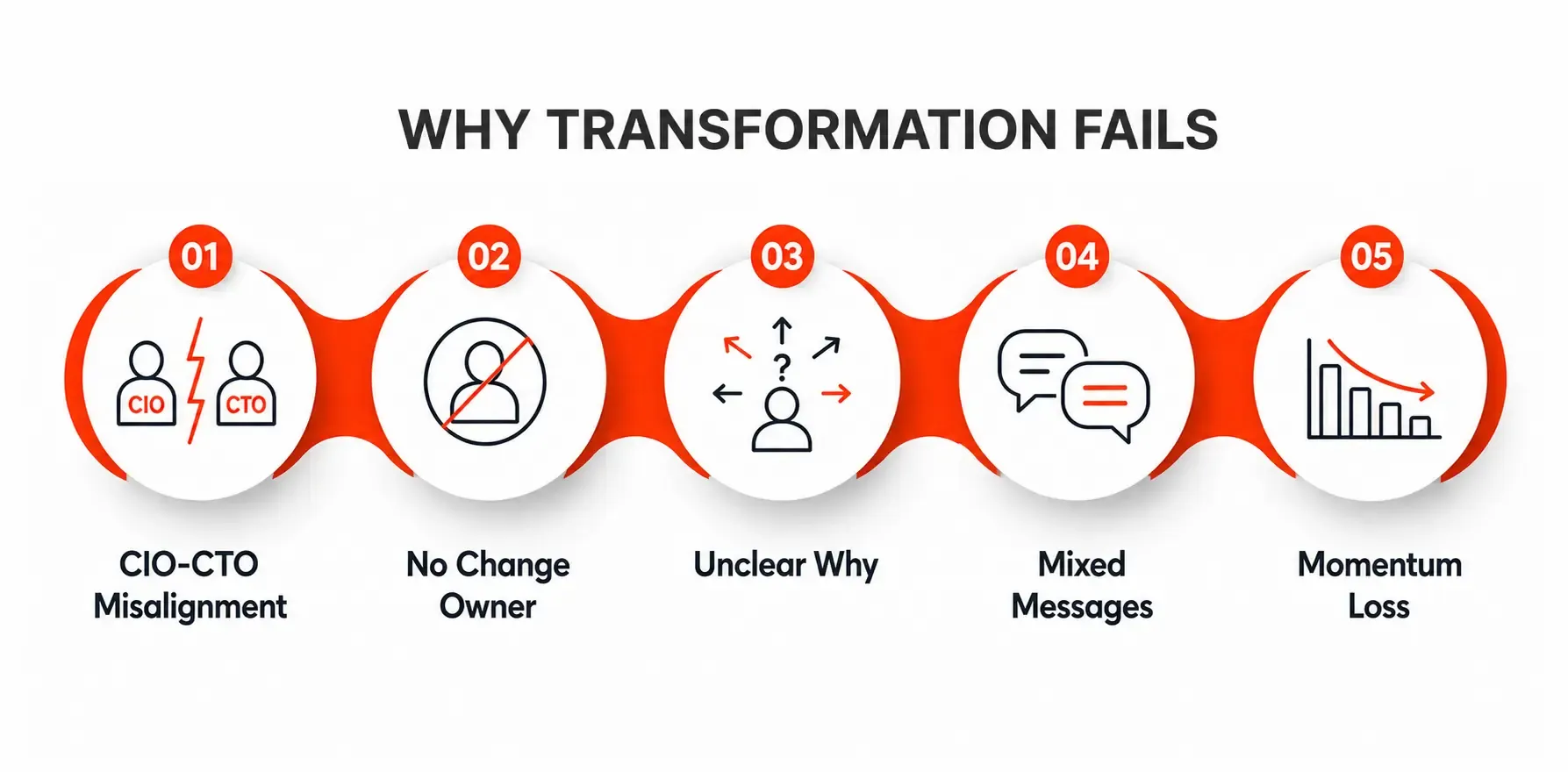
CIO and CTO digital transformation communication fails in one specific and consistent way. Both roles speak to the same audiences about the same programme in completely different languages. The CIO speaks in business outcomes. The CMO hears a customer experience vision. The CTO speaks in technical architecture. The operations director hears a systems integration project. Both are talking about the same programme. Neither audience believes they are.
The result is a transformation programme that different parts of the organisation understand differently. Different expectations. Different timelines. Different definitions of what done looks like. And a go live event where every business unit is surprised by something the programme team believed had been clearly communicated.
Tips to address and resolve: Before any major transformation communication produce a single message document that both the CIO and CTO review and approve. Not a press release. A translation guide. What this transformation means for finance. What it means for operations. What it means for customer service. What it means for the front line. Digital transformation 2026 programmes with a joint communication approval process between CIO and CTO consistently reduce post-go live confusion and accelerate time to full adoption across every business function.
Every transformation programme has a dangerous period. It begins around month six and ends around month eighteen. The initial energy has faded. The go live is not yet in sight. The workforce has transformation fatigue. And the business is starting to wonder whether the investment will actually deliver.
This is the period where most transformations quietly fail not with a dramatic cancellation but with a gradual drift back to old behaviours. The programme continues. The milestones are reported as green. And the business outcome that was supposed to justify the investment is silently descoped to make the timeline work.
Tips to address and resolve: Schedule a joint CIO and CTO programme health intervention at the nine month mark of every transformation programme regardless of whether the status is green. Bring three questions to that session. Are people still behaving differently because of this programme or have they reverted? Is the original business outcome still the one we are building toward? And is the energy in the delivery team sufficient to sustain quality for the remaining duration? The answers to those three questions in month nine will tell you more about whether the transformation will succeed than any status report produced in the preceding months.
CIO and CTO digital transformation programmes that invest in the human side — in employee literacy, in change management ownership, in consistent communication, and in protecting the dangerous middle — produce a compounding cultural advantage that extends beyond the programme itself.
Employees who experienced a transformation that was explained honestly, communicated consistently, and supported through uncertainty are significantly more likely to embrace the next one. The cultural resistance that destroys so many transformation programmes decreases with every programme that treats people as the primary success factor rather than a secondary consideration after technology.
The enterprise software company's transformation worked perfectly from a technical perspective. It failed completely from a human one. And in 2026 the difference between those two outcomes is the only metric a CEO should care about when evaluating whether a transformation delivered.
Success is not measured in systems deployed. It is measured in behaviours changed, decisions improved, and business outcomes delivered. All three of those metrics are fundamentally human. And both roles must own them together from the first day of the programme to the last.
Partner with Complere Infosystem and let our transformation specialists help you close the culture gap that costs most programmes their return on investment.

Listen in for business strategies and interviews with business experts to help you build a business and a life that you love.
About Us