
Ready to lead real change? Discover 8 proven steps CEOs and CTOs must take to launch their digital transformation journey in 2026 and avoid the pitfalls.

A Fortune 500 retail CTO once said: "We didn't fail at transformation. We failed at starting it correctly." His company had spent $5.8M across 14 months and transformed nothing.
In 2026, the difference between organizations winning and those writing post-mortems isn't budget or technology. It's the discipline with which they launch their digital transformation journey. Starting wrong costs more than not starting at all.
Before vendors are shortlisted or pilots scoped, leadership must know where the organization actually stands — not where the board deck says it is. Audit across four dimensions: data quality, infrastructure and technical debt, process standardization, and cultural readiness.
What leaders must do: Commission an assessment that reports to the CEO, not the CTO. When technology leaders assess their own infrastructure, findings are often optimistic.
The question anchoring the entire digital transformation journey must be: "What specific, measurable outcome are we trying to achieve?" Not "become data-driven." Specific outcomes — supply chain lead time reduced by 30 days, claim processing cut from 12 days to 48 hours.
When outcome definition is vague, the digital transformation process becomes a technology procurement exercise, and the business outcome quietly disappears from the agenda.
What leaders must do: Write the success definition before writing the project brief. If leadership can't agree on measurable success, the initiative isn't ready to be funded.
One of the most underestimated digital transformation challenges is the leadership alignment gap. When the CEO prioritizes customer experience, the CFO cost efficiency, and the CTO infrastructure modernization — transformation doesn't accelerate, it fractures.
What leaders must do: Before launch, all C-suite stakeholders must align on three things: the primary business outcome, shared success metrics, and investment sequencing. Resolve disagreements before kickoff — not during.
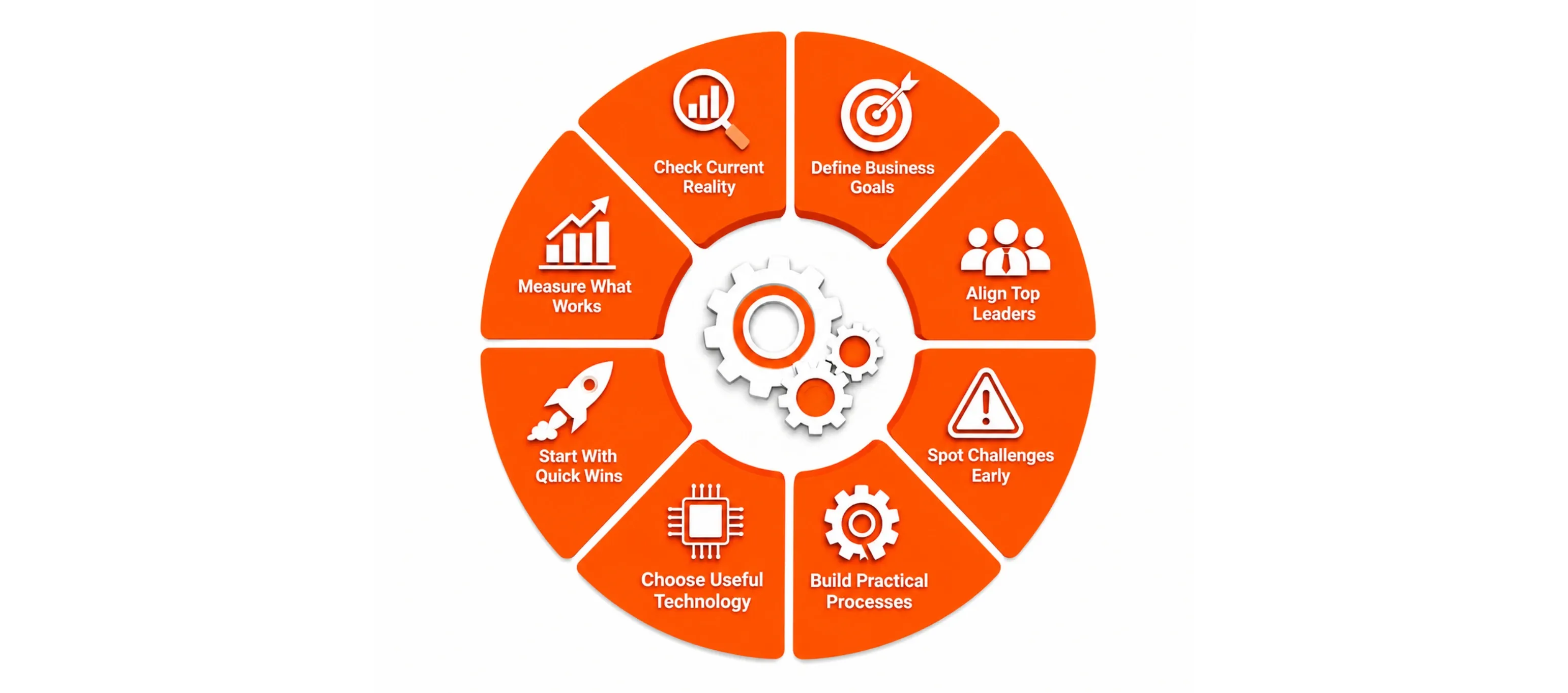
Successful leaders don't avoid digital transformation challenges — they anticipate them. Common categories include data readiness gaps, legacy integration complexity, talent shortfalls, and organizational resistance disguised as compliance concerns.
What leaders must do: Build a challenge registry before kickoff. Assign an owner to each risk. Review it monthly. This single practice separates transformation programs that finish from those that get quietly de-scoped.
The digital transformation process that looks elegant in a consulting deck frequently collapses when it meets real teams and real workflows. Processes must be designed with the people who execute them — not for them.
What leaders must do: Allocate 20–25% of the transformation budget to change management — communication, stakeholder engagement, process iteration, and adoption measurement. Not just training.
In 2026, technology selection is increasingly influenced by what peers are implementing rather than what the organization needs. The question is never "Is this impressive?" It's always "Does this solve the specific problem defined in Step 2?"
What leaders must do: Require every technology proposal to map directly to the defined business outcome. Require vendors to demonstrate on your data and your use case — not sanitized demos.
A phased digital transformation journey isn't a compromise — it's a strategic tool. The most effective roadmaps front-load value by identifying which capability delivers measurable impact within 90 days and building Phase 1 around that.
What leaders must do: Design Phase 1 to prove value, not build infrastructure. Infrastructure phases with no visible output in the first 90 days will face defunding before value ever arrives.
One of the most persistent digital transformation challenges is leaders refusing to declare something isn't working. Outcome metrics — revenue influenced, costs reduced, decisions accelerated — must be defined before launch. Not features deployed or training completed. Those are activity metrics. They tell you the project is busy, not whether transformation is working.
What leaders must do: Run a monthly outcome review separate from project status reviews. One tracks what's happening. The other asks whether transformation is delivering. Most organizations only run the first.
These steps form a dependency chain — the integrity of each protects the investment in every step that follows.
Skipping Step 1 makes Step 2 a guess. Weak Step 3 alignment fuels resistance in Step 5.
Poor Step 6 decisions make Step 7 execution unpredictable and expensive.
Sequential execution consistently outperforms running steps in parallel or out of order.
Winning leaders in 2026 prioritize disciplined sequencing over speed.
For CEOs: Transformation is a business program that happens to involve technology. Your job is to maintain outcome clarity and executive alignment — not just approve budgets.
For CTOs: Your credibility in 2026 is built on whether technology delivers business outcomes, not architectural sophistication. Recommending a simpler solution that delivers beats a complex one that impresses.
The digital transformation journey that succeeds in 2026 belongs to leaders who are honest about where they start, disciplined about what they measure, and decisive enough to course-correct. That's a leadership capability — not a technology one.
Ready to launch your digital transformation the right way? Book a free call with Complere Infosystem.


Listen in for business strategies and interviews with business experts to help you build a business and a life that you love.
About Us