Last quarter a global manufacturing group quietly shelved a culture programme that had been running for two years. The launch had been impressive. A new values framework, leadership workshops in every region, internal campaigns, and a dedicated transformation office. Two years and several million dollars later employee surveys looked almost identical to where they began. Senior leadership stopped mentioning the programme in town halls.
Sound familiar? It should. Research from McKinsey has consistently shown that around 70 percent of large scale change programmes fail to achieve their stated goals, and culture initiatives are among the most fragile of all. Not because the intent was wrong. But because the most damaging culture transformation challenges are rarely the ones the programme charter actually addresses.
In 2026 the organisations getting culture transformation right are not those with the biggest change budgets. They are those who understand why most programmes quietly die and address those mistakes before the damage compounds.
Mistake 1: Most Programmes Treat Symptoms, Not Systems
The first mistake leaders make is misdiagnosis. Leaders see disengagement, slow execution, or innovation drought and respond with values workshops, engagement campaigns, or new rituals. The symptoms are real. The interventions rarely touch the systems generating them.
A financial services firm spent eighteen months rolling out a "speak up" campaign to address declining innovation. Adoption was high. Behaviour did not change. The actual blocker was a promotion system that quietly rewarded political navigation over honest dissent. The campaign treated the symptom. The system kept producing the same culture.
Tips to address and resolve: Before approving any culture transformation budget require the sponsoring leader to map the systems generating the current behaviour. Promotions, performance reviews, escalation paths, meeting norms. If the systems do not change the transformation culture you are building will not survive contact with daily operations.
Mistake 2: Sponsorship Without Behaviour Change Is Theatre
The second most consistent mistake is leadership sponsorship that ends at the kick off email. Sponsors who fund the programme but do not change their own behaviour send a louder signal than any workshop curriculum. Teams read the signal correctly. The culture leadership is asking for is not the culture leadership is willing to model.
This pattern appears in almost every stalled programme.
Tips to address and resolve: Make sponsor behaviour change the first deliverable of the programme, not the last. Define three observable behaviours each executive sponsor will change in the first ninety days. Make those behaviours visible to the organisation. A practical culture transformation framework treats leadership modelling as the precondition for everything else, not an afterthought.
Mistake 3: Programmes Skip the Middle Management Layer
The third mistake that stalls transformation culture initiatives is the missing middle. Executive sponsors design the programme. Front line teams are the audience. The layer in between, where most cultural reality actually lives, is treated as a delivery channel rather than a critical participant.
Middle managers translate every strategic intent into daily behaviour. This is particularly visible in technology organisations where engineering directors and IT leads sit between digital transformation mandates and the teams expected to deliver them. When they are not engaged early, not equipped to lead the conversations, and not measured on the new behaviours, the programme dies in their teams quietly and predictably.
Tips to address and resolve: Build middle management engagement into the first phase of any culture transformation roadmap, not the rollout phase. Equip them with practical scripts for the conversations they will need to lead. Measure them on cultural indicators alongside operational ones. Without genuine middle layer ownership the programme cannot survive contact with daily operations.
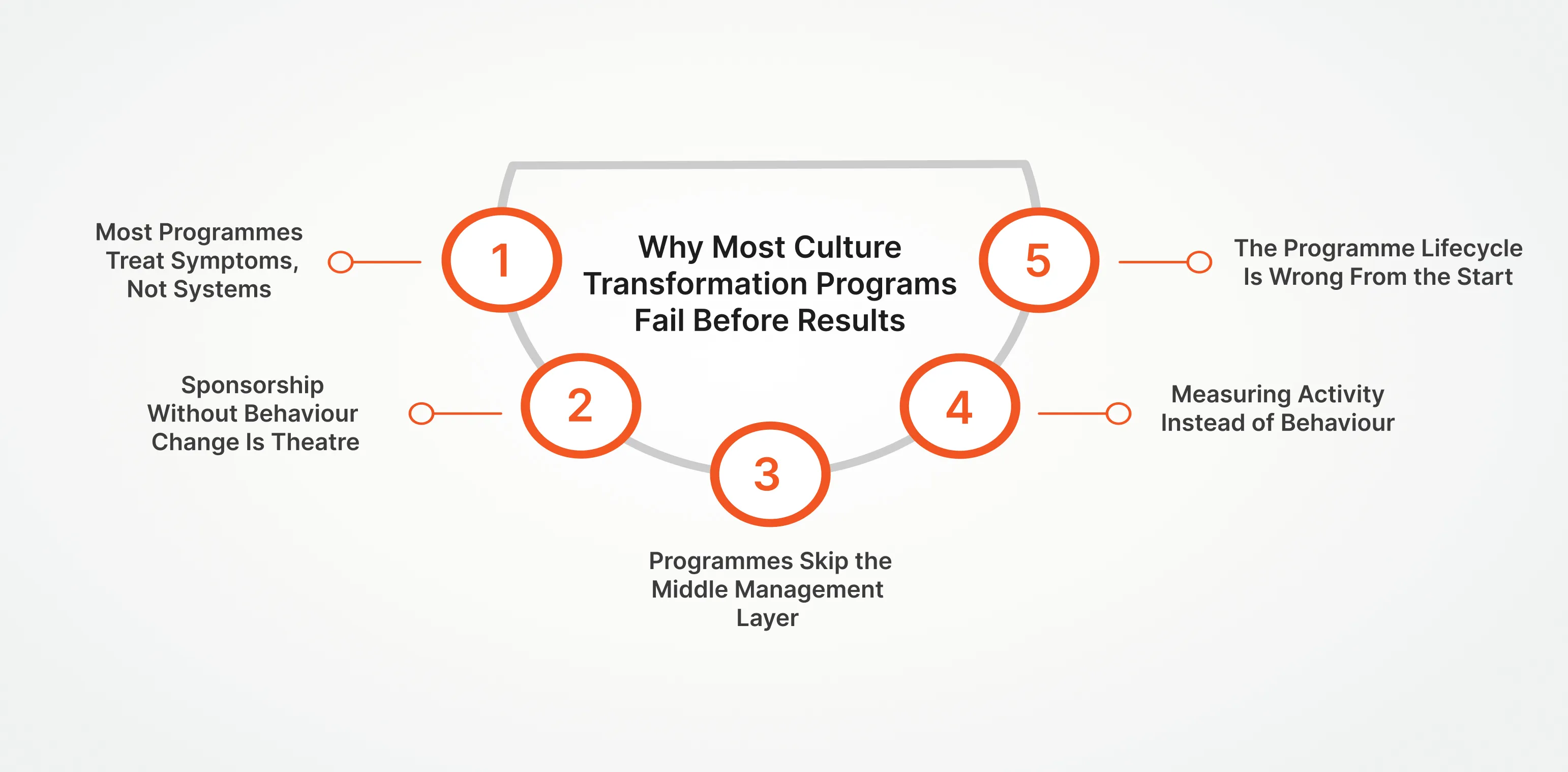
Mistake 4: Measuring Activity Instead of Behaviour
The entrepreneurial temptation in culture work is to measure what is easy. Workshop attendance, survey participation, communications reach. These numbers look healthy in steering committee decks and reveal almost nothing about whether the culture has actually shifted.
Programmes that report on activity rather than behaviour create a false sense of progress that delays the honest conversations leadership needs to have.
Tips to address and resolve: Define behavioural indicators before the programme launches. Decision speed at the team level. Frequency of honest disagreement in leadership meetings. Voluntary attrition patterns among strong performers. Internal mobility rates. Intentional culture transformation requires measuring whether behaviour is actually changing, not whether the programme is being consumed.
Mistake 5: The Programme Lifecycle Is Wrong From the Start
The most overlooked mistake in culture transformation is structural. Programmes are designed with start dates, milestones, and end dates. Culture does not work that way. A programme with an end date signals to the organisation that the change is temporary and survival is possible by waiting it out.
Culture is not a project. It is the cumulative weight of every leadership decision the organisation watches over time. A programme architecture that pretends otherwise is designed to fail before launch.
Tips to address and resolve: Reframe culture transformation as an operating discipline, not a programme. Build the new behaviours into permanent systems such as performance reviews, promotion criteria, and onboarding. The visible programme can have a launch and a closing ceremony. The underlying work continues indefinitely because changing the culture is never finished.
Why These Mistakes Compound
These five culture transformation challenges do not appear in isolation. Programmes that treat symptoms tend to be sponsored by leaders unwilling to change their own behaviour. Initiatives that skip the middle also measure activity rather than outcomes. And programmes designed with end dates almost always create the conditions for the next failed programme three years later.
The organisations executing culture transformation effectively in 2026 diagnose the system before the symptom, build sponsor behaviour change as the first deliverable, engage the middle layer as owners, and treat the work as permanent rather than a project with an exit date.
The Bottom Line
Culture transformation programmes do not fail because the intent was wrong or the budget was too small. They fail because of structural mistakes made before launch. Misdiagnosed systems, theatrical sponsorship, skipped middle layers, the wrong measurement model, and a programme lifecycle that signals temporariness to the entire organisation.
Before your next culture investment ask five questions. Are we addressing the system or the symptom? Will our sponsors actually change their own behaviour first? Have we engaged the middle layer as owners rather than recipients? Are we measuring behaviour or activity? And have we designed this as permanent work or a project with an end date?
If any answer is unclear address that first. The culture transformation built on honest diagnosis with genuine sponsor commitment and permanent systems will always deliver more than anything launched with the wrong architecture.
Ready to design a culture transformation that actually delivers? Partner with Complere Infosystem today.