How Culture Transformation Drives Business Growth
- May 27, 2026
- Isha Taneja
Culture transformation drives business growth more than strategy or technology. Discover 5 leadership lessons and practical tips to build a culture that actually delivers.

Culture transformation drives business growth more than strategy or technology. Discover 5 leadership lessons and practical tips to build a culture that actually delivers.

Two years ago, a medium-sized fintech firm rolled out an ambitious innovation programme. New labs, new tools, hackathons every quarter, and a chief innovation officer reporting directly to the CEO. Eighteen months later the patents filed had dropped, the best engineers had quietly left, and the board was asking uncomfortable questions.
The strategy was sound. The investment was real. What was missing was the culture that turns investment into outcomes.
In 2026 the organisations growing fastest are not those with the boldest strategies. They are those who treat culture transformation as the actual product of leadership, not a side effect of it.
Most leadership teams treat culture as something you decorate with. Posters in the lobby, values on the careers page, a quarterly town hall. The organisations winning at growth treat culture as the operating system every decision runs on.
A consumer goods company in Asia spent four years building a category leading R&D team. Their secret was not compensation or facilities. It was that every senior leader spent one day a month working alongside junior researchers. The signal was unmistakable. Ideas mattered more than hierarchy. Within five years their innovation pipeline tripled.
Audit the signals your leadership behaviours actually send. What gets celebrated in meetings. Who gets airtime. What gets escalated. Intentional culture transformation begins when leaders accept that culture is built by what they do repeatedly, not by what they announce occasionally.
The second most consistent driver of stalled growth is a culture where failure is quietly penalised even when leadership publicly claims to encourage experimentation. Teams read the signal in promotion decisions and project reviews. They learn quickly that the safest career move is the predictable project, not the breakthrough one.
This is one of the most underestimated culture transformation challenges facing executive teams today.
Build a clear distinction between intelligent failure and careless failure. Reward the first publicly and address the second privately. A practical culture transformation framework treats project reviews as learning artefacts, not blame sessions. When leaders share their own failures first the rest of the organisation follows.
Leaders frustrated by slow execution usually respond by adding process. Approval layers, stage gates, governance committees. The result is the opposite of what they wanted. Decisions slow further, ownership diffuses, and the best people stop bothering.
Speed in strong performing organisations comes from trust. When teams know they have decision authority within clear guardrails, they move. When every decision requires escalation, they wait.
Map your current decision bottlenecks. For each one ask whether the problem is capability or trust. If it is capability invest in development. If it is trust push the decision down one level and watch what happens. Changing the culture of how decisions get made is often the fastest path to measurable growth.
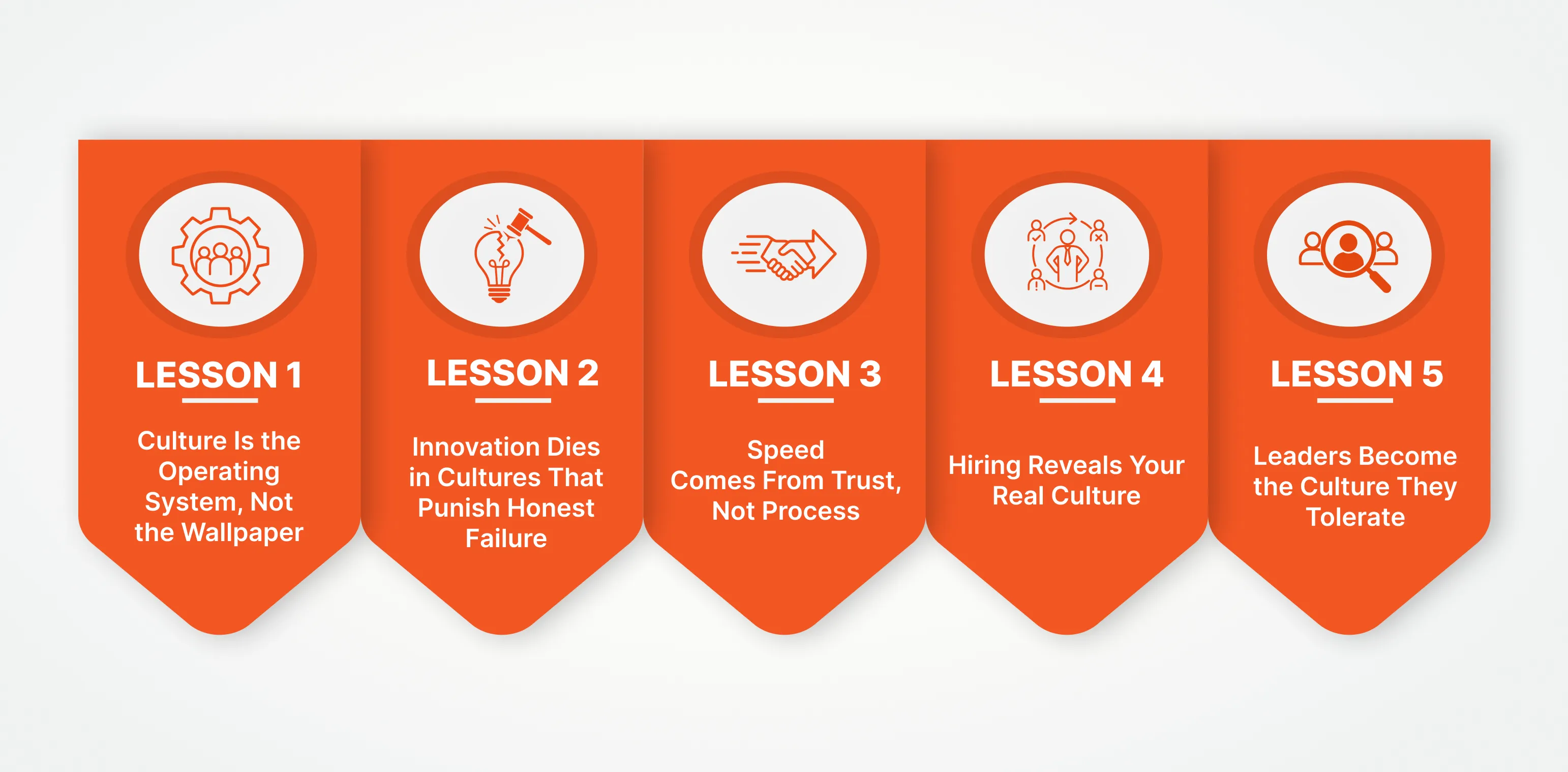
The entrepreneurial temptation when scaling is to hire fast for capacity. Every senior leader has felt the pressure of an open role and a missed quarter. But hiring is the single most powerful expression of your transformation culture. Each new hire either reinforces the culture you say you want or quietly dilutes it.
Organisations that grow without intentional hiring discipline end up with a culture they did not choose, defined by the loudest voices that joined during the scaling rush.
Define three absolute cultural attributes before opening any senior role. Build a structured interview process that tests for them. Be willing to keep a role open for an extra quarter rather than hire someone who will erode what you have built. Your culture transformation roadmap should treat hiring as a primary lever, not an HR function.
The most overlooked truth about culture transformation is personal. The behaviours a leader tolerates from their strongest performers define the actual culture far more than any written values document. When a top billing executive bullies their team and stays in role, the entire organisation learns that results outrank respect. No town hall reverses that signal.
"You cannot delegate culture. The team is always watching what you walk past," says one senior operator who turned around a struggling industrial business.
Identify the one behaviour you have been tolerating from a senior person because the numbers are good. Address it directly within 30 days. The cost of acting is high. The cost of not acting compounds across every team that watches.
Why Culture Transformation Compounds Growth
These five lessons do not operate in isolation. Leaders who treat culture as wallpaper hire fast and tolerate bad behaviour. Organisations that punish honest failure also add process to compensate for declining trust. The compounding effect is real, and it works in both directions.
The organisations executing culture transformation most effectively in 2026 treat it as a daily leadership practice. They hire for it deliberately, reward it visibly, and protect it from the strongest performers when necessary.
Business growth and innovation are not primarily strategy outputs. They are culture outputs. Strategy sets the destination. Culture determines whether the organisation has the trust, courage, and discipline to actually arrive.
Before your next strategic initiative ask five questions. What signals are our leadership behaviours actually sending? Do our people believe honest failure is safe? Are we slowing ourselves down with process when we should be building trust? Is our hiring reinforcing or diluting the culture? And what are we tolerating that we should be addressing?
If any answer is unclear, start there. Strategy executed inside a strong culture will outperform brilliant strategy executed inside a weak one every single time.
Ready to build a culture that actually drives growth? Partner with Complere Infosystem and understand how culture transformation translates into measurable business outcomes.

Listen in for business strategies and interviews with business experts to help you build a business and a life that you love.
About Us