Signs Your Organization Needs a Culture Transformation Strategy
- May 28, 2026
- Isha Taneja
Wondering if your organization needs a culture transformation? Discover 5 warning signs and practical tips that tell leaders when intentional change is overdue.

Wondering if your organization needs a culture transformation? Discover 5 warning signs and practical tips that tell leaders when intentional change is overdue.

A few months ago a healthcare technology company posted record quarterly revenue and lost three of its top engineering leaders in the same week. The numbers told one story. The exit interviews told another. By the time the CEO connected the two, six more senior people had already started conversations with recruiters. The culture had been quietly failing for eighteen months. The financial results had been masking it.
Sound familiar? It should. Strong financial performance is one of the most reliable disguises for cultural decay. Research from Gallup has consistently found that fewer than one in four employees globally are genuinely engaged at work, and most leaders do not recognise the warning signs until the cost has already compounded.
In 2026 the organisations responding earliest to these signals are not those with the deepest HR functions. They are those who understand what the warning signs actually look like and respond before the damage becomes structural.
The first and most reliable signal that your organisation needs culture transformation is the pattern of who is leaving. Not the volume. The pattern. When your high judgement, low drama performers begin departing without dramatic exits or counteroffer negotiations, the culture has already shifted in ways the executive team has not seen.
These are the people who do not complain. They diagnose, decide, and leave cleanly. By the time their resignation lands on a desk the decision was made six months earlier.
Tips to address and resolve: Run a quiet audit of your last twelve months of senior departures. Look for the pattern, not the headline reasons. If your strongest performers are leaving for roles that do not represent obvious career upgrades, your culture is the reason. Begin intentional culture transformation before the next cohort starts updating their profiles.
The second signal is decision velocity. Organisations with healthy cultures make decisions at the lowest reasonable level with the right information. Organisations with cultural problems escalate everything. The same decisions that took a week now take a month. The same approvals that needed one signature now need five.
This pattern is particularly visible in technology organisations where CTOs and CIOs notice that engineering and infrastructure decisions which used to flow now stall in committee. The slowdown is rarely a process problem. It is a trust problem dressed as governance.
Tips to address and resolve: Map five recent decisions that took longer than they should have. For each one identify whether the actual blocker was capability, information, or trust. If trust appears more than once your culture transformation framework needs to address decision authority and psychological safety before adding any further process.
The third reason organisations need to begin changing the culture is the slow disappearance of honest disagreement at the leadership level. When senior meetings become performances where everyone agrees in the room and the real conversations happen in corridors afterwards, the culture has moved into a dangerous phase.
This is one of the most underestimated culture transformation challenges because the meetings themselves look productive. Calendars are full. Decks are polished. Decisions are recorded. And almost nothing important is actually being said.
Tips to address and resolve: Track the frequency of genuine disagreement in your leadership meetings over the next four weeks. Count the number of times someone openly challenges the most senior person in the room. If the count is zero or near zero the culture is no longer safe for honest input. Address this before the next strategic decision is made on incomplete information.
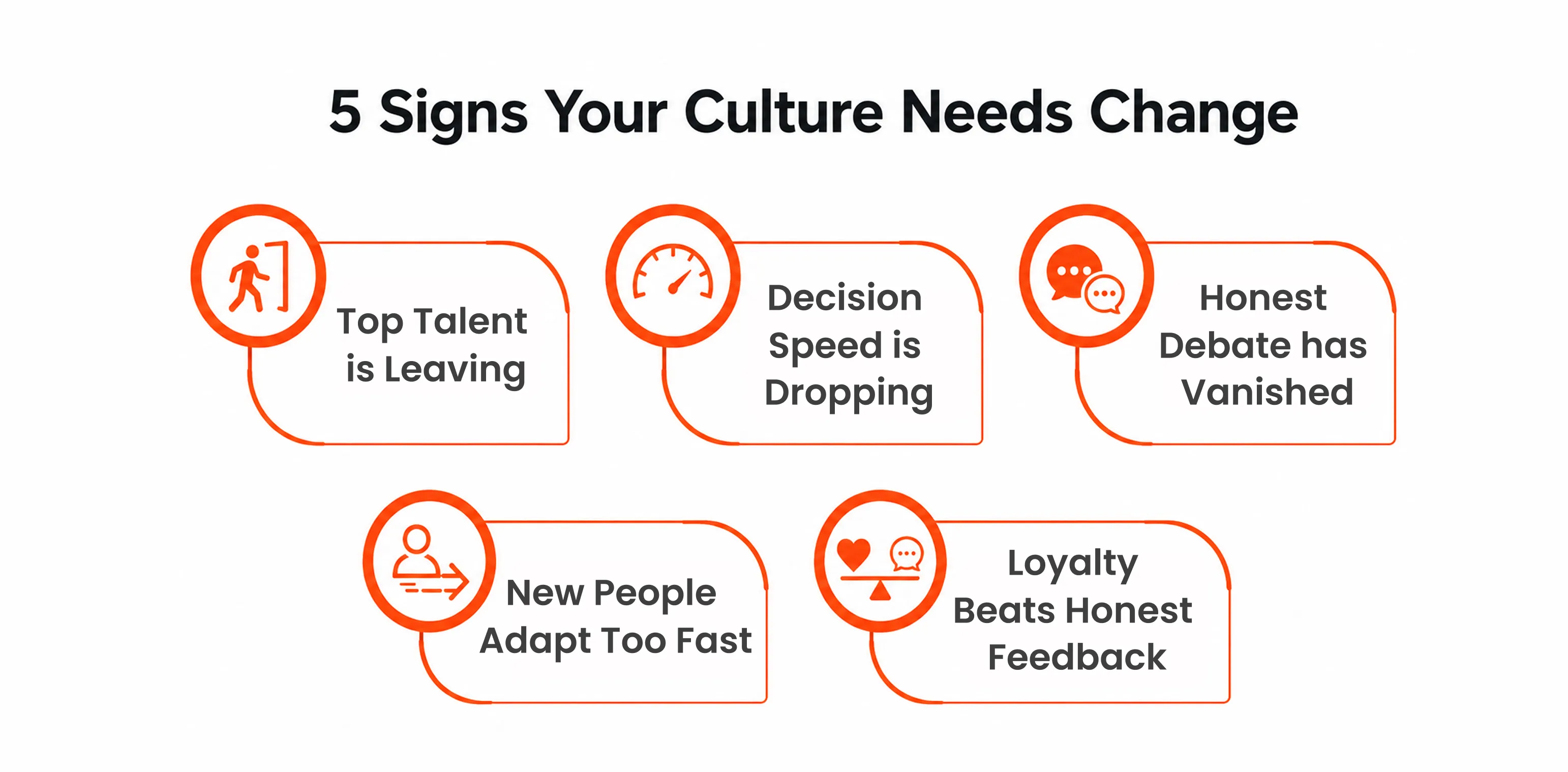
The entrepreneurial temptation when scaling is to assume that fresh talent will refresh the culture. In healthy organisations new hires bring questions, challenge assumptions, and accelerate change in their first six months. In organisations that need transformation culture work, the opposite happens. New hires arrive with energy and quickly learn to match the existing tempo. They stop asking questions. They stop challenging norms. They become indistinguishable from the people who hired them within ninety days.
When this pattern repeats across multiple cohorts, the culture is actively absorbing rather than evolving.
Tips to address and resolve: Interview five recent hires at the ninety day mark. Ask them what surprised them, what they would change, and what they have stopped saying out loud. If their answers reveal a pattern of silenced observations, your culture is no longer learning from fresh perspectives. Build new hire input mechanisms into your culture transformation roadmap as a permanent feedback loop.
The most overlooked signal that an organisation needs culture transformation is personal. The behaviours senior leaders unconsciously reward in the people closest to them define the entire organisational culture. When loyalty, tenure, or personal alignment with the leader begin to outweigh judgement, dissent, and truth telling, the organisation has crossed a line that almost always precedes serious decline.
The signal is rarely visible in formal reviews. It shows up in who gets the next promotion, who gets airtime in critical meetings, and who gets protected when results disappoint.
Tips to address and resolve: Audit your last six senior promotions honestly. Were they decided on capability and judgement, or on proximity and loyalty? If the answer is uncomfortable, begin there. Cultures shift faster through promotion decisions than through any internal campaign.
These five signals of needed culture transformation do not exist in isolation. Organisations losing their strongest people quietly are usually the same organisations where honest disagreement has already disappeared. Slowing decisions and absorbed new hires both reflect a leadership pattern that rewards loyalty over truth. Each signal accelerates the others.
The organisations responding effectively in 2026 read these signals early, treat them as diagnostic rather than cosmetic, and begin intentional culture transformation before the cost shows up in financial results.
Cultures do not collapse loudly. They erode quietly through patterns most leadership teams notice individually and rarely connect. Strong performers leaving without drama. Decisions slowing inside committees. Meetings without disagreement. New hires losing their voice. Promotions decided on loyalty rather than judgement.
Before your next strategic planning cycle ask five questions. Who has left in the last twelve months and why. How fast are decisions actually moving. When did someone last openly challenge the most senior person in a meeting. What are our new hires no longer saying. And what are we rewarding in our last six promotions.
If any answer concerns you address that first. The culture transformation built on early diagnosis at the first honest signal will always cost less than one launched after the financial results have started to follow the culture down.
Ready to read the signals and begin a culture transformation that actually delivers? Partner with Complere Infosystem tob diagnose cultural decay before it shows up in your results.

Listen in for business strategies and interviews with business experts to help you build a business and a life that you love.
About Us