
Big Data Analytics Challenges Enterprises Must Prepare in 2026
- May 28, 2026
- Isha Taneja
Big data analytics challenges are evolving fast in 2026. Discover 5 leadership lessons and practical tips to prepare your enterprise before the cost compounds.

Big data analytics challenges are evolving fast in 2026. Discover 5 leadership lessons and practical tips to prepare your enterprise before the cost compounds.

A few months ago a global pharmaceutical enterprise paused its flagship analytics programme after eighteen months of investment. The platform was operational. The data lake was populated. The dashboards were live. And the leadership team had quietly lost confidence in the numbers reaching their desks. Not because the technology was failing. Because the challenges underneath the platform had compounded faster than the team could address them.
Sound familiar? It should. Research from IDC has consistently shown that worldwide data volumes are growing at rates most enterprise architectures were never designed to handle, and the gap between what enterprises collect and what they actually use continues to widen. The most damaging big data analytics challenges in 2026 are not the headline issues. They are the structural ones that compound when leadership treats them as future problems.
In 2026 the enterprises responding best are not those with the largest analytics teams. They are those who recognize the challenges early and prepare before the next wave of complexity arrives.
The first challenge enterprises must prepare for is the gap between data growth and architecture readiness. Most enterprise data architectures were designed for the volumes of three to five years ago. The data they handle today already strains the design, and the data they will handle by 2027 will exceed it entirely.
This is not a future problem. It is a present problem most leadership teams have not fully diagnosed because the architecture is still technically functioning, just slowly and expensively.
Tips to address and resolve: Run a capacity audit against projected data volumes for the next twenty four months. Identify which workloads will exceed the current architecture and which will not. Modernise the workloads that will exceed it before they begin to fail. Prevention is significantly cheaper than emergency rearchitecture.
The second challenge is conceptual and growing in 2026. The big data analytics vs data analytics distinction used to be relatively clear. Volume, velocity, and variety defined the boundary. As traditional analytics platforms have grown more powerful and big data tools have become more accessible, the boundary has blurred. Enterprises increasingly struggle to decide which approach fits which problem.
The wrong choice in either direction is expensive. Big data architectures for simple problems waste investment. Traditional architectures for genuinely large scale problems quietly limit what the business can do.
Tips to address and resolve: Build a decision framework that maps each major analytics use case to the right approach. For every new initiative require an explicit decision on which side of the boundary the problem sits. Treat this as a strategic decision rather than a technical one, because the cost of getting it wrong compounds for years.
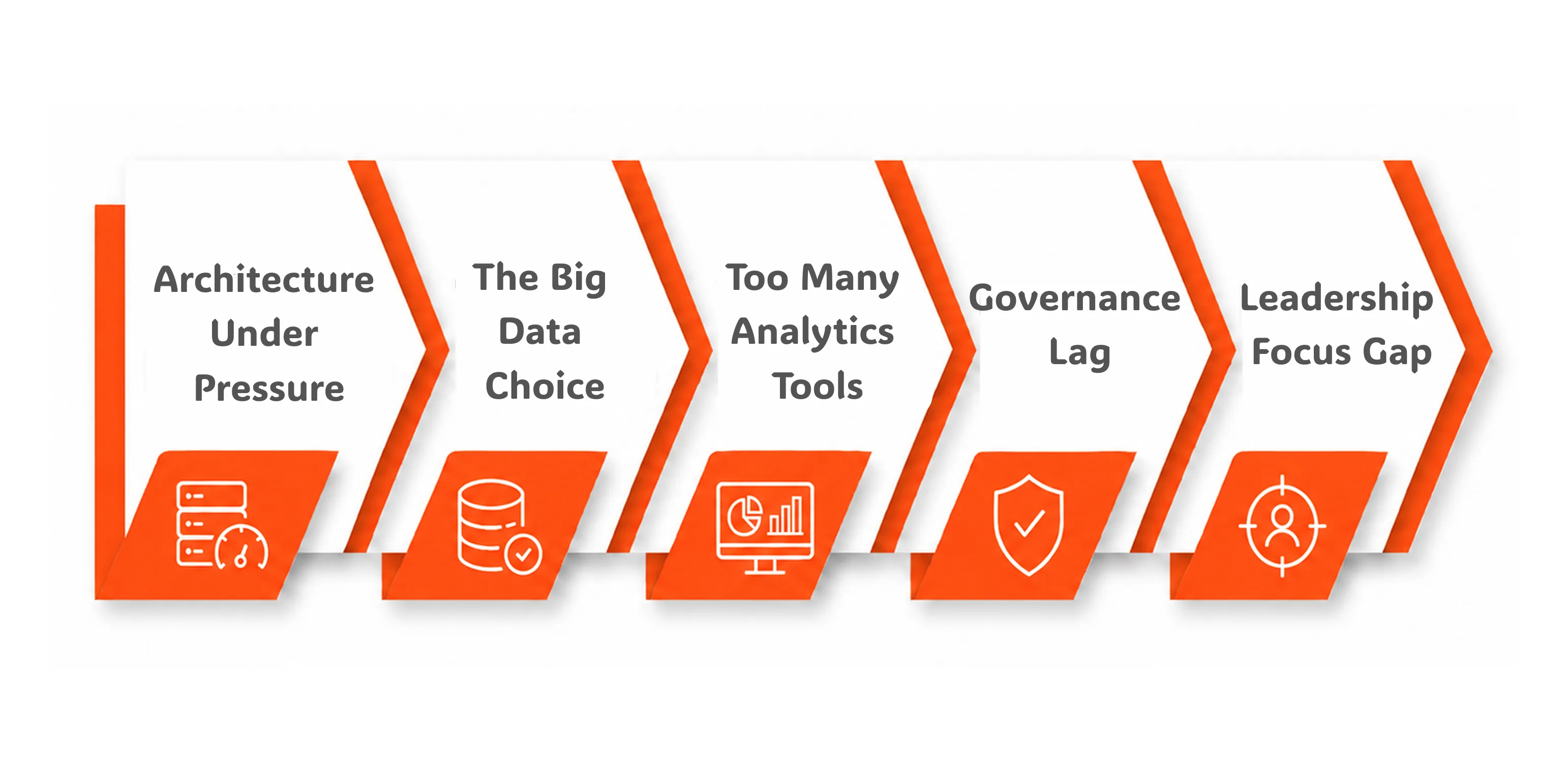
The third challenge enterprises must prepare for is tool sprawl. Big data analytics tools have multiplied dramatically. Streaming engines, machine learning platforms, vector databases, real time pipelines, semantic layers, and observability tools. Each tool solves a real problem. Together they create an integration burden that quietly slows every analytics initiative.
This pattern is particularly visible in technology organisations where CIOs and CTOs find their teams maintaining more tools than they are actually using effectively, while still onboarding new ones every quarter.
Tips to address and resolve: Audit your current tool inventory honestly. Identify which tools are genuinely critical, which are duplicative, and which were adopted without a clear use case. Consolidate where possible. Every tool removed reduces integration cost, security surface area, and operational complexity. Discipline at the tool layer is one of the highest leverage decisions in 2026.
The entrepreneurial temptation in analytics is to accelerate insight generation while assuming governance will catch up. It does not. As enterprises adopt more advanced analytics, more AI driven models, and more cross functional data sharing, the governance gap widens. Regulators, customers, and internal risk functions are all closing in from different directions.
Enterprises that treat governance as a slower lane behind analytics consistently discover that the governance gap eventually halts the analytics work entirely, often at the worst possible moment.
Tips to address and resolve: Build governance into the analytics operating model rather than running it as a parallel function. Define data ownership, access policies, and quality standards for each critical domain before scaling analytics across it. Looking at what is big data analytics with example based outcomes worth if the governance underneath cannot be defended to a regulator or a board. Sustainable analytics requires sustainable governance.
The most overlooked challenge enterprises face in 2026 is structural. Executive teams are attempting to drive AI initiatives, modernisation programmes, cost optimisation, and analytics maturity in parallel. Each programme is valid. Together they fragment leadership attention to the point where no individual programme receives the sustained focus it actually requires.
Analytics initiatives are particularly vulnerable to this fragmentation because their value compounds slowly over time and is easy to deprioritise when shorter cycle initiatives demand attention.
Tips to address and resolve: Define the two or three analytics outcomes that genuinely matter most for the next eighteen months. Assign a single accountable executive for each. Protect those outcomes from the attention pull of competing initiatives. Focus is the most underrated leadership input in enterprise analytics.
These five big data analytics challenges do not exist in isolation. Architecture strained by data volume is harder to govern. Tool sprawl makes the big data versus regular analytics decision harder to make consistently. And fragmented leadership attention quietly cancels whatever residual progress the technical teams might have delivered. Each challenge accelerates the others when ignored.
The enterprises responding effectively in 2026 modernise architecture ahead of demand, decide the big data versus regular analytics question deliberately, consolidate tools rather than expanding them, build governance into the operating model, and focus leadership attention on the few outcomes that genuinely matter.
Big data analytics challenges in 2026 are not surprises. They are the predictable consequences of scaling decisions made over the last several years catching up to enterprises that did not prepare for the next phase. Architecture under strain. A blurred boundary between big data and regular analytics. Tool proliferation outpacing integration. Governance falling behind analytical ambition. And leadership attention spread too thin.
Before your next analytics investment ask five questions. Will our architecture handle the next twenty four months of data growth. Are we making the big data versus regular analytics decision deliberately. Are we consolidating tools or accumulating them. Is our governance keeping pace with our analytics. And is leadership attention focused on the outcomes that genuinely matter.
If any answer is unclear address that first. The enterprise that prepares for predictable challenges will always outperform one that responds to them only after they have compounded.
Ready to prepare your enterprise for the big data analytics challenges of 2026? Partner with Complere Infosystem today.


Listen in for business strategies and interviews with business experts to help you build a business and a life that you love.
About Us