Accelerating data governance with change management and data fluency — reframing governance not as a burden, but as a spark for trust, adoption, and AI readiness.
Data governance has often been treated like a control system. For many organizations, it means policies, rules, ownership models, documentation, standards, compliance, and review meetings.
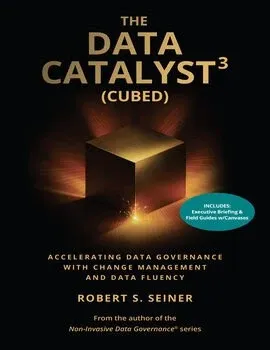
But Robert S. Seiner asks leaders to look at it differently. In The Data Catalyst³ (Cubed): Accelerating Data Governance with Change Management and Data Fluency, he presents governance not as a burden, but as a spark. A spark that can build trust. A spark that can improve adoption. A spark that can help organizations become ready for AI, analytics, and faster business change.
This book is not only about governing data. It is about helping people, teams, and leaders work with data in a more confident, responsible, and meaningful way. For executives, data leaders, transformation teams, and business decision makers, The Data Catalyst³ offers a powerful message: data governance alone is not enough, change management alone is not enough, and data fluency alone is not enough — but when all three work together, they can create real momentum.

The Data Catalyst³ is a practical guide for organizations that want to make data governance more useful, more accepted, and more connected to business value. Robert S. Seiner challenges the old idea that governance is only about control. He shows that governance can become a force that accelerates trust, adoption, and better decisions.
Today, organizations are surrounded by data platforms, dashboards, AI tools, automation systems, and digital transformation projects. But many of these efforts struggle because people do not fully trust the data, understand the data, or know how to use it correctly. That is where this book becomes important.
Seiner explains that organizations need three connected disciplines. Data governance creates accountability and trust. Change management helps people adopt new ways of working. Data fluency helps teams understand, speak, and act with data confidence. Together, these three disciplines become the catalyst. They do not slow the organization down — they help it move faster with clarity. The book gives readers practical guides, leadership actions, field tools, canvases, roadmaps, and real examples that can help organizations move from confusion to confidence.
“Governance should not feel like pain.
— The core message of the book
Governance should feel like power.
For years, many teams have seen data governance as something that creates extra work. More meetings. More approvals. More rules. More resistance. But Seiner reframes the story. He shows that governance, when done properly, is not about stopping people. It is about helping people make better decisions with trusted data.
The book explains that governance should be embedded into daily work. It should not sit outside the business as a separate program that people ignore or fear. It should become part of how people define data, use data, share data, protect data, and make decisions with data.
This is where the idea of cubed becomes powerful. The book does not say governance is the only answer. It says governance becomes stronger when it works with change management and data fluency. Governance creates structure. Change management creates adoption. Data fluency creates understanding. When these three come together, organizations can build trust faster, reduce friction, and prepare for the AI era with more confidence.
Many organizations are trying to become more data driven. They are investing in AI, building modern data platforms, creating dashboards, hiring analytics teams, and exploring automation and agentic AI. But technology alone cannot solve the real problem.
If people do not trust the data, they will not use it. If people do not understand the data, they will misuse it. If people are not guided through change, they will resist it. If governance feels heavy, people will avoid it.
Speed becomes a risk.
Speed with clarity and control.
AI may move fast. Autonomous agents may change workflows. New tools may enter the business every month. But without trusted data, clear accountability, and data-confident people, speed can become a risk. Seiner’s book gives leaders a way to stay in control while still moving forward.
One of the strongest ideas in the book is that three disciplines must work together — each a catalyst in its own right, and far more powerful in combination.
The book presents data governance as a way to build trust, not as a system of restriction. Governance helps organizations define ownership, improve data quality, create accountability, and make data easier to use across teams.
Seiner’s approach focuses on formalizing accountability without creating unnecessary disruption. This is important because many governance programs fail when they feel too forced, too technical, or too disconnected from daily work.
In this book, governance becomes practical. It becomes something people can use in their everyday roles. It becomes a way to improve decisions, not just manage compliance.
Change is one of the hardest parts of any data program. People may understand that data governance is important, but still resist it because it changes how they work. They may fear extra responsibility. They may worry about new processes. They may not see the value clearly.
The book explains that resistance should not always be seen as a problem. It can also be seen as useful energy. It shows where people are confused, uncertain, or disconnected. Through change management, organizations can turn that resistance into movement.
Seiner highlights the importance of small changes, leadership support, storytelling, and clear communication. These make governance easier to accept and easier to sustain.
Data fluency is about helping people speak the language of data. It is not only about training. It is about building confidence. A data fluent organization does not depend only on technical experts. People across the business understand what data means, how it should be used, and why trusted data matters.
This is important because data governance cannot succeed if only a small group understands it. Everyone who creates, uses, reports, or acts on data has a role to play.
The book shows that data fluency raises the baseline for the whole organization. It helps people make better decisions and participate more actively in governance.
A major strength of this book is its focus on storytelling. Seiner argues that organizations need to stop selling governance as pain. This is a very important point for leaders. Many governance programs fail not because the idea is wrong, but because the message is wrong.
If people hear “governance” and think of control, audits, restrictions, and extra work, they will naturally resist it. But if they hear “governance” and understand trust, clarity, better decisions, AI readiness, and business value, the conversation changes. The book encourages leaders to reframe governance as a catalyst — not an enforcer, not a blocker, not a burden. This shift in language can change how people respond, helping teams see governance as something that supports them instead of slowing them down.
The Data Catalyst³ is not only a concept-driven book. It also gives practical tools that organizations can use, organized into three major guides.
Helps leaders understand why the catalyst is needed, what role executives must play, and how governance, change management, and data fluency connect to business outcomes.
Moves teams from idea to action — including the integration blueprint, the momentum flywheel, the leadership accord, the 12-month roadmap, and the SPARK Test.
Practical canvases and tools: alignment checklists, governance matrices, momentum maps, shared-language glossaries, and narrative reframing tools.
These tools make the book useful for both leaders and practitioners. It does not only tell readers what should change — it helps them understand how to start.
AI has made data governance more urgent. Organizations are no longer only using data for reports and dashboards. They are using data to train models, guide automation, personalize experiences, support decisions, and power intelligent agents. This means poor data is no longer just an operational issue — it can become a business risk.
If AI systems are built on unclear, unmanaged, or poorly trusted data, the results can create confusion, bias, compliance problems, and poor decisions. The Data Catalyst³ helps leaders understand that AI readiness starts before AI implementation. It starts with governance. It starts with change adoption. It starts with data fluency.
The book makes a strong case that organizations cannot win the AI era only by buying tools. They need the internal capability to guide, govern, and grow with those tools. That is the real advantage.
This book is valuable for anyone responsible for data, transformation, governance, AI readiness, or business decision making. It is especially useful for:
For organizations struggling with resistance, silos, unclear ownership, or low data confidence, this book offers a practical way forward. It is also helpful for leaders who want to explain governance in a simpler, more business-friendly way — giving them language that connects governance with value.
At The Executive Outlook, we feature books that help leaders think better, lead better, and build stronger organizations. The Data Catalyst³ fits that vision because it speaks directly to one of the biggest challenges modern leaders face: how do we create trust in data while moving fast with AI and digital transformation?
This book does not treat data governance as a technical side topic. It connects governance with leadership, adoption, culture, fluency, trust, and acceleration. The book reminds us that transformation is not just about systems — it is about people: how teams understand data, how leaders create accountability, and how organizations build trust before chasing speed.
The Data Catalyst³ is more than a book about data governance. It is a guide for leaders who want to turn governance into movement. Robert S. Seiner shows that data governance does not have to be heavy, slow, or difficult to explain. When connected with change management and data fluency, it becomes a powerful force for trust, adoption, and growth.
Get the book, connect with the author, or dive into his Executive Outlook feature.

Listen in for business strategies and interviews with business experts to help you build a business and a life that you love.
About Us