
How modern data systems shape human experiences — revealing why technology must serve people, not machines, and why the future of AI, blockchain, and digital infrastructure depends on building systems with trust, responsibility, and purpose.
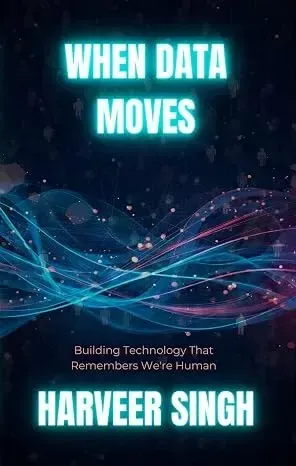
Every moment of modern life depends on data moving silently in the background.
A coffee order, a financial transaction, a medical record, a business decision, or a global payment system — behind every digital experience is an invisible network of data systems making decisions, transferring information, and creating outcomes. But as technology becomes faster and more intelligent, one important question remains: are we building systems that truly serve people?
That is where Harveer Singh begins in When Data Moves. This book challenges the technology industry to look beyond machines, platforms, and architectures and remember the purpose behind every system: improving human experiences.
This is not simply a technical book about data pipelines, AI models, or infrastructure. It is a reminder that every technical decision has real-world consequences. A small architectural choice can impact businesses, communities, and individual lives. In a world where organizations are collecting more data than ever before, the challenge is no longer only about moving information faster. The challenge is about moving data with accuracy, trust, responsibility, and human purpose.

When Data Moves is written by Harveer Singh, a globally recognized data and AI leader with 25 years of experience transforming financial institutions and building enterprise-scale technology systems. As a former Chief Data Officer and current Co-Founder and CIO at Rizz Wireless and Rizzentials.AI, he has spent his career working at the intersection of data strategy, AI, telecom, blockchain, and digital transformation.
Throughout his journey, he witnessed how invisible data infrastructure powers everyday life — from financial transactions to critical services. His experience led him to a bigger question: how can technology evolve while staying connected to humanity?
When Data Moves explores this question by connecting technical excellence with responsibility. It shows that engineers, architects, and executives are not simply creating systems — they are designing the infrastructure that shapes society.
“Data is not valuable because machines can process it.
— The core message of the book
It is valuable because it helps humans make better decisions.
Many organizations view data as a technical asset. They focus on storage capacity, processing speed, analytics platforms, and AI capabilities. But Harveer Singh presents a deeper perspective: data is not valuable because machines can process it. Data is valuable because it helps humans make better decisions and experience better outcomes.
A financial system is not successful only because transactions process quickly — it is successful because people can access money when they need it. A healthcare system is not successful only because information is stored efficiently — it is successful because the right information reaches the right person at the right moment. A business platform is not successful only because it generates reports — it is successful because those insights help people take meaningful action.
The book encourages leaders to think beyond technology performance and focus on human impact.
Artificial intelligence has changed how organizations think about data. Companies are investing in AI models, automation, analytics platforms, and intelligent systems. But AI is only as powerful as the data behind it.
Poor data, disconnected systems, and a lack of trust.
Reliable data, connected systems, and responsible AI.
This is why When Data Moves is especially relevant today. The future of AI will not only depend on advanced algorithms. It will depend on whether organizations can build reliable, responsible, and human-centered data foundations.
The answers to these questions will define the next generation of digital transformation.
One of the strongest ideas in the book is that technical decisions are never only technical. A database choice, an architecture decision, or a system design can influence real lives. A simple data mistake can prevent someone from completing an important transaction. A delay in processing can affect whether a business succeeds during a critical moment. A lack of trust in information can impact decisions across an entire organization.
Behind every line of code, every database table, and every digital interaction are people depending on those systems. For Harveer Singh, technology leaders must see themselves differently: they are not just building software, they are creating the infrastructure that supports modern society.
Modern businesses often focus on adopting the latest technologies — AI, blockchain, cloud, automation. But he argues that technology alone does not create transformation. Transformation happens when organizations combine Data + Strategy + Trust + Human Purpose.
Data must move efficiently. Systems must communicate effectively. Organizations must understand why they are building technology in the first place. This mindset extends beyond enterprise systems into his current work with Rizz Network, where he explores the future of interconnected digital ecosystems combining telecom, AI, blockchain, and rewards.
The vision is not just better technology. It is a more connected digital economy where networks create value for the people who participate in them.
When Data Moves is valuable for anyone who wants to understand how technology shapes modern life. It is especially useful for:
This is not only a book for data professionals. It is a book for anyone who wants to understand the invisible systems that power our connected world.
At The Executive Outlook, we feature books that help leaders understand the future of technology, business, and transformation. When Data Moves represents an important conversation for modern executives because organizations today are surrounded by technology, but they still need something more: trusted data, responsible AI, human-centered systems, better digital foundations, and technology with purpose.
Harveer Singh reminds leaders that behind every data system is a human experience waiting to be improved.
When Data Moves is a powerful reminder that technology is not only about systems, platforms, and algorithms. It is about people. The future will belong to organizations that do not just move data faster, but move it with purpose, responsibility, and trust.
Get the book or connect with the author to explore human-centered data and AI.


Listen in for business strategies and interviews with business experts to help you build a business and a life that you love.
About Us