
Developing your data leadership superpowers — a practical reset for data leaders who are tired of defending the importance of data and want to start proving its value with measurable results.
For years, organizations have been told the same thing. Build better platforms. Create stronger governance. Hire more data talent. Invest in modern tools. Follow proven best practices.
And yet, many data programs still struggle to prove their real business impact. Dashboards are built, but not always trusted. Data platforms are launched, but not always adopted. Governance frameworks are designed, but not always followed. Data teams work hard, but business teams still ask the same question: what value did this actually create?
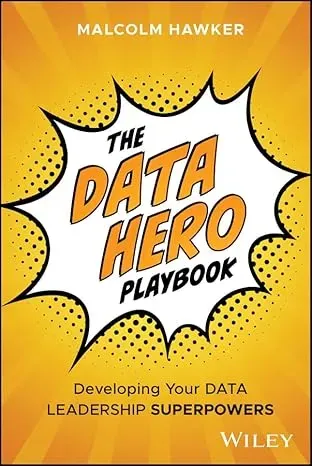
This is the uncomfortable gap Malcolm Hawker addresses in The Data Hero Playbook: Developing Your Data Leadership Superpowers. The book is not written as another technical manual for data teams. It is written as a practical reset for data leaders who are tired of defending the importance of data and want to start proving its value with measurable results. At its heart, the book challenges one of the biggest assumptions in modern data work: the problem is not always the technology. Sometimes, the real problem is mindset.

The Data Hero Playbook is a leadership-focused guide for data professionals, business executives, founders, managers, and transformation leaders who want to make data work more directly connected to business outcomes. Malcolm Hawker brings years of experience in data strategy, master data management, governance, and enterprise analytics into a book that speaks honestly about what has not worked in the data world.
For decades, many organizations have followed familiar data management patterns — larger systems, longer roadmaps, bigger transformation decks, and more complex operating models. But complexity did not always lead to value. In many cases, data teams became trapped in a cycle of explaining why data should matter instead of showing how data changes revenue, cost, risk, customer experience, or decision quality.
This book offers a different direction. It asks data leaders to stop thinking like internal service providers and start thinking like value creators. That shift is powerful. When data is treated only as a back-office function, it becomes something people request when they need a report. But when data is treated as a business product, it becomes something that helps customers, teams, and leaders make better decisions every day. The Data Hero Playbook is about that transformation — helping data leaders become more courageous, more customer focused, more commercially aware, and more connected to business value.
“Do not just manage data.
— The core message of the book
Create value with it.
Many data programs do not fail because the people involved are not talented. They fail because the organization is working from the wrong belief system. Some teams believe business users will naturally adopt a data product just because it exists. Some believe governance will succeed because policies were created. Some believe data quality will improve once the right tool is purchased. Some believe AI will solve problems the organization has not clearly defined. Some believe value will appear later, even if it was never measured from the beginning.
Malcolm Hawker challenges these assumptions. The book encourages data leaders to move away from passive thinking and toward ownership. Instead of saying, “The business does not understand data,” the modern data leader asks, “Have we made data useful enough for the business?” Instead of saying, “People do not use the dashboard,” they ask, “Did we build something that truly supports a decision?” Instead of saying, “Governance is hard to sell,” they ask, “Have we connected governance to something the business already cares about?”
This is where the idea of the “data hero” becomes meaningful. A data hero is not someone who knows every tool. A data hero is someone who takes responsibility for turning data into measurable business value.
Stop thinking like an internal service desk that delivers reports on request. Start thinking like a value creator who builds data products that help customers, teams, and leaders make better decisions every day.
Instead of “the business does not understand data,” ask “have we made data useful enough for the business?” The modern data leader takes responsibility for turning data into measurable value.
Projects completed, reports delivered, and platform milestones are not the same as business impact. A data hero asks whether the work actually changed a decision or improved performance.
Organizations are now under pressure to use AI, automation, analytics, and data products faster than ever. Leaders want speed. Teams want clarity. Customers want better experiences. Boards want return on investment.
But speed without trusted data creates risk. AI cannot fix poor data foundations. Analytics cannot create value if no one acts on the insight. Governance cannot succeed if people see it as control instead of enablement. Data platforms cannot prove impact if their outcomes are not connected to business performance.
Data stays a promise.
Data becomes proof.
Data leadership today requires more than technical knowledge. It requires commercial thinking, product thinking, communication, courage, and customer focus — the ability to connect data work with outcomes people can see, measure, and trust. The Data Hero Playbook reminds data leaders that their role is not only to manage data. Their role is to make data valuable.
One of the strongest ideas in the book is that data teams need to think more like product teams. A product team does not build only because it can — it builds because someone has a problem worth solving. The same should be true for data work. A dashboard should not exist only because the data is available. A report should not exist only because someone requested it. A governance program should not exist only because the organization wants control. A data platform should not exist only because the technology is modern.
Each effort should answer a clear business question: Who is the customer? What problem are we solving for them? What decision will this improve? What value will this create? How will we know if it worked?
This customer-centered thinking changes the entire role of a data team. It moves data from support function to strategic partner, and it forces a higher standard. If users do not trust the dashboard, that is not only a user-adoption problem — it may be a product problem. If teams avoid governance, that may be a value-communication problem. If leaders do not fund data initiatives, that may be a business-case problem. This is the kind of accountability modern data leadership needs.
For many executives, the biggest frustration with data programs is not effort — it is measurement. Data teams may be working hard, but the value is not always visible in terms the business understands. The Data Hero Playbook pushes data leaders to quantify value more clearly, connecting data work to outcomes such as:
This is where the book becomes practical for executives. It does not position data as valuable simply because everyone says it is. It encourages leaders to prove value through measurable impact — because modern organizations cannot afford data work that only looks impressive in presentations. They need data work that changes decisions, improves performance, and that the business would choose to fund again because the value is clear.
Another powerful idea in the book is that data leaders should think more like business owners. That means treating the data function with the same seriousness as a product, service, or profit center. A business owner understands customers, measures value, makes trade-offs, prioritizes what creates impact, and knows that activity is not the same as progress.
This mindset can be a major shift for data teams. Many data functions are measured by project completion, number of reports delivered, platform milestones, or governance documents created. But these are not always signs of business impact. A data team can complete many projects and still fail to change decisions. The Data Hero Playbook encourages leaders to ask a better question: are we delivering value that the organization can feel?
That question changes priorities. It moves teams away from building everything and toward building what matters most. It also helps data leaders speak the language of executives. CEOs, CFOs, and business leaders may not care about every technical detail, but they do care about growth, risk, efficiency, customer outcomes, and competitive advantage. Modern data leaders must be able to connect the two worlds.
The AI era has made this conversation even more urgent. Many organizations are rushing toward AI adoption — automation, copilots, predictive systems, personalization, and intelligent workflows. But AI does not remove the need for strong data leadership. It increases it.
AI systems depend on the quality, context, governance, and usability of data. If the data foundation is weak, AI can produce confident but unreliable outcomes. If teams do not understand the business problem, AI can automate the wrong process. If governance is missing, AI can create risk faster than value. This is why the data hero mindset matters: modern data leaders cannot simply wait for AI tools to solve old problems. They must build the foundation that makes AI useful, trusted, and aligned with business goals.
That means asking: Do we know which business problem AI is solving? Do we have the right data to support it? Can we measure the value it creates? Do business users trust the output? Are we reducing risk while improving performance? Are we creating adoption, not just experimentation? In this sense, The Data Hero Playbook is not only a book about data leadership — it is also a book about AI readiness. In the AI era, the organizations that win will not be the ones that only buy more tools. They will be the ones that turn data into trusted, measurable, customer-centered value.
The Data Hero Playbook is valuable for anyone responsible for making data more useful inside an organization. It is especially useful for:
This is not a book only for technical professionals. It is a book for leaders who want data to stop being a promise and start becoming proof.
At The Executive Outlook, we feature books that help leaders think better, lead better, and build stronger organizations. The Data Hero Playbook fits that mission because it speaks to one of the most important challenges in modern business: how do leaders turn data into real value? Most organizations already know data is important. Most already have tools, teams, and transformation plans. Most already talk about becoming data driven. But the real question is different — can they prove the value of their data work?
Malcolm Hawker’s book brings a practical and honest perspective to that question. It challenges outdated thinking, pushes data leaders toward customer-centered execution, and makes the case for a more accountable, value-driven approach to data leadership. It does not celebrate data for the sake of data — it asks leaders to make data useful, measurable, trusted, and connected to the business.
The Data Hero Playbook is a timely and practical book for the modern data era. It reminds leaders that better data outcomes do not come only from better platforms. They come from better mindsets, better ownership, better customer focus, and better measurement.
Get the book or connect with the author to develop your data leadership superpowers.


Listen in for business strategies and interviews with business experts to help you build a business and a life that you love.
About Us