How to be an agent of insight — treating questions not as small conversation starters, but as leadership tools that open hidden thinking, challenge weak assumptions, and turn information into real insight.
Every leader wants better answers. Better answers from data, from customers, from teams, from strategy meetings, dashboards, board discussions, and AI tools.
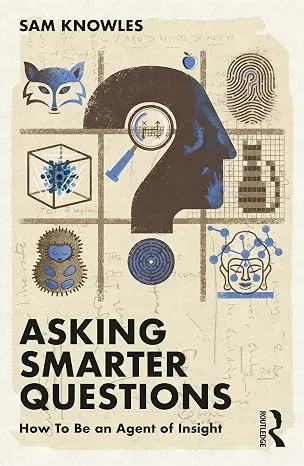
But very few leaders pause to ask a deeper question: are we asking the right questions in the first place? That is where Sam Knowles begins in Asking Smarter Questions: How To Be an Agent of Insight. This book does not treat questions as small conversation starters. It treats them as leadership tools — the kind that can open hidden thinking, challenge weak assumptions, reveal better evidence, and help people move from surface-level information to real insight.
In today’s business world, this matters more than ever. Organizations are surrounded by reports, platforms, dashboards, analytics teams, customer feedback, market signals, and AI-generated responses. Information is no longer the problem. The bigger problem is clarity. Leaders are not short of answers — they are often short of the right starting point. Insight rarely begins with a perfect report. It begins with curiosity, with listening, and with the courage to ask a question that helps us discover what we have not yet seen.

Asking Smarter Questions is written by Sam Knowles, a data storyteller, author, speaker, trainer, and consultant known for helping organizations use evidence with greater clarity and impact. This book is part of his Using Data Better trilogy, following Narrative by Numbers and How To Be Insightful. Together, these works focus on a theme every modern leader should care about: how to move from data to meaning, and from meaning to action.
But Asking Smarter Questions goes one step earlier in the journey. Before the story. Before the insight. Before the analysis. Before the decision. It begins with the question.
The book shows that questions are not neutral — they shape the quality of thinking that follows. A narrow question can limit the answer. A biased question can lead the team in the wrong direction. A complicated question can create confusion. A rushed question can produce shallow thinking. But a smarter question can change the whole conversation. It can help a team see the customer differently, reveal why a strategy is not working, expose where data is weak, and turn a meeting from a status update into a moment of real progress. That is the power of this book — it is not just about communication, it is about better thinking.
“Insight does not begin when the answer arrives.
— The core message of the book
It begins when the right question is asked.
Many organizations believe they need more data to make better decisions. Sometimes they do. But very often, they already have enough information — what they lack is the ability to frame the right question around it.
A business may ask, “Why are sales down?” That may be useful, but it may also be too broad. A smarter question could be, “Which customer segment changed behavior first, and what happened before that change?” A company may ask, “Why are employees disengaged?” A smarter question could be, “Where are employees experiencing the most friction in their daily work?” A data team may ask, “Why is the dashboard not being used?” A smarter question could be, “What decision was this dashboard supposed to support, and does it actually help someone make that decision faster?”
This is where Sam Knowles’ message becomes valuable for executives. Questions are not only a way to collect answers — they are a way to direct attention. They decide what people look at, what teams discuss, what evidence matters, and whether a leader confirms an assumption or discovers something new. For leaders, that distinction is critical, because poor questions can make smart people work on the wrong problem.
Leadership today is not just about having a strong opinion. It is about creating the conditions where better thinking can happen. That requires curiosity.
In many organizations, people are rewarded for sounding certain. They are expected to move fast, answer quickly, and appear confident. But confidence without curiosity can become dangerous.
Meetings become confirmation exercises.
Meetings become discovery spaces.
A leader who asks better questions does not weaken authority — they strengthen it. They show that the goal is not to be the loudest person in the room, but to reach the clearest understanding of the situation. Sometimes the best leader is not the one with the fastest answer, but the one who asks the question that helps everyone see the real issue.
One of the strongest parts of the book is its simple and practical foundation. Sam Knowles highlights six principles that help people ask better questions and generate more useful answers.
Curiosity is where insight begins. A curious leader does not enter a conversation trying to prove a point — they enter willing to learn something new, and keep asking, “What else could be happening here?”
Open mindedness helps leaders separate evidence from assumption. It creates room for different perspectives, encourages honest disagreement, and lets leaders hear what may be uncomfortable but necessary.
Good questions are rarely accidental. Preparation helps leaders understand what they really want to learn, avoid vague or overloaded questions, and bring the real issue into focus with one sharp question.
Open questions invite depth. They do not trap people in yes-or-no answers — they create space for context, experience, and explanation. A closed question confirms a fact; an open question reveals a pattern.
Simple questions are often the most powerful. Complexity can hide weak thinking, while simplicity brings clarity, reduces noise, and makes the answer more useful. When the question is clear, the conversation is clearer too.
A question has no value if the answer is not truly heard. Smarter questioning requires patience, silence, attention, and the humility to let the answer change your thinking.
Together, these six principles turn questioning from a casual habit into a deliberate leadership skill — the place where smarter questions become stronger decisions.
This book feels especially relevant now because leaders are making decisions in an age of data abundance and AI acceleration. AI can generate answers quickly. Dashboards can display metrics instantly. Reports can summarize performance. Analytics teams can model patterns. Automation can speed up workflows. But speed does not guarantee understanding.
If the question is weak, the answer can still be misleading. A business can ask AI for a strategy and receive a confident response — but if the question is unclear, the output may sound impressive while still being shallow. A team can build a dashboard with accurate numbers, but if nobody asked what decision it should support, the dashboard may still fail. A company can invest in advanced analytics, but if leaders do not ask what problem they are solving, the project may produce activity without impact.
This is why smarter questioning is becoming an executive skill for the AI era. The future will not belong only to people who have access to more tools. It will belong to people who know how to ask better questions of those tools. Before trusting an answer, leaders must understand the question behind it.
Asking Smarter Questions is valuable for anyone whose work depends on insight, decision making, communication, and change. It is especially useful for:
This is not a book only for data professionals. It is a book for anyone who wants to think more clearly and lead more effectively.
At The Executive Outlook, we feature books that help leaders think better, lead better, and build organizations with more clarity. Asking Smarter Questions fits that purpose because it speaks to a problem many leaders face today: they are surrounded by information, but still searching for insight; they have access to data, but still need judgment; they have technology, but still need better thinking.
Sam Knowles reminds us that the path to better insight does not always begin with another tool, another report, or another meeting. Sometimes, it begins with one better question. That is what makes this book valuable for modern executives: the quality of a decision often depends on the quality of the question that came before it.
Asking Smarter Questions is a thoughtful and practical book for leaders who want to move beyond surface-level answers and create deeper insight. It encourages curiosity without making it abstract, connects questioning with better decision making, and shows why listening is as important as asking. It reminds leaders that clarity is not created by data alone.
Get the book or connect with the author to start asking smarter questions.

Listen in for business strategies and interviews with business experts to help you build a business and a life that you love.
About Us