Enterprise business intelligence often begins with a simple promise: give more people access to data and help them make better decisions.
The real challenge appears when adoption grows.
A small analytics deployment soon needs stronger security, embedded dashboards, identity management, AI capabilities and structured reporting. These are essential for running BI in production, yet they are often locked behind higher-priced plans, enterprise licenses or per-user charges.
That can leave technology leaders in a difficult position. A platform may appear affordable during evaluation, but the economics can change quickly when hundreds of employees, customers or partners need access.
Helical Insight is now challenging that model.
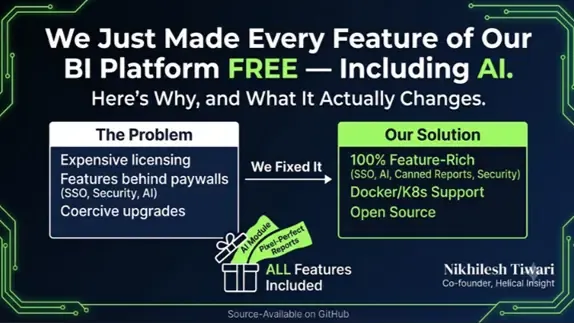
With the release of Helical Insight 7.0, the company has made its enterprise BI capabilities available through its free Community Edition. Instead of charging organizations to unlock advanced features, it plans to generate revenue through enterprise support, implementation, consulting and service-level agreements.
Many software companies follow a familiar pattern.
The community edition introduces users to the product. As they need better security, embedding, governance or scalability, they are pushed towards a paid edition.
Helical Insight previously followed a similar community-versus-enterprise model. That has now changed.
According to the company, Helical Insight 7.0 brings the same core analytical capabilities to its Community Edition. These include AI-powered conversational analytics, interactive dashboards, pixel-perfect and paginated reporting, embedded analytics, Single Sign-On, row-level data security, multi-tenancy, white labelling, report scheduling and report bursting.
The paid Enterprise Edition is differentiated mainly through dedicated technical support, professional services, branding removal and SLA-backed assistance.
The change separates software capability from commercial support. Organizations can evaluate and deploy the platform without immediately reaching a feature wall, then purchase support or implementation services if their needs become more complex.
The significance of this decision becomes clearer when viewed through the economics of BI adoption.
A successful analytics platform rarely remains limited to a small internal team. Executives, analysts, operational employees, customers and partners may all require access.
Per-user and per-viewer pricing can therefore become a major concern, especially for SaaS companies embedding analytics within customer-facing products.
Helical Insight says its Community Edition allows organizations to embed dashboards and reports without per-viewer fees.
The platform also includes multi-tenancy, allowing a single deployment to serve multiple isolated customers or business units. Row-level security can control which records are visible to individual users, roles or organizations.
Free licensing, however, does not mean deployment is cost-free. Organizations must still consider infrastructure, implementation, maintenance, monitoring, security, governance and technical ownership.
The difference is that those costs are no longer tied directly to unlocking individual product features.
Helical Insight 7.0 also reflects the growing demand for natural-language and generative AI capabilities in business intelligence.
Its AI layer uses a Bring Your Own LLM model.
Organizations can connect their preferred external model provider or use a locally hosted model, depending on their architecture, privacy requirements and governance policies.
Users can ask questions in natural language and receive responses such as charts, tables or narrative summaries. The company says businesses can use their own model of credentials rather than depending on a single centrally controlled AI environment.
There is a presence of inter-mediate Semantic Model layer, helping in reducing chances of hallucinations and specifying guardrails.
Conversational analytics can make information easier to access, but trust still depends on the quality and governance of the underlying data.
Modern BI conversations often focus on interactive dashboards, self-service analytics and AI assistants.
Yet many organizations still depend on structured reports.
Finance teams need invoices, balance sheets, profit and loss statements and management reports. Compliance teams require regulatory documents with consistent layouts. Operational teams may need controlled headers, page breaks and print formats.
These requirements cannot always be replaced by a dashboard.
Helical Insight’s Community Edition includes pixel-perfect and paginated reporting for multi-page business documents. The company positions this capability as a bridge between traditional reporting systems and modern analytics platforms.
Helical Insight 7.0 can operate across on-premises infrastructure, private and public cloud platforms, Docker and Kubernetes. It can also connect with relational databases, cloud data warehouses and modern query engines.
For regulated businesses, self-hosting may provide more control over data location. For cloud-first organizations, Docker and Kubernetes support can align the platform with existing deployment practices.
Technology leaders should still evaluate performance, monitoring, upgrades, backup, high availability and long-term support before moving the platform into production.
Helical Insight’s source code is available through GitHub, but the free edition includes a small Helical Insight attribution mark on exported charts and embedded dashboards.
That branding cannot be removed from the Community Edition.
The paid Enterprise Edition removes the attribution and adds dedicated support and service-level commitments.
Because of this condition, Helical Insight describes the platform as free and source-available, rather than open source under the traditional Open-Source Initiative definition.
This distinction matters. The terms free, open source and source-available are often used interchangeably, but they do not mean the same thing.
Technology leaders should therefore review the license and assess whether its terms align with their deployment, modification, branding and redistribution requirements.
Helical Insight is replacing feature gating with a services-led commercial model.
The company expects customers to pay when they need professional implementation, technical consulting, guaranteed support response times, enterprise SLAs or complete removal of Helical Insight branding.
The assumption is that product capability can drive adoption, while operational confidence creates the commercial relationship.
This approach is familiar across databases, infrastructure platforms and developer tools, where vendors generate revenue through support and implementation expertise.
The model also carries risk. Some users may adopt the Community Edition without purchasing support, while others may expect enterprise-level reliability from community resources.
Helical Insight will therefore need to prove that its implementation expertise, documentation, support quality and technical accountability provide enough value to sustain the business.
For CIOs, CDOs and analytics leaders, the announcement introduces another option in a market where cost, flexibility and vendor dependence are under increasing scrutiny.
A feature-complete Community Edition can reduce the barrier to experimentation. Teams can test embedded analytics, security controls, AI capabilities, deployment models and paginated reporting before committing to a commercial agreement.
However, features should not be the only selection criteria.
Technology leaders should also assess platform security and maturity, production performance, documentation, community support, integration with identity and governance systems, licensing terms, infrastructure costs, backup and recovery, and the reliability of enterprise support.
Free access may reduce licensing friction, but it does not replace architecture, governance or operational planning.
Helical Insight’s decision reflects a broader shift in enterprise software.
Buyers are becoming more cautious about products that appear open during evaluation but introduce limitations when deployment becomes business-critical. At the same time, vendors need sustainable revenue to fund development, support, security and innovation.
The debate is therefore not whether enterprise software should always be free. It is about what customers should be paying for.
Should organizations pay simply to access security, SSO, embedding and reporting? Or should they pay for implementation expertise, service guarantees and operational support?
Helical Insight has chosen the second approach.
Whether the model succeeds will depend on adoption, trust and the company’s ability to build a strong community while delivering enterprise-grade services.
But the move introduces a meaningful alternative to the traditional BI licensing playbook.
Enterprise features do not always have to be the product being sold. Sometimes, the greater value lies in helping organizations deploy, govern, and scale them with confidence.


Listen in for business strategies and interviews with business experts to help you build a business and a life that you love.
About Us