


Three months ago, a fintech company spent $2.4M implementing a data mesh architecture. Their CTO heard about it at a conference. The board approved it. Today, the data mesh sits unused. Teams still pull reports from the old warehouse. The investment delivered zero business value.
What went wrong wasn’t the technology. It was the sequence. This is the most common pattern in failed digital transformation — companies build the penthouse before laying a foundation. In 2026, it remains the number one reason transformation initiatives collapse before delivering a single dollar of return.
The Pattern That Kills Most Digital Transformation Projects
Digital transformation doesn’t fail because the technology is wrong. It fails because organizations skip the readiness work that makes technology function. A recent gathering of 120 senior data leaders confirmed it: “Everything came back to data governance and data quality.” Not the shiny new tools. The basics.
A healthcare company wanted AI for patient readmission prediction. Testing accuracy: 87%. Production accuracy: 34%. The cause was simple production data was missing 40% of diagnostic codes. The technology worked. The data didn’t.
This pattern repeats everywhere. Retail companies with inventory data that doesn’t match reality. Financial firms with customers duplicated across 12 systems. You cannot transform what you cannot trust.
Why Most Digital Transformation Strategies Miss the Foundation
Most failed transformations skip three things: data quality teams can actually trust, governance that clarifies ownership and definitions across systems, and basic adoption of existing tools before layering advanced features on top.
A retail company spent $400K on analytics and saw only 11% usage after six months. They rebuilt with simpler metrics and direct user input — adoption hit 89% within two months. The technology didn’t change. The approach did.
Digital transformation strategies that work are people-first, problem-first, adoption-first. Before building real-time dashboards with AI insights, make sure people are actually using your current reports.
The Digital Transformation Framework That Actually Works
Organizational readiness for digital transformation follows a clear sequence: foundation first, then capability, then scale. Most companies skip straight to scale, investing in advanced AI platforms and real-time analytics before their data house is in order. That’s why 73% of digital transformation initiatives fail to deliver expected ROI, wasting an average $2.4M per failed initiative according to recent enterprise studies.
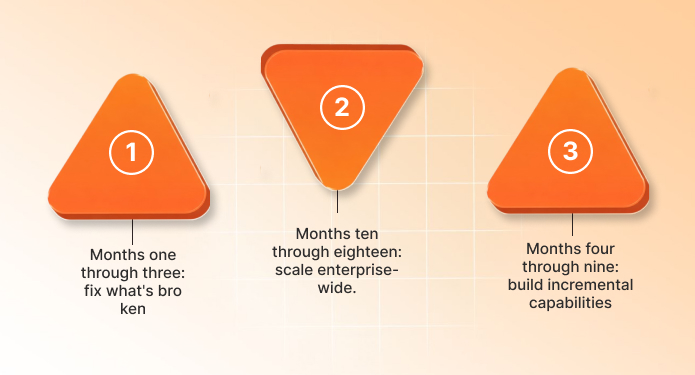
Months one through three: fix what’s broken. This phase isn’t glamorous, but it’s critical. Audit data quality across your core business systems—you can’t build intelligence on garbage inputs. Document actual data ownership with real accountability, not just org chart titles that mean nothing when issues arise. Establish basic governance that teams will actually follow, starting with 3-5 critical policies rather than 89 comprehensive rules nobody reads. Get existing reports actually used by fixing what’s broken in current analytics before building new capabilities. One manufacturing company discovered their “trusted” customer data was only 67% accurate—imagine building AI recommendations on that foundation.
Months four through nine: build incremental capabilities. Start automating manual processes, but begin small with high-value, low-risk workflows that demonstrate ROI quickly. Deploy basic predictive models for inventory optimization, customer churn, or demand forecasting—use cases with clear business metrics and short feedback loops. Deliver measurable ROI in weeks, not years, proving the approach works before expanding scope. A retail company automated their pricing updates in this phase, saving 847 hours monthly and improving margin by 2.3% before touching more complex processes.
Months ten through eighteen: scale enterprise-wide. Now—and only now—launch advanced AI initiatives, but only on the quality data foundation you’ve built. Implement real-time systems where business value justifies the complexity and cost, not everywhere just because you can. Build data products teams actually want to use by involving them early, measuring adoption religiously, and killing what doesn’t work rather than forcing adoption of unused systems. This is when your data mesh, data fabric, or lakehouse architecture finally makes sense—after you’ve proven you can manage data well at smaller scale.
This framework prevents $2.4M mistakes by building on proven success. Technology comes third—after foundations.
One financial firm followed this: fix data (67%→96%), automate (234→12 hours), then AI. Result: $18M savings, 3.2x growth.
The fintech that skipped foundations now spends $1.8M fixing what they ignored.
The Bottom Line
Digital transformation in 2026 isn’t about the technology you adopt. It’s about the foundations you build first.
Next time someone proposes the latest technology trend, ask one question: “What needs to be true in our organization for this to work?” If the answer includes better data quality, clearer governance, or more adoption of current tools — fix those first. The technology will still exist when you’re ready. And when you implement it on solid foundations, it’ll actually work.
Technology without foundations fails. Foundations with the right technology compound. That’s the difference between digital transformation that burns millions and digital transformation that returns $18M.
Tired of digital transformation projects that promise big and deliver little? Complere Infosystem builds the data foundations that make technology work.
Editor Bio

I’m Isha Taneja, serving as the Editor-in-Chief at "The Executive Outlook." Here, I interview industry leaders to share their personal opinions and provide valuable insights to the industry. Additionally, I am the CEO of Complere Infosystem, where I work with data to help businesses make smart decisions. Based in India, I leverage the latest technology to transform complex data into simple and actionable insights, ensuring companies utilize their data effectively.
In my free time, I enjoy writing blog posts to share my knowledge, aiming to make complex topics easy to understand for everyone.