
In one meeting, a performance dashboard showed patient operations improving. In the next, the finance view suggested rising costs with no clear explanation. No one in the room was lying. No one was careless. But the outcome was the same leaders hesitated; teams started debating, and decisions slowed down.
In 2026, leadership gets tested. Not on whether you bought the right tool, but on whether your people can trust the data that runs your organization. That trust doesn’t appear by accident. It is built through transformational leadership in healthcare leadership that creates clarity, ownership, and belief, even in complex environments.
What Is Transformational Leadership When the Stakes Are Real?
So, what is transformational leadership in a healthcare setting? It is leadership that changes the default behavior of the organization. It moves teams from reactive work to reliable execution. It replaces confusion with confidence.
In theory, transformational leadership focuses on inspiration. In practice, it shows up as daily decisions that signal what matters. Leaders model new standards. Teams follow those standards because they make work easier, safer, and faster.
This is why transformational leadership characteristics are not soft ideas. They are operating behaviors:
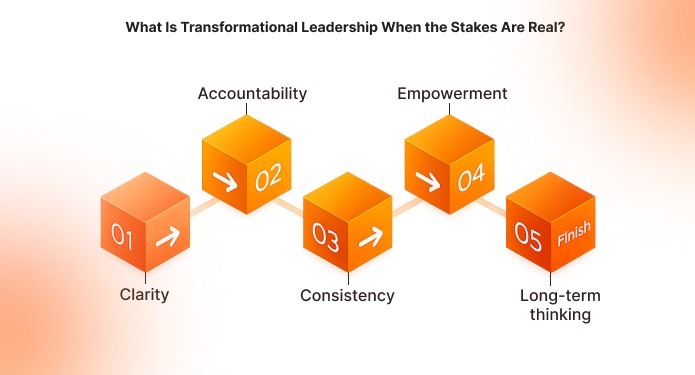
- Clarity: Everyone knows what “good data” means. advantage or enable operations?
- Accountability: Someone owns every critical data element.
- Consistency: The same rules apply even under pressure.
- Empowerment: Teams have the authority to fix root causes, not just symptoms.
- Long-term thinking: Data quality is treated as a program, not a one-time cleanup.
When these behaviours are present, motivation becomes natural. People stop wasting energy on uncertainty and start spending it on impact.
A Healthcare Example: The Red Flag That Changed Everything
A healthcare team had modernized parts of their data stack, but they were still living in a painful reality: when a pipeline failed, the team had no clear visibility. They discovered issues lately. Monitoring was a manual. Fixes depended on who noticed first. Every delay created downstream errors that affected reporting and day-to-day workflows.
The turning point wasn’t a bigger team or another platform. It was a leadership shift.
They implemented three simple changes:
- A dashboard that clearly flagged failures with a red indicator.
- A governance process that defined who owned the fix.
- A prevention mindset – root cause analysis, not repeated patchwork.
One rule made the system work: if the dashboard is red, someone is accountable to make it green today. Not tomorrow, not next sprint, not after a postmortem that nobody reads.
That one leadership decision changed behaviour across teams. People stopped double-checking everything. They stopped carrying stress into every report review. Trust improved not because errors never happened, but because when errors happened, the organisation knew exactly how to respond.
That is transformational leadership in healthcare. It creates safety through clarity.
The CEO Perspective:
From a CEO lens, the biggest mistake is treating data as a technical topic instead of a business asset. In healthcare, data impacts patient outcomes, compliance, staffing decisions, and financial sustainability. Yet many leaders still ask about data only after there’s a problem.
Transformational CEOs change this by making data part of the strategy of conversation. They ask, with the same seriousness used for finance:
- What is the current health of our data?
- Where are we losing time due to rework and mismatched numbers?
- Which datasets are mission-critical to patient operations and risk?
The CEO’s role is not to become a data expert. It is to set the expectation that data is owned, measured, and managed. That signal creates motivation across the organization because teams stop feeling like they’re cleaning up “invisible mess.” The work becomes valued, recognized, and connected to outcomes.
There’s also a business case leader who ignores too long: poor data quality silently wastes money through inefficiency and missed opportunities. If leaders want new growth in 2026, reducing waste is one of the fastest wins and data is where a large share of that waste hides.
The CTO Perspective:
CTOs don’t need to convince that data problems are real. They live them. Conflicting reports, broken pipelines, “quick fixes” that become permanent, and teams losing weeks to reconciliation.
From a CTO perspective, motivation comes from flow. Teams want to build, not chase ghosts. But they can’t build at speed if they don’t trust inputs.
This is where transformational leadership characteristics like empowerment and long-term thinking matter most. CTOs drive trust by building an operating system around data:
- Monitoring that catches issues early.
- Ownership that assigns responsibility automatically.
- Processes that move from detection to fix to prevention.
One of the most expensive hidden costs is talent. Data scientists, analysts, and engineers spend a large chunk of their week handling data quality issues before they can do the work they were hired to do. Trusted data doesn’t just reduce incidents; it frees your most expensive talent to create value.
From Theory to an Operating Model:
Transformational leadership theory becomes real when leaders stop treating data as a one-time project.
A simple model works well here:
Program: the ongoing capability – people, standards, training, and governance
Projects: targeted fixes – priority datasets, broken workflows, mismatched reports
Operations: sustained discipline – dashboards, ownership, follow-up, prevention
This matters because projects end. Programmes and operations stay. In healthcare, sustainability is the difference between “we improved for a quarter” and “we can rely on this for years.”
The 2026 Reality:
Healthcare teams don’t need more slogans in 2026. They need fewer surprises. Motivation rises when systems are dependable; responsibilities are clear, and leaders remove friction that steals attention from patient care.
That is why transformational leadership in healthcare is powerful. It doesn’t just inspire. It stabilizes. It helps people trust their work, trust their tools, and trust the decisions they make.
If your teams work hard but still hesitate to trust their data, it’s time to build a leadership-led operating model for ownership, monitoring, and prevention, so confidence becomes the default, not the exception.
Editor Bio

I’m Isha Taneja, serving as the Editor-in-Chief at "The Executive Outlook." Here, I interview industry leaders to share their personal opinions and provide valuable insights to the industry. Additionally, I am the CEO of Complere Infosystem, where I work with data to help businesses make smart decisions. Based in India, I leverage the latest technology to transform complex data into simple and actionable insights, ensuring companies utilize their data effectively.
In my free time, I enjoy writing blog posts to share my knowledge, aiming to make complex topics easy to understand for everyone.