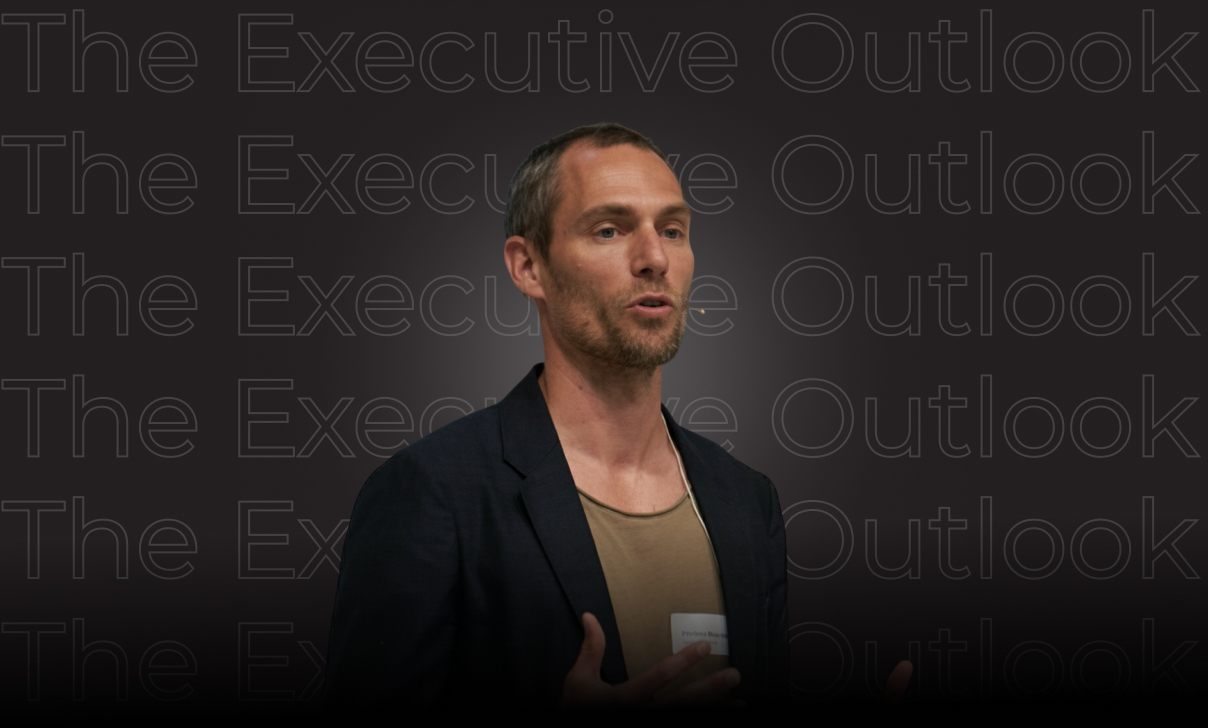

During a recent conversation on The Executive Outlook, Noel Toal, Chief Technology and Transformation Officer at Repurpose It, shared a journey that moves from writing code in a fintech startup to owning a cardboard box factory to leading technology and transformation in healthcare and now in a fast-growing industrial business. The path sounds unusual, but it perfectly explains his core belief: technology is only useful when it serves people and the real needs of business.
Through every step, one pattern stays the same: people, data and business reality come first. Tools come later.
From developer dreams to transformation leader
Noel started his career as many graduates, imagining himself as a software developer. His first role in a fintech startup came through an “experienced developer” job application he technically wasn’t qualified for. Instead of rejecting him, the owner offered a dual role: support the lead developer and take care of the help desk, networks and general ICT support. It was messy, hands-on work, and they threw him problems that most graduates would never see so early.
Over time, he realized something important. He enjoyed solving live issues, talking to colleagues and keeping systems running more than fixing bugs alone in front of a screen. That insight quietly shifted his direction.
Later roles as the inaugural IT person at Victorian Breast Screen, at a systems integrator serving big clients like BHP and the Australian Grand Prix, and finally a long spell as regional head of IT in a global software company all reinforced the same lesson: the closer technology is to real business problems, the more impact it has.
Prefer to listen on the go? Tune in to the full podcast episode on Spotify below:
Learning business by owning one
That realization pushed Noel beyond pure technology. Instead of studying for a technical master’s degree, he chose an Executive MBA to learn finance, strategy and how executives think. Even then, he felt the theory wasn’t enough. So, he took a bold step and bought a cardboard box manufacturing business.
He had never run a factory before. Owning the business meant being responsible for sales, operations, people, cash flow and risk. Over roughly three years, he used both technology and business model changes to consolidate operations, move into a new factory, add new product lines and improve performance. He eventually sold the company to a listed firm.
The exit was a success, but the deeper insight was simple: IT is not a support department on the side. When done well, it is tightly tied to revenue, cost, resilience and growth.
Watch the full conversation on YouTube by clicking the link below:
Moving into healthcare and Repurpose It
After selling his business, Noel wanted his work to clearly benefit the community. That led him into two executive technology roles in healthcare, both inaugural positions where he had to set strategy and lead transformation from scratch.
For Noel, healthcare wasn’t just another vertical; it was a deliberate move into work where technology and data directly shape access to care for disadvantaged communities, not just margins on a balance sheet. By then, organizations understood that IT wasn’t just “keeping the lights on”. It was central to patient access, service quality and financial stability.
Today, Noel brings that combined experience to Repurpose It as Chief Technology and Transformation Officer. The company is resource recovery business that is growing quickly. “Transformation” in his title is not a buzzword; it is the expectation that technology, data and process changes will actively fuel the next stage of growth.
Starting with trust, not tools
When Noel walks into a new organization, he doesn’t start with AI or big platform decisions. He starts with a basic question: can people rely on their everyday technology?
If the network is unstable, PCs are slow and help desk tickets stay open for months, no one will believe in any grand digital story. So, his first focus is often on core ICT operations: stabilizing the network, cleaning up recurring issues and improving support. It may not sound glamorous, but it builds trust.
Once people feel that “IT just works”, they are far more open to conversations about automation, data platforms or new ways of working.
Follow the business and the money
With the basics under control, Noel turns to the real engine of transformation: the business model. He doesn’t begin with the question “What tool should we buy?” He starts with:
- Where are we leaking revenue?
- Where are processes slow or manual?
- Where are decisions being made on guesswork instead of facts?
For him, the order is clear. First, understand the problems and opportunities. Second, design a transformation strategy around them. Only then, third, choose the technology that best supports that strategy.
Reversing this order—starting with tools and hunting for a use case—almost always leads to wasted budget and frustration.
Data as the engine of change
In practice, almost every transformation he leads ends up revolving around data. Early on, Noel Toal maps the data landscape: which core systems exist, whether there is a data lake or warehouse, and what is actually flowing into it. Just as importantly, he asks what valuable information isn’t being captured at all.
Marketing is a simple example. Many organizations track campaigns, but they don’t consistently link them to the phone calls, emails or bookings that follow. Without that connection, it’s impossible to know which activities really worked.
On top of that, he inspects data quality. Are key fields mandatory or regularly left blank? Are forms so long or confusing that people skip important information?
You can’t fix all historic data overnight, but you can fix how data is captured from today onward. That matters even more in an AI-driven world. If the underlying data is incomplete or inconsistent, dashboards will mislead and predictive models will simply predict the wrong things.
Build, buy and hybrid teams
When it comes to delivering new data platforms or systems, Noel avoids the extremes of “build everything ourselves” or “just buy a product and hope it fits”. He starts by looking at the skills and capacity of the existing team and then at what strong products already exist in the market.
In many cases, he prefers a hybrid approach. External experts help with architecture, detailed design and the early build, while internal staff work alongside them. The aim is to deliver value quickly but also grow internal capability so the organization can own and extend the solution later.
Before he brings external partners, he also prefers to sort out the basics—especially data access. If vendors or core systems still block key data, external teams end up waiting while costs keep running. When access is secured up front, partner work feels much closer to a fixed, controllable investment instead of an open-ended spend.
He is also blunt with boards and CEOs about uncertainty: you can confidently price the next stage, not the next three years, so each phase needs a clear deliverable, clear value and a clear cost before you move to the next.
The “Display Home” Way to Build Systems
One of Noel’s most practical ideas is what he calls the “display home” approach. He compares traditional specifications to a house plan on paper. On the plan, three bedrooms and a kitchen look fine. But when you walk through a display home, you suddenly notice that the rooms feel small or the layout doesn’t fit how you live.
Technology projects are similar. If business users only see documents and diagrams, they think they understand the future system—until it is delivered and feels wrong.
To avoid this, Noel prefers to show something tangible early: a small proof of concept, a clickable wireframe or a quick low-code prototype that people can actually click through. Once users see and touch an early version, their feedback becomes concrete. You discover what they really need before large amounts of time and money are spent.
Afterwards, when specifications are agreed, big new ideas in the middle of the project can be clearly treated as enhancements for later phases, not “bugs” that must be fixed immediately.
Choosing tools that reduce complexity
Over the years, Noel has worked with many stacks, but today he often favours the Microsoft ecosystem, combined with platforms like Databricks for data and AI. He likes that one developer can move across Power Platform, Power BI, Dynamics and custom applications without constantly switching tools or languages.
Integration is strong, AI capabilities are being embedded deeply, and there is a wide pool of talent and partners who already know the stack. Databricks adds powerful data engineering and analytics on top, with plenty of training material and community support. For Noel, the point isn’t the logo; it is having a platform that lets teams move fast, stay integrated and avoid niche tools that are hard to staff.
Healthcare in action: fewer missed appointments
A clear example of Noel’s philosophy in action comes from his time at DPV Health. The organization used separate systems for GP visits, allied health, NDIS-funded services, aged care and dental. The same person could appear in several systems, and no one had a complete view.
His team built a new layer using Microsoft and Dynamics to bring that information together. When a patient called, staff could see all services that person used and all upcoming appointments in a single view. It became easier to coordinate care and even match multiple appointments on the same day.
Then they added a predictive model. Using historical data such as service type, location, age and other attributes, they estimated how likely a patient was to attend an appointment at a particular time. The goal was simple: offer people slots they were more likely to keep.
The model reached around 91 percent accuracy, and over time the “fail to attend” rate dropped from about 25 percent to roughly 10–11 percent, depending on the service. Clinician time was used better, waiting lists shrank, funding was more stable and patients got care faster.
Just as important as the model itself was the discipline of measuring before and after. Once leaders saw concrete improvements in no-shows, wait times and revenue stability, it became much easier to keep reinvesting in data and AI initiatives rather than treating them as one-off experiments.
From monthly reports to live steering
Noel also sees a shift away from end-of-month reporting towards live steering. In the past, managers waited for monthly reports and only then discovered whether targets were met. By that time, it was too late to change anything.
With modern data and analytics, he believes managers should see performance in real time or near real time. When they can track progress during the month, they can adjust quickly instead of reacting after the fact. Data stops being a rear-view mirror and becomes a steering wheel.
Final thoughts: people first, data always
Across startups, large software companies, his own factory, healthcare and now Repurpose It, Noel has kept one belief at the center: technology on its own is never enough. Trust comes first. People need tools that work, issues that are heard, and change that feels purposeful, not forced.
Data then becomes the compass that guides decisions and reveals where the next opportunity or risk lies. Technology is the enabler that ties it all together.
As Noel sees it, technology is just a tool; people are the real drivers of transformation. When you trust and support them, change stops being a project and becomes a way of working.
For more real-world stories on data governance strategy, AI readiness and leadership, follow The Executive Outlook and explore our latest interviews with global data and AI leaders.
Editor Bio

I’m Isha Taneja, serving as the Editor-in-Chief at "The Executive Outlook." Here, I interview industry leaders to share their personal opinions and provide valuable insights to the industry. Additionally, I am the CEO of Complere Infosystem, where I work with data to help businesses make smart decisions. Based in India, I leverage the latest technology to transform complex data into simple and actionable insights, ensuring companies utilize their data effectively.
In my free time, I enjoy writing blog posts to share my knowledge, aiming to make complex topics easy to understand for everyone.