

The transformation roadmap looked perfect on paper. New platforms approved. Budgets signed off. Teams are mobilized.
Six months later, leaders were still debating basic metrics. Reports didn’t align. Decisions slowed. Confidence dropped.
This is a pattern quietly repeating across industries. Companies don’t fail at digital transformation because they lack technology. They fail because their digital transformation strategies are built on data that no one fully trusts.
From both a CEO and CTO perspective, this is the uncomfortable truth of 2026: transformation collapses when data credibility is assumed instead of engineered.
What Is Digital Transformation?
Before asking why strategies fail, it’s worth clarifying what digital transformation is in practice.
It is not cloud migration.
It is not analytics dashboards.
It is not automation alone.
Digital transformation is the ability to make faster, better decisions at scale using technology. That ability depends on one non-negotiable input: trusted data.
If leaders cannot rely on data to reflect reality, transformation efforts become surface-level. Tools get adopted, but behavior doesn’t change. Technology moves forward, while decisions stay stuck.
The Hidden Failure Point:
Most digital transformation strategies assume data will “sort itself out” along the way. Leadership focuses on tools, architecture, and timelines, while data quality and ownership are left implicit.
That’s where failure starts.
When data lacks trust:
- Teams double-check instead of deciding
- Reports disagree across functions
- Automation amplifies errors instead of efficiency
- AI models produce insights nobody believes
Transformation doesn’t stop; it stalls. And stalled transformation is more dangerous than no transformation at all, because it consumes budget, morale, and credibility.
Strategy Without Confidence Is Not Strategy
From a CEO’s lens, digital transformation in business is about competitiveness, growth, and resilience. But strategy depends on belief. Leaders must believe in the numbers they see.
When data trust is missing, CEOs face hidden friction:
- Strategy reviews turn into reconciliation exercises
- Board discussions focus on “which number is right”
- Opportunities are missed because decisions are delayed
This is why so many digital transformation strategies are underperformed. Leadership invests heavily in systems but hesitates to invest in data ownership, governance, and accountability.
A transformational CEO reframes from the question. Instead of asking, “Are we digital enough?” they ask, “Do we trust the data driving our most critical decisions?”
Technology Moves Faster Than Trust
CTOs often feel this breakdown first. Systems go live. Pipelines run. Dashboards refresh. Yet teams still lack confidence.
Engineers are called in to explain numbers. Analysts spend time reconciling sources. Data scientists clean inputs before they can create insights. The organization moves slower despite better tools.
This reveals a hard truth: speed comes from trust, not technology. You cannot out-engineer data credibility.
Successful CTOs anchor digital transformation strategies in:
- Clear ownership of critical data
- Monitoring that surfaces issues early
- Processes that ensure fixes don’t repeat
Without these foundations, every new platform increases operational complexity instead of reducing it.
A Common Business Scenario That Explains the Failure
Consider a business that launches a new reporting layer as part of its digital initiative. Dashboards look impressive. Leadership is optimistic.
Then the first issue appears. A number turns red. No one knows who owns it. The dashboard exists, but there is no defined follow-up process. Meetings are scheduled. People investigate manually. The same issue reappears weeks later.
The problem isn’t the dashboard. It’s the lack of an operating model around data.
Digital transformation strategies fail when data initiatives are treated as one-time projects instead of ongoing capabilities. Technology exposes problems faster, but leadership must decide how the organization responds to them.
Digital Transformation in Business Requires Programs, Not Patches
One of the biggest mistakes organizations make is confusing fixes with foundations.
A project might clean data once.
A program ensures it stays clean.
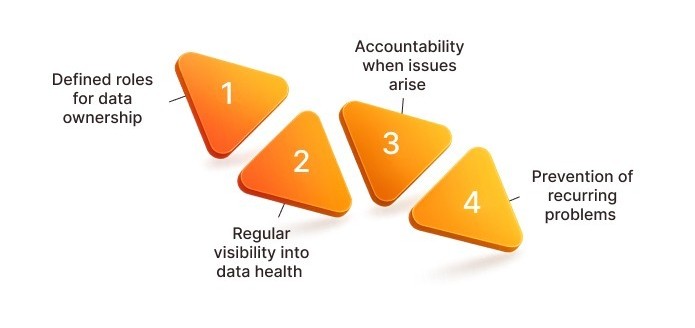
Digital transformation in business succeeds when leaders build sustained capability around data. That means:
- Defined roles for data ownership
- Regular visibility into data health
- Accountability when issues arise
- Prevention of recurring problems
This shift from reactive fixes to proactive programs is not technical; it is leadership driven.
Why Trusted Data Changes Everything
When data becomes reliable, behavior changes across the organization:
- Teams stop arguing over numbers
- Analysts focus on insights, not cleanup
- Automation delivers value instead of noise
- Executives decide faster, with less hesitation
This is the real promise of digital transformation strategies. Not modern tools, but modern confidence.
Trusted data aligns people. It reduces friction. It turns transformation from an initiative into a way of working.
The 2026 Reality Check
As organizations push deeper into AI, automation, and advanced analytics, the cost of untrusted data will rise. Models will scale mistakes faster. Decisions will carry more risk. Regulatory scrutiny will increase.
In this environment, digital transformation strategies that ignore data trust will continue to fail quietly. Those that embed trust as a leadership priority will compound advantage over time.
Final Thought for CEOs and CTOs
Digital transformation does not fail because companies lack ambition. It fails because ambition outruns trust.
Leaders who treat data as a true business asset owned, monitored, and improved build transformation that lasts. Those who don’t will keep investing in technology while wondering why progress feels slow.
If your digital initiatives are live but decision-making still feels uncertain, it’s time to revisit your data foundation. Let’s assess how trusted data can turn digital transformation strategies into measurable business outcomes.
Editor Bio

I’m Isha Taneja, serving as the Editor-in-Chief at "The Executive Outlook." Here, I interview industry leaders to share their personal opinions and provide valuable insights to the industry. Additionally, I am the CEO of Complere Infosystem, where I work with data to help businesses make smart decisions. Based in India, I leverage the latest technology to transform complex data into simple and actionable insights, ensuring companies utilize their data effectively.
In my free time, I enjoy writing blog posts to share my knowledge, aiming to make complex topics easy to understand for everyone.