
Own the Data Value Chain, Not Just the Tech Stack
- Every team has a different definition of “revenue,” “active customer,” or “churn.”
- Dashboards don’t match finance numbers.
- AI models are built on inconsistent, undocumented pipelines.
From Dashboards to Decision Intelligence
- What is the question?
- What data actually matters for this decision?
- How will we know if the decision worked?
- Standard definitions and metric layers (one version of truth).
- Data products that serve specific decisions (pricing, credit risk, marketing spend, capacity planning).
- Feedback loops where the outcome of decisions flows back into datasets and models.
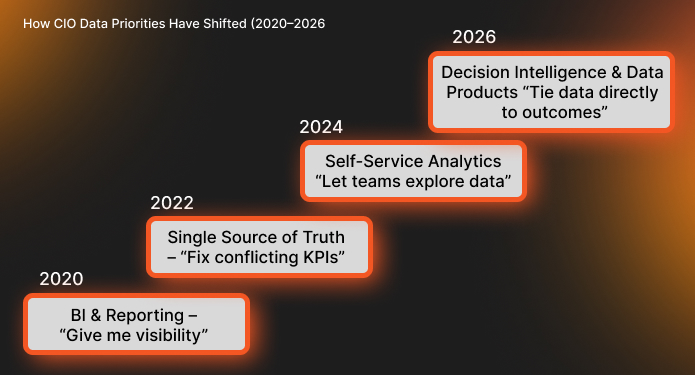
How CIO Data Priorities Have Shifted (2020–2026)
|
Year |
Primary CIO Data Priority |
|
2020 |
BI & Reporting – “Give me visibility” |
|
2022 |
Single Source of Truth – “Fix conflicting KPIs” |
|
2024 |
Self-Service Analytics – “Let teams explore data” |
|
2026 |
Decision Intelligence & Data Products – “Tie data directly to outcomes” |
- Well-designed data products with clear owners.
- Metric catalogs and semantic layers.
- Decision playbooks: which data to use, and how.
Why Data Foundations Decide AI ROI
- Data quality: Rules, validations, and monitoring on critical entities—customer, product, order, invoice, claim, patient, policy.
- Data governance: Clear ownership, access policies, lineage, and impact assessment when changes are made.
- Data contracts: Agreements between source systems and downstream consumers so schema and meaning don’t change silently.
- Observability: Alerts when pipelines break, metrics drift, or volumes behave abnormally.
- No AI model is approved without clarity on which tables, which columns, and which rules protect data quality.
- KPIs used in board decks must trace back to documented logic, not one-off Excel adjustments.
- Changes in ERP/CRM fields trigger review workflows, not surprises in month-end reports.
How CIOs in 2026 Allocate Data Investment
|
Data Function |
Approx. Allocation |
What It Covers |
|
Data Platform & Engineering |
30% |
Lakehouse/warehouse, pipelines, CDC, performance, scalability |
|
Data Governance & Data Quality |
25% |
Catalogs, lineage, rules, policies, DQ monitoring, data contracts |
|
Analytics & Decision Intelligence |
20% |
Metric layers, BI, decision workflows, experimentation frameworks |
|
AI / ML Initiatives |
15% |
Models, MLOps, scenario simulation, personalization, risk models |
|
Literacy, Change & Enablement |
10% |
Training, playbooks, office hours, data communities, change management |
The Human Side: Data-Literate Leadership
- Executive data bootcamps for CxOs and business heads: how to read metrics, question biases, and ask better data questions.
- Data playbooks for each function: sales, finance, operations, HR, product. Each gets a simple guide—key KPIs, how they are calculated, what levers impact them.
- Community of practice: Data champions embedded in teams, supported by central data/analytics.
- Storytelling rituals: Monthly “decision review” sessions where leaders share a decision, the data behind it, and what they learned.
Complere Infosystem & Data Confidence by Design
- Data quality frameworks with rule catalogues for critical entities.
- Standard KPI definitions exposed through a semantic layer and dashboards.
- Validation accelerators (like reusable SQL rules and orchestration) so new data sources can be onboarded faster without sacrificing trust.
- Data maturity roadmaps where each quarter has visible, measurable improvements—fewer reconciliation issues, faster close, higher self-service adoption.
The Future: CIOs as Chief Data Orchestrators
- Balancing central standards with local flexibility.
- Aligning data, AI, finance, and risk around shared definitions and guardrails.
- Turning fragmented systems (CRM, ERP, E-com, support, payments) into a coherent data backbone that supports every major decision.
Final Thought
If you want your CEO outlook to be more than a slide deck—and turn into daily habits your teams actually follow—The Executive Outlook and Complere Infosystem can help. Together, we help you define the culture you want, the metrics that prove it, and the data foundations that make it real.
Editor Bio

I’m Isha Taneja, serving as the Editor-in-Chief at "The Executive Outlook." Here, I interview industry leaders to share their personal opinions and provide valuable insights to the industry. Additionally, I am the CEO of Complere Infosystem, where I work with data to help businesses make smart decisions. Based in India, I leverage the latest technology to transform complex data into simple and actionable insights, ensuring companies utilize their data effectively.
In my free time, I enjoy writing blog posts to share my knowledge, aiming to make complex topics easy to understand for everyone.