
CEO Outlook 2026: Turning AI Hype into Outcomes the Board Can See 

CEO Outlook 2026 Turning AI Hype into Outcomes the Board Can See

Why the CEO Outlook Is Changing in 2026

In 2026, almost every industry tech outlook looks identical: AI, automation, cloud, data platforms, edge, copilots, security. The language is bold and futuristic, promising the world of cutting-edge innovation. However, as the excitement fades and the boardroom doors close, the reality hits: CEOs are no longer interested in chasing every new trend. The conversation has evolved—what matters now is not the technology itself, but the tangible outcomes it can drive. CEOs are asking themselves, “Where did this actually change an outcome?” The focus is shifting from hype to measurable results. It’s no longer enough to present a list of emerging technologies; executives are demanding evidence that these tools and trends have a direct, positive impact on the business, from reducing costs to increasing efficiency. For years, organizations have been overwhelmed by the rapid pace of technological change, constantly playing catch-up and hoping to integrate the latest innovations. In this race to stay ahead, many initiatives lacked clear objectives and failed to deliver promised value. As a result, CEOs are now insisting on a more pragmatic approach—one where technological investments are evaluated not by their potential to disrupt, but by their ability to drive specific business outcomes. This shift is forcing leaders to rethink their digital transformation strategies and focus on clear metrics that link technology investments to measurable business performance. CEOs now understand that while new technologies can unlock potential, they must be backed by a solid, actionable plan. They need to align technology strategies with business goals and ensure that every initiative has a clear path to success. This is where the real change is happening. Instead of getting lost in a sea of complex technologies, CEOs are focusing on simplicity, transparency, and the ability to execute. The key to success is not the technology itself, but how effectively it can be used to achieve the organization’s goals.

How Does a CEO Turn AI Hype into Outcomes the Board Can Actually See?
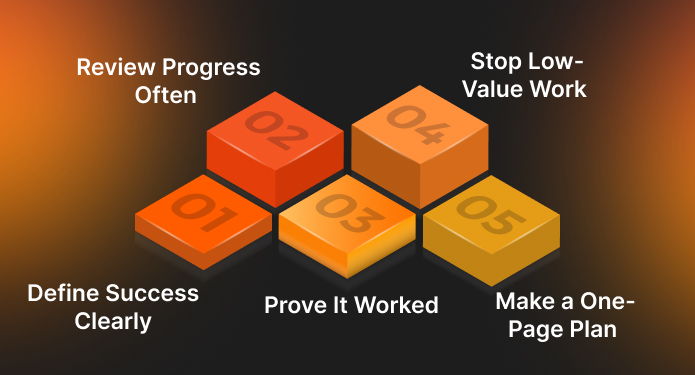
How Does a CEO Turn AI Hype into Outcomes the Board Can Actually See

1 - Define Success Clearly

Define the exact KPI it should move (margin, churn, incident rate, cycle time) and what “success” looks like on a timeline.

2 - Review Progress Often

Track a small set of indicators weekly/monthly (automation rate, turnaround time, error reduction) so results are visible, not theoretical.

3 - Prove It Worked

Boards don’t care how complex the architecture is—they care whether the initiative measurably changed business performance.

4 - Stop Low-Value Work

If impact is unclear or small, stop it. Focus and credibility increase when teams don’t protect vanity pilots.

5 - Make a One-Page Plan

Strip the crowded industry tech outlook down to a few defensible bets with owners, metrics, and review cadence.
Spaces like Executive Outlook magazine are becoming useful in this context. Their value is not in repeating trends already seen in an industry tech outlook, but in showing how real leaders cut through the noise, dropped weak ideas, and kept only the technology bets they were willing to defend in front of customers, regulators, and investors.

From Vision Slides to a CEO’s Daily and Monthly Rhythm

When the CEO outlook matures, it shows up first in the operating rhythm, not in a glossy strategy document. Technology stops being a once-a-year agenda item and becomes part of how the company is run week by week. CEOs start to follow a small set of tech-linked indicators—AI-driven leads, automation rates, turnaround times, error reduction, complaint trends—and ask the same question every month: Is this initiative doing what we said it would do? Quarter by quarter, the same discipline continues. Promised outcomes are compared with real results. Some initiatives are reshaped; others are stopped even if they are “innovative,” simply because the impact is weak or unclear. Once a year, the broader industry tech outlook is reviewed again, but only after the company has looked honestly at what worked in practice, not what sounded modern. Technology teams are no longer judged by how much they built, but by how clearly they can show cause-and-effect between their work and business outcomes. Real stories illustrate this shift. A financial services firm that once ran AI pilots in a separate “innovation lab” now ties each model to a concrete service metric, like fraud loss per 1,000 transactions or dispute resolution time. Many experimental projects disappear, but the ones that remain are easier to explain to the board and to regulators. In manufacturing, CEOs who once felt overwhelmed by talk of digital twins and predictive maintenance now frame their CEO outlook around “flow” instead of features. They begin with a simple map of where work gets stuck—on the shop floor, in maintenance, in logistics—and use IoT and analytics only where they genuinely improve that flow. The story they tell the board is not about tools. It is about less downtime, faster repairs, and more reliable deliveries.

How Complere Infosystem and The Executive Outlook Support the CEO Outlook

At Complere Infosystem, we see the same pattern across industries. Leadership teams are not short of ideas. They are overloaded with them. Every industry tech outlook adds more possibilities—new platforms, new models, new approaches. The real challenge is translation: turning all that noise into a CEO outlook that fits on one page and leads to a handful of measurable, defensible bets. Our work often starts by helping executives choose five to seven core KPIs that will prove whether AI and data investments are working. From there, we focus on the boring but crucial foundations: clean, consistent data; reliable pipelines; and dashboards that a CEO can read in minutes without a technical escort. When that layer is solid, technology discussions with the board become simpler and more honest. Leaders can say, “This is where we improved the story, this is where we failed, and this is what we are changing next.” In parallel, The Executive Outlook provides the narrative layer—documenting how real executives made these trade-offs, which projects they killed, how they negotiated with boards and regulators, and how they kept teams focused on outcomes rather than buzzwords. Those stories help other CEOs see that the shift in CEO outlook is not about learning more jargon. It is about being willing to do fewer things, measure them properly, and stop activities that do not deliver. The leaders who stand out in 2026 will not be the ones who chase every new trend first. They will be the ones who can look at a crowded industry tech outlook, strip away decoration, and say: These are the few moves we will back. This is how we will measure them. And this is what we will stop doing to make room for them. That clarity is the real heart of a modern CEO outlook.

Ready to turn your CEO outlook into outcomes your board can see and trust? Partner with The Executive Outlook and Complere Infosystem to link every technology bet to clear KPIs, strong governance, and real business value.

Editor Bio

Isha Taneja

I’m Isha Taneja, serving as the Editor-in-Chief at "The Executive Outlook." Here, I interview industry leaders to share their personal opinions and provide valuable insights to the industry. Additionally, I am the CEO of Complere Infosystem, where I work with data to help businesses make smart decisions. Based in India, I leverage the latest technology to transform complex data into simple and actionable insights, ensuring companies utilize their data effectively.
In my free time, I enjoy writing blog posts to share my knowledge, aiming to make complex topics easy to understand for everyone.


Leave a Reply

Your email address will not be published. Required fields are marked *