
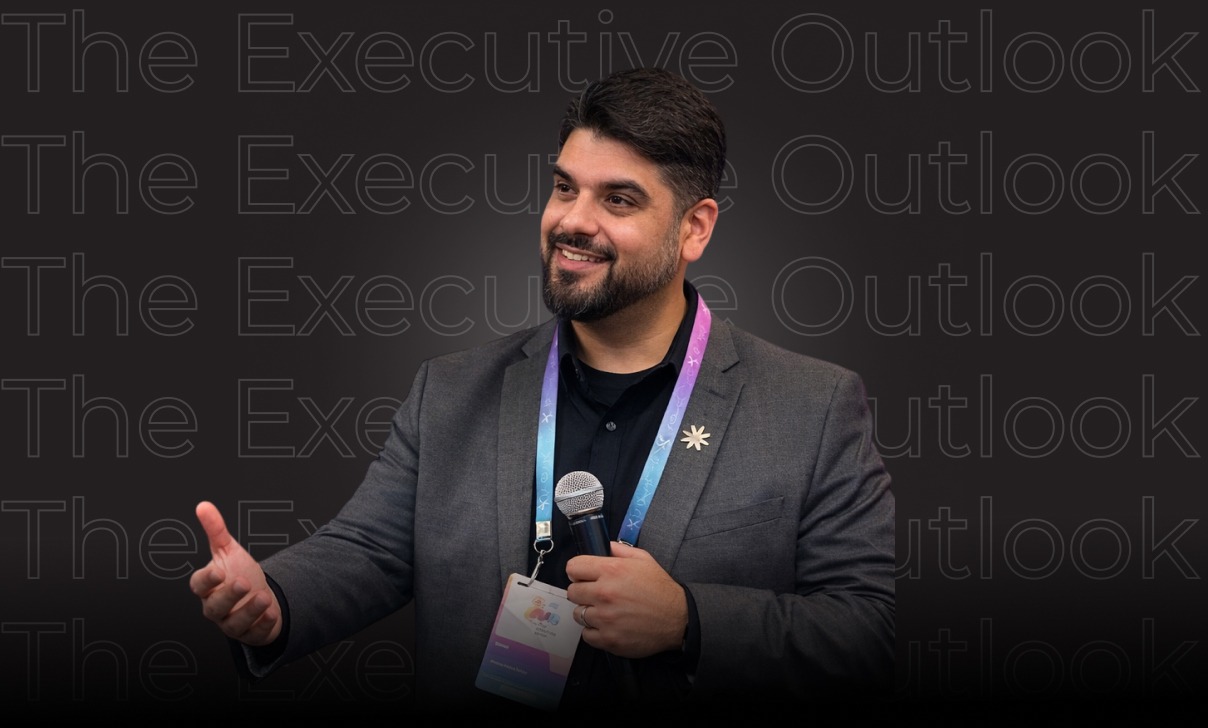
During a recent conversation on The Executive Outlook, I spoke with Shaje Ganny, a digital transformation leader, founder, guest lecturer, TEDx speaker and author of “AI Won’t Bite.”
Digital transformation is something every executive wants. Faster execution. Better decisions. More value. Yet most programs still fail quietly, not because teams are not smart, but because they solve the wrong problem first.
What Shaje shared was different. It was not a checklist. It was not a tool story. It was a human story about how digital transformation works when leaders start from the floor, connect change to business value and design for the full value chain.
Shaje has spent two decades inside Procter & Gamble. Yet he spoke like someone who has never fallen in love with a title. He spoke like someone who keeps falling in love with one thing only. The business problem.
The Pattern That Quietly Shaped Shaje’s Career
Shaje began in the supply chain. That is the official starting point.
But the real starting point was a realization he had earlier, almost like a private truth he carried from one role to the next. He said he was not the typical supply chain person. Then he smiled and made it broader. He was not the typical of anything.
Every two years, he changed what he was doing. New role. New scope. New environment.
From the outside, it might look like career hopping inside one company. From the inside, it was something else. He was following the friction. He was chasing the place where work did not flow, where teams were stuck, where outcomes were not matching effort.
He described the feeling he kept chasing.
Find what is not working. Step into it. Fix it. Unleash business value. Then move on.
At that time, nobody called it digital transformation. It was simply problem-solving, powered by technology. And because Shaje had studied IT, business and psychology, he could do something that many people struggle to do. He could see the system, the incentives and human behavior at the same time.
Over time, one project built on the next. The work kept pulling him toward transformation. And Shaje said something that mattered. He was happy because he felt like he had found his calling.
The Root Cause Mistake That Makes Digital Transformation Fail
When I asked Shaje the difference between transformations that succeed and those that fail, he did not hesitate.
He said most programs fail because teams fix the symptoms, not the disease.
Then he gave an image that stayed with me.
A broken hand. A bandage. No X-ray. No cast.
It looks like an action. It feels like progress. But it is not healing. It is hiding.
In the real world, this is what happens when organizations rush:
- A process feels slow, so we automate it.
- A workflow feels messy, so we add a new tool.
- A reporting layer feels inconsistent, so we build another dashboard.
And then leadership is surprised when the new solution fails. But Shaje’s point was simple. The solution failed because the problem was never understood.
Smart people, good intentions, urgency, budget and still a miss. Because the root cause stayed untouched.
Why the Real Problem Lives Far Away from Leadership
Shaje then said something that many leaders may not like, but most will recognize.
Management rarely sees the true picture.
Not because leaders are bad. Because information changes as it moves upward. People package updates. They share what they think management needs to know. They hide what feels messy. They soften what feels risky.
So, when value is being generated three steps away from a manager, the manager can be excellent and still be blind to daily reality.
This is why Shaje starts transformation in a place many executives do not spend enough time in.
The floor.
He goes to the people doing the work and asks them to describe their day. He asks where the friction is. He asks what frustrates them. Then he asks the question that opens everything.
If I gave you a magic wand, what would you change?
He joked that they do all the work and he takes the credit. But the method is serious. Pain should be defined by the people who feel it. Not by leadership perception. Not by reports. Not by packaged updates.
The Hard Truth About Pain
Then Shaje introduced a filter that separates serious transformation leaders from busy ones.
Pain is not enough.
Just because something hurts does not mean it is worth solving with a transformation program. Not every problem deserves money, time and disruption. If you invest and stay in the same place, you have not transformed. You have just moved.
If you are going to do digital transformation strategy the right way, something must improve. Throughput. Output. Cost. Employee satisfaction. Customer experience. Something is real.
This is also where momentum comes from. When business value is clear, sponsorship shows up. When the problem is real and voiced by the people living it, buy-in shows up. Then the program has a foundation that can hold weight.
The Lesson He Learned After a “Perfect” Win
Shaje’s most powerful story was not about success. It was about the kind of success that later teaches you humility.
He led a transformation where performance moved from 7 percent to 100 percent. It went so well that he got promoted. It felt like a clean win.
Then time passed. He moved on. Later, he came back.
His unit was still performing, but the world around it was breaking down.
When he asked what happened, the answer was uncomfortable.
He had pushed the inefficiencies out of his unit.
His silo became stronger and the network became weaker.
This is the part most digital transformation slide decks never mention. You can improve your corner so aggressively that you export pain to everyone else. Your metrics rise, but the total value falls.
Shaje said this became a principle for him.
Transformation must deliver total value, not silo value.
He also said something important. Failure is a teacher, if you allow it to teach you and you have space to learn.
That lesson changed how he led the next effort. He shared that in the very next project; he achieved 100 percent adoption because he stopped designing a silo and started designing the full value chain.
AI in Digital Transformation: Why Process Comes Before Tools
Then AI entered the room and the conversation got sharper.
Shaje teaches a course called AI for Leaders. He runs a not-for-profit focused on human-centric AI. He advises companies on AI transformation and policies. He has been invited into rooms where CIOs are deciding how enterprise AI will be used, governed and scaled.
And across those rooms, he keeps hearing the same instructions.
Just do AI.
That phrase sounds exciting. It also sounds empty.
Shaje shared that he once walked away from a project because the intention was to bring AI, not improve the process. For him, that is not digital transformation. That is technology excitement pretending to be strategy.
His ratio was clear and memorable:
- People and process are 70 percent.
- The system you choose is 20 percent.
- The algorithm is 10 percent.
If you ignore the 70 percent and obsess over the 20 percent, you get a new tool and the same old pain.
Then he shared a line that has guided him for years, quoting Adam Grant.
Success lies in defining the future, not defending the past.
The Future We Are Building With AI
Shaje spoke about being at Davos and asking one simple question.
What is the future we are building with AI?
He said he is concerned because many organizations approach AI from fear instead of a growth mindset. Policies become restrictive instead of empowering. Decisions are driven by myth instead of reality.
For him, this is not a minor issue. It is a leadership issue. Because when fear drives policy, innovation slows down, people stop experimenting, and the organization becomes reactive instead of intentional.
The Quiet Risk Hidden Inside Convenience
Shaje was clear about something many people do not say out loud.
He loves AI.
It made him more productive. It changed how he works. It opened the doors. He believes AI can augment and uplift humanity.
Then he turned to danger.
Using AI as a substitute for thinking.
He described the pattern. Your manager asks for something. You ask AI. You copy-paste the output. You send it. You did not think about it. You did not read it deeply. You did not check it.
He referenced the idea of cognitive offloading and joked that kids call it brain rot. He also explained how humans naturally choose the easiest route, connecting it to ideas from Daniel Kahneman about friction and the path of least resistance.
The message landed like a warning sign.
The thinking must stay yours.
The Cloud Code Example That Made It Real
We spoke about a workshop moment where I had learned simple skills. Define the logic. Be specific. Take command. Tell the tool exactly what you want, in the format you want.
Shaje agreed. But then he pointed out the alternative route most humans will take.
Someone could open a chat, ask AI to generate the exact instructions, paste them into a tool and get acceptable results without truly understanding what they are doing.
The first time, they might think it through. The second time, they might not. This is where habits form. This is why leaders need to teach teams not just to use AI, but to use AI with responsibility.
A Case Study That Shows Business Value Without Hype
When I asked Shaje for a story of real business impact, he went somewhere surprisingly simple.
Office cleaning contracts.
He supported a consortium of 15 companies through nonprofit consulting. They wanted to collaborate and help each other. Shaje explored procurement because it is often an overlooked opportunity for cost saving.
Across the group, only two suppliers were being used. Yet contracts were fragmented. Many companies had multiple contracts per supplier. Some used both suppliers. They were dividing volume into small chunks, thinking they were being competitive, but actually weakening their negotiating position.
When they ran the numbers, the scale became obvious. Roughly 2 to 2.5 million was spent cleaning across the consortium. By consolidating volume against the most expensive contract terms, without any negotiation, that total could have dropped to around 1 million. A savings of roughly 1.5 million Swiss francs.
The lesson was not about cleaning. It was about visibility, consolidation, and doing math before chasing complex solutions.
Shaje also noted that today, AI could make this kind of procurement scenario analysis faster, but only if humans still own the thinking.
What Shaje Would Do in the First 30 Days
Shaje said he has not changed companies in a long time, but he described how he structures early success.
First, get clear on expectations. What is the mandate? What does success look like? How will success be defined and measured?
He referenced the idea of the first 30 days of learning and mentioned a book concept around the first 100 days. The point was consistent. Before you act, understand what you are expected to deliver.
Then, understand reality. Talk to people. Learn what they need. Find what can be solved to move the ship in the right direction.
He shared a leadership truth that sounded simple but is rare in practice. The only thing that matters is being genuine, honest and humble.
Then you just crack on.
The 3 Magic Cs That Make Decisions Clear
To close, Shaje offered a framework leaders can use before they fund any digital transformation strategy or AI transformation initiative.
Company
Does it solve a real business problem and create real value?
Consumers
Will it improve customer experience and trust? If it does not, why do it?
Community
How will it impact employees and the wider ecosystem around the business? What consequences might show up later?
He called them the three magic Cs.
Company, Consumers, Community.
It is a simple filter, but it forces a leader to stop chasing hype and start chasing outcomes.
Final Thoughts
This conversation with Shaje Ganny made one message very clear.
Digital transformation is not about adopting tools. It is about diagnosing the real disease, not treating the symptoms. It is about learning from the floor, not relying on packaged updates. It is about co-creating change across the value chain, not optimizing one silo. And in the age of AI, it is about using technology to uplift human capability, not replacing human thinking.
At the end of our conversation, Shaje mentioned it was his first time on video, and he sounded genuinely excited. It was a small line, but it matched the tone of the entire episode. Curiosity, humility and forward motion.
For more inspiring stories of leaders shaping the future of technology, governance and strategy, stay tuned with The Executive Outlook.
Editor Bio

I’m Isha Taneja, serving as the Editor-in-Chief at "The Executive Outlook." Here, I interview industry leaders to share their personal opinions and provide valuable insights to the industry. Additionally, I am the CEO of Complere Infosystem, where I work with data to help businesses make smart decisions. Based in India, I leverage the latest technology to transform complex data into simple and actionable insights, ensuring companies utilize their data effectively.
In my free time, I enjoy writing blog posts to share my knowledge, aiming to make complex topics easy to understand for everyone.