Top CEO Qualities Habits, Skills & Life Balance 

Top CEO Qualities Habits, Skills & Life Balance
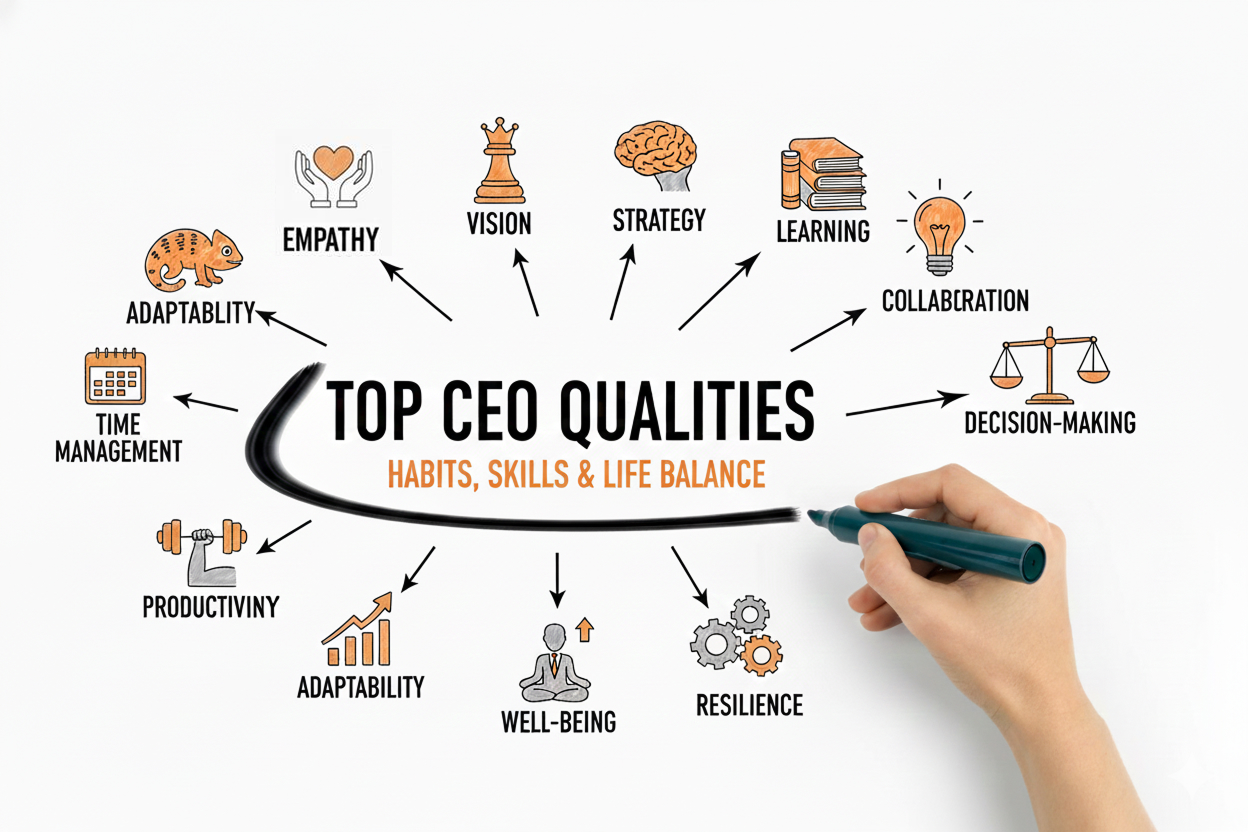
The modern CEO quality standard has transformed. The role is no longer defined by aggressive growth goals or relentless hustle culture. Instead, the best CEO quality today is the ability to lead with clarity, emotional intelligence, and long-term judgment—while maintaining a grounded quality of life that allows for sustainable performance. The CEO of 2026 is not the exhausted hero at the top. They are a systems thinker—able to build alignment, protect focus, and shape culture in a world where talent autonomy, digital decisions, and stakeholder expectations move faster than ever. The shift happened for a reason. CEOs today are leading companies in markets defined by uncertainty—economic volatility, AI-driven disruption, shifting customer expectations, and new ethics debates around data and automation. The organizations that thrive are those led by CEOs who combine strategic insight, resilience, and human-centered communication. In other words: strong CEO qualities and skills are not just technical or financial—they are behavioral. Leaders who can stay calm in pressure, articulate purpose, and make decisions based on principle earn trust. And trust is the currency of execution. But leadership strength means little without sustainability. The CEO quality of life has become a strategic priority—not only for personal well-being but for organizational health. When CEOs burn out, cultures erode, decisions become reactive, and direction becomes fragmented. Leaders who maintain rhythm—focused thinking time, sleep discipline, boundary-setting, and intentional renewal—perform better and model healthier work design for teams. The optimal quality of CEO is therefore a balance: high accountability paired with regulated energy, deep work paired with real recovery. This is the new mandate: CEOs who win are not the busiest—they are the clearest.

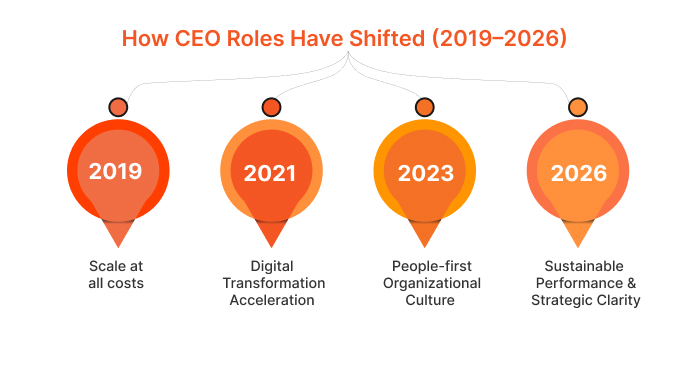
How CEO Roles Have Shifted (2019–2026)

From Hustle-Driven Execution → Principle-Led Clarity & Sustainable Leadership .
How CEO Roles Have Shifted (2019–2026)

Why These CEO Qualities Matter Now

Executives are no longer judged by financial performance. Boards, teams, and customers evaluate:
    • Whether the CEO can inspire trust during uncertainty
    • How well decisions reflect values and long-term impact
    • Whether the organization’s culture protects autonomy and innovation
    • How sustainable the CEO’s leadership model is
A CEO who cannot regulate pace or build psychological safety cannot retain talent or drive innovation. The organization mirrors the leader’s internal state.
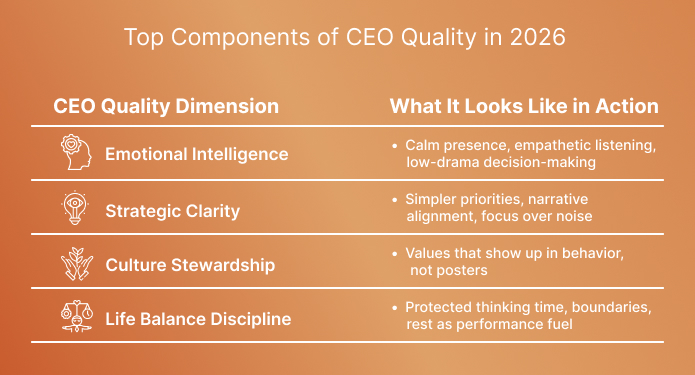
Top Components of CEO Quality in 2026

The Human Layer: Leadership as Energy Management

Great CEOs don’t just manage meetings, tasks, and stakeholders—they manage their internal state. They know:
    • Clarity requires silence.
    • Good judgment requires rest.
    • A cultural tone is set by how they respond to stress—not by what they say in all-hands meetings.
A team does not follow strategy; it follows emotional cues. A CEO who is frantic breeds urgency without direction. A CEO who is grounded breeds momentum with purpose.

Case Insight:

In conversations with global CEOs featured in The Executive Outlook, a pattern emerges: the most successful leaders do not chase complexity—they reduce it. They:
    • Create narrative clarity so teams know why their work matters
    • Establish a decision rhythm that prevents escalation chaos
    • Use reflective practices (journaling, coaching, solitude blocks) to think, not react
    • Protect their CEO quality of life so they can lead with presence, not exhaustion

These leaders measure success not just in revenue, but in cultural stability, leadership pipeline strength, and long-term trust.

The Future CEO: Stewards of Direction, Energy & Integrity

As businesses face:
    • AI-driven restructuring
    • Remote-distributed collaboration
    • Transparent reputation ecosystems
    • Continuous adaptation as the default condition
The quality of CEO that wins is one who:
    • Stays principled when pressure rises
    • Builds culture that sustains itself
    • Makes fewer but higher-quality decisions
    • Protects the energy of the organization by protecting their own

The most valuable leadership trait now is not urgency—it is clarity.

Final Thought

CEOs who succeed in this era are more than strategic operators. They are:
    • Thinkers of clarity
    • Designers of culture
    • Guardians of sustainable pace
In the age of accelerated change, the organizations that win are not led by CEOs who move the fastest but by those who move the wisest.

Want to become the leader who scales clarity, not chaos? The Executive Outlook helps high-performing CEOs refine presence, narrative, cultural influence, and sustainable leadership practices.Join our leadership community.

Editor Bio

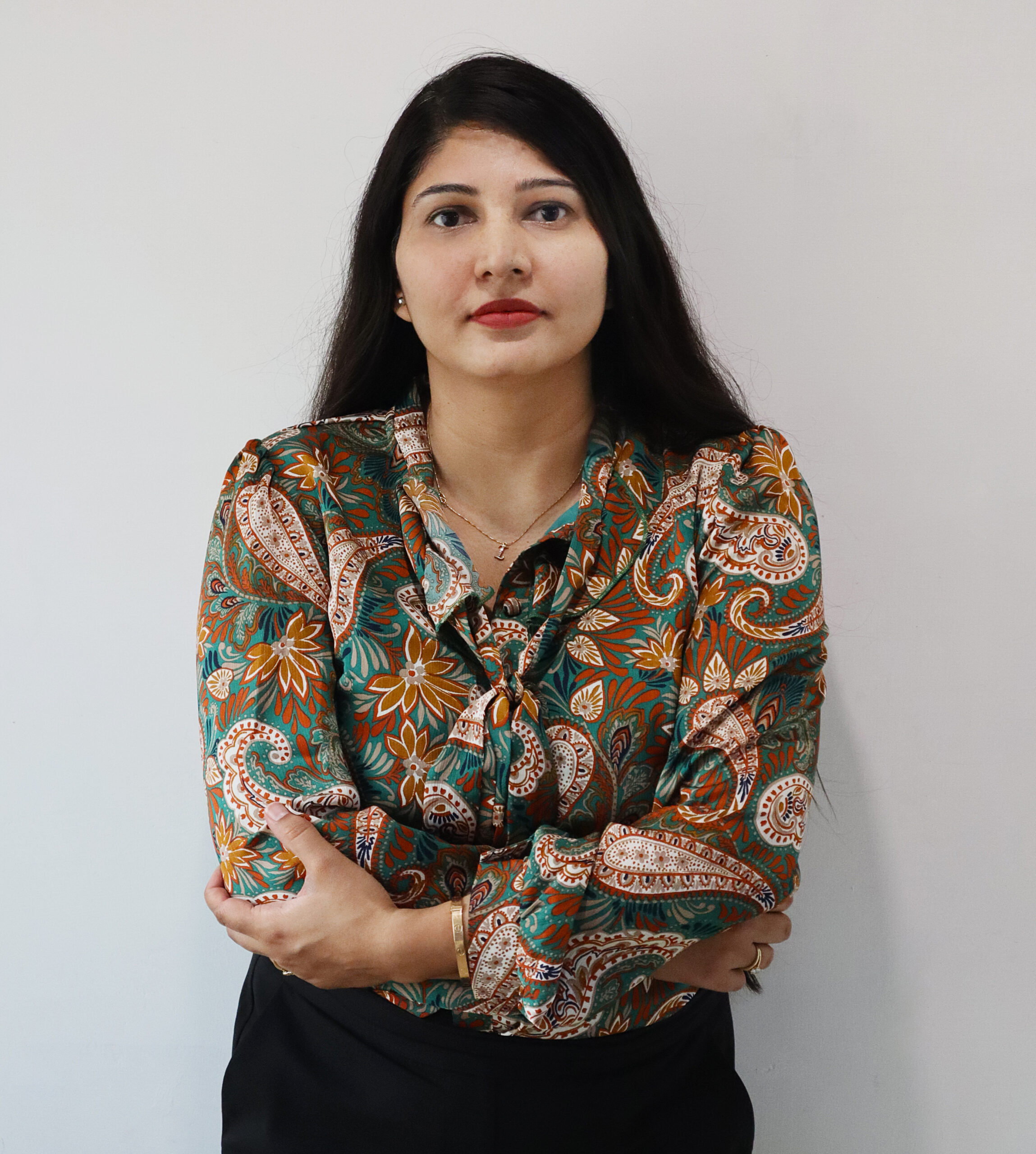
Isha Taneja

I’m Isha Taneja, serving as the Editor-in-Chief at "The Executive Outlook." Here, I interview industry leaders to share their personal opinions and provide valuable insights to the industry. Additionally, I am the CEO of Complere Infosystem, where I work with data to help businesses make smart decisions. Based in India, I leverage the latest technology to transform complex data into simple and actionable insights, ensuring companies utilize their data effectively.
In my free time, I enjoy writing blog posts to share my knowledge, aiming to make complex topics easy to understand for everyone.


Leave a Reply

Your email address will not be published. Required fields are marked *